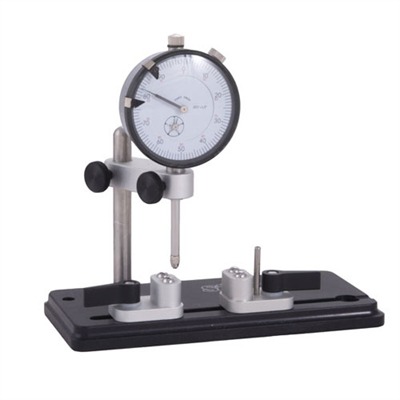
Neck thickness checker???

yes and yes, as for the .012 question it depends on the brass, it might be .012 and .010 on the thin side. rule of thumb is to turn a few pieces, flip a coin and then start with a bushing .003 under the size of a loaded round
 
Measure a bunch of your necks, all of em if you're really anal, cull the few that are somewhat out of spec, then take the ones that have the thinnest necks and skim turn them for Uniform thickness. Then turn the rest of your brass down to that diameter. If your brass has a large variation in thickness, you might need to do two passes on the thickest pieces.
 
Late to the party but this is the one ... $132 from X-Reload (feb '16)

RED_26400__85491.1391447445.380.500.jpg


Comes with 2 mandrels to fit small and large primer flash holes and 2 pilots: .22 (for the small mandrel) and .30 cal.

Addditional pilots are ~ $10
 
I ended up getting that one, and put it to work this last week.

I think it works well. I'm new to this, but it tells me about concentricity and thickness, and is good value for the $$.

My lapua 6.5 brass is now all within .012 and .013..... I think that'll out-do my shooting abilities for a while!!!
 
Warning about bushing dies.

I you reduce the neck diameter .005 or more with a bushing die you will induce neck runout. This is why it is recommended to reduce the neck diameter in two steps when sizing the neck .005 or more. Also at the custom Whidden die webpage it states the standard non-bushing full length die will produce less runout.

The bushing floats in a bushing die and can move slightly from side to side and even tilt. And when sizing the case neck .005 or more the floating bushing will cause a increase in neck runout.


Whidden Gunworks
Explanation of Bushing and Non-Bushing Sizer Dies


Quite often we hear the question “What is the difference between a bushing full length sizer die and a non-bushing full length sizer die and which is best?”

Full length sizer dies can be broken down into two types. With no preference on either, these types include the bushing sizer die and the non-bushing sizer die.

The bushing sizer die uses a bushing to aid in the sizing of the neck while the body of the die does the sizing of the case body. When sizing the case, the bushing of the die is pressed around the outside of the neck just after the expander ball of the die passes through the neck. As the neck enters the bushing the bushing applies a predetermined amount of tension on the neck. The amount of tension is determined by the size of bushing used. As this action is performed the inconsistencies of the case neck wall are forced to the inside of the neck. As the sizer die is removed from the case the bushing exits the case neck and the expander ball returns through the neck. The diameter of the expander ball will determine the neck tension. When this action occurs the inconsistencies of the case neck wall are forced back to the outside of the neck case. In our experience this allows for a more consistent neck tension when the case is loaded.

Some shooters prefer using no expander ball with a bushing die. In this case the expander ball is replaced with a pin retainer. The pin retainer is used to retain the decapping pin and protects the stem of the die. It serves no function in sizing. When a bushing sizer die is used with no expander ball, neck sizing is done by the bushing itself. With this method the amount of neck tension is determined by the
size of the bushing as it is the only and last area of the die to be in contact with the neck of the case.

The non-bushing sizer die works basically like the bushing sizer die. However, the non-bushing sizer die uses an expander ball to size the neck of the case. The expander ball passes through the neck of the case and sets the amount of neck tension. The non-bushing die is designed to size the outside of the neck as the case enters the body of the die. In determining neck tension with the non-bushing sizer die, simply change the expander ball size to obtain the desired amount of tension.

So now, which is best? We’ll let you decide...

The bushing sizer die allows more flexibility in the amount of neck sizing. This is beneficial when changing brands of brass, neck turning brass to achieve different wall thickness and experimenting with different neck tensions in loading.To ease case neck entry into the bushing, all bushings have a small radius on the inside edge. This radius doesn’t allow the sizing of the case neck fully to the shoulder.

The non-bushing sizer die typically yields more concentric ammo in our experience. It also fully sizes the case neck fully to the shoulder for smoother functioning. Neck tension can only be determined by changing expander balls with the non-bushing die


http://www.whiddengunworks.com/wp-content/uploads/2015/02/Bushing.NonBushingExplanation.pdf

Also if turning necks you only need to remove 75% for minimum neck turning and 100% is not needed. All that is required is to basically to remove the high areas, the more you remove increases the chance of getting donuts from brass flow into the case neck.
 
Last edited:
I have the Redding Case Neck Concentricity Gage and with one twist of the case it tells you all you need to know. Meaning it much quicker than a ball mike taking severial readings. The Redding gauge quickly tells you if the case is even worth the effort of neck turning. Cases with wide variations in neck and body thickness will expand more on the thin side and warp.

Below the Redding gauge and a Remington .223 case with .004 neck thickness variations, and the reason why many reloaders buy Lapua brass. Some of these Remington cases had as much as .008 neck thickness variations.

IMG_2136_zps079ece9b.jpg


IMG_2137_zps66bcfc13.jpg


Below you can't make a silk purse from a sows ear, meaning if I neck turned and neck sized the Remington case above it would still cause .004 misalignment with the bore. I full length resize these Remington cases and just use them in my AR15 carbine for practice at 100 yards or less.

neckcenter_zps94286f86.jpg


As a side note I have been buying once fired Lake City 5.56 brass because of its quality and cost.

Firstly, I'll say I'm dog tired which is maybe why my brain cannot compute some of this.
I have not started trimming cases for runout yet, but I have purchased an RCBS case neck turner(This one: http://www.rcbs.com/Products/Case-Preparation/Case-Trimming/Hand-Case-Neck-Turner.aspx).
I would imagine I first need to purchase something to allow me to measure runout, such as this redding tool, the one in the picture you posted with 4 thou of runout - is that the redding tool you mentioned above?

Ed, what would be your max runout allowable for you to be using the brass for serious target shooting?

Another question for you, in the above example where even though the user has turned the brass down to take off the high spot, the center of the neck is still not aligned with the centre of the case. How can this A) Be detected, and B) Be prevented?`
 
Hi,

I'm not Ed, and I'm new to this, but this is my understanding.

That is the Redding tool (I own one, so I know this for sure....)

ZERO runout is ideal, maybe not attainable, but ideal. All of mine that I've turned is under 1 thou.

In the example, it would be detected with the redding gauge provided the arbor is true. I think it can be rectified by turning off a little more neck, again, provided your arbor is true.

-J.
 
I would imagine I first need to purchase something to allow me to measure runout, such as this redding tool, the one in the picture you posted with 4 thou of runout - is that the redding tool you mentioned above?

That Redding tool will tell you whether your case necks are thicker or thinner in spots around the neck. It does not tell you if your neck is concentric with the case, or if the bullet is concentric to the neck.

These are the tools used to measure runout (concentricity). There are a few others others around but I like this one from 21st Century. $239US

76251dac9d3c8202ecd296848a63060e_c5cd.jpg


Note if you're buying from 21st Century: use coupon code FBOOK10 when checking out for a 10% discount. It'll at least pay for the shipping.

Then there is this one from Accuracy One but its $325-$400US depending on the indicator used:

concentricitygauge_features.jpg


There is this one from NECO $170US at h ttp://www.neconos.com/item/Concentricity-Wall-Thickness-and-Runout-Gauge-12

12.JPG


Then there is this one from Sinclair $150US :

p_749007271_6.jpg


or look up the usual suspects from Hornady or RCBS.
 
Last edited:
Back
Top Bottom