neck turning clarification please!!

willyqbc

Regular
Rating - 100%
86   0   0
So I'm going to try outside neck turning my brass...this will be for factory chambered rifles...yes I know it may not be worth the time in a factory rifle....but i'm gonna do it anyways cause at the very least its an interesting experiment and it couldnt hurt to make my brass more concentric!!

so the info i have gathered on this rifle thus far
3x fired in this rifle win brass for a 270 win, brass was annealed prior to this firing
neck sizes vary .0005" - .0010" depending on where I measure them
have no mics so calipers will have to do for measuring at this point...mine register in 1/2 Thou but obviously not as accurately as a micremoter.

O.D. of neck after firing - .3090" avg
O.D. of neck after neck sizing - .3035"
O.D. of neck when loaded - .3045"

so now the questions...well more like confirmation to see if I have a bit of a handle on this

my chamber will be .001" - .002" larger than the neck OD of a fired brass....so .310" to .311" ??
my current neck clearance is chamber diameter .3105" minus loaded diameter .3045" divided by 2 = .0030" neck clearance??
my current neck tension is .001" ??

I'm thinking if I turn my sized necks from their current .3035" down to .3025" it should clean up the not so concentric brass??
this will take my loaded neck size down to .3035" leaving me with a neck clearance of .0035"??

Ok...now that my head hurts...does this all sound about right? any problems i'm not seeing??

Again, just wanna improve the concentricity of my brass....may do absolutely nothing, but what the heck!!

any input appreciated
Chris
 
In a nut shell,my sporter type rifles,all I turn is just enough to clean up about 3/4 of the neck circumstance.Some will be more,some will be less.I do it in shooting brass groups,50 pieces.Does it make a difference.....yes....if you make sure you bullet is straight,it does provide consistent groups with those pesky flyers at a minimum.
 
Chris. Sorry to say but you're going about your calculations incorrectly, you MUST have a proper mic to see how thick your brass is at the neck. First off neck turning is not only to control the clearance of the case neck, that is not the purpose of the exercise (for factory rifles). Neck turning helps precision reloaders control the amount of tension of the neck on the bullet. This allows a more consistent release of the bullet, for precision shooting. Secondly how are you sizing your neck, are you using bushing die or a collet neck die? How are you controlling your neck tension? Are you Annealing? Neck turning may be not yield any consistent result if you're not able to control how tightly your neck is "squeezed" or if your not controlling the brass hardness neck consistency in the mix.

To go through the exercise:

If your OD of a fired case is 0.3090", 0.277" is your bullet diameter, THICKNESS of your brass times two I'm using an average case neck thickness of 0.014" (you will need to measure your actual). eg. 2x(0.014")=0.028", 0.277"+0.028"=0.305" is the OD diameter of your round (think neck wall, bullet, neck wall equals OD of a loaded round). SO currently you have 0.3090"(fired round) minus 0.3050" Loaded round. Your neck clearance is 0.010" total. So you have approximately 0.005" of clearance on the OD of your case. IMO you do not need to neck turn because you have good clearance for your neck. Factory rifles will have very generous neck clearance IMO. If you go any thinner at the neck you may not get the case neck obturation that would properly seal your chamber.

If you want to improve the "concentricity" of your un-altered brass use a Lee Collet neck sizing die and FL sizing and bumping back the shoulders. Since it is a hunting rifle I would absolutely suggest FL sizing since you don't want any issues with rounds loading.

Here is a video from showing how a Lee Collet Neck Sizing die may improve your neck concentricity. NOT scientific but sort of explains how easily brass flows. However the Youtuber mentions that you can get more neck tension by turning the collet die down, but that is incorrect because the die is forming the brass around a mandrel that is a certain fixed diameter, so you can't increase the neck tension any greater than the mandrel's diameter.
 
Last edited:
I have turned for 204 Ruger and saw a tiny difference. The Hornady brass has significantly varying neck wall thickness so I went to the turning and collet die route which took a lot of run out away. I use a Lee collet die. If I could buy Lapua brass for it I wouldn't Bother. I would suggest this first - buy Lapua brass and Forster FL die and seater die. That will help take care of a lot of error, at least it did for me in other cartridges where Lapua brass was available and that method made my groups smaller. It’s difficult for me to consistently set up the collet die to have the exact same tension as it had the last reloading session but at 300 m I can’t see the difference on paper.
 
Last edited:
One of our sponsors Jerry at Mystic Percision has some really good tech articles on this subject on his Facebook page.
Definitely worth a read.
Joe
 
Good info...thanks folks! A little more info

Currently using a lee collet neck die on all my rifles, with a FL sizing to bump the shoulder after 2 firings. Also anneal after two firings. The loads i currently run in this rifle is VERY accurate by factory rifle standards so my thinking that "it couldnt hurt" may be incorrect from what im reading here?? If i read this right, i may actually mess up my neck tension and screw up the load i have currently??? Perhaps i should leave well enough alone in this case!

Perhaps i will try it next rifle i develop a load for...any reccomendations on what neck turner to buy? Also, standard mic or blade style?

Thanks
Chris
 
As Sharp shooter stated if you can get Laupa brass by all means try it. The necks are really good. If not then I would just turn them enough to have them all the same thickness if possible. Not to much as factory chambers are already pretty sloppy. To eliminate run out i've found ,after this ,is to use a Redding body die to size the body and bump the shoulder back appx .003 and a Lee collet die to size the neck. This should give you very low run out, and may translate into smaller groups for you.
 
As with others I use a Lee collet die , bump shoulders etc.

I neck turn a minimum amount, just enough to reduce thickness variation. I don't get excited about what the actual thickness is, just so long as they are the same, neck turn a batch at a time as it's a one time function. BTW be sure to cut a few thou below the neck /shoulder juncture.

Also, when using the Lee collet die it is prudent not to take too much off as the die may not function as designed with a 'thin' neck.

The benefit of neck turning or necks that have low variance in thickness, is getting consistent bullet release and therefore a better/low extreme spread which will help at long range.
 
Good info...thanks folks! A little more info

Currently using a lee collet neck die on all my rifles, with a FL sizing to bump the shoulder after 2 firings. Also anneal after two firings. The loads i currently run in this rifle is VERY accurate by factory rifle standards so my thinking that "it couldnt hurt" may be incorrect from what im reading here?? If i read this right, i may actually mess up my neck tension and screw up the load i have currently??? Perhaps i should leave well enough alone in this case!

Perhaps i will try it next rifle i develop a load for...any reccomendations on what neck turner to buy? Also, standard mic or blade style?

Thanks
Chris

You need a Mic tube ball spherical anvil. Check out iguaging on Amazon.com for an example. Neck Turners brand I would recommend are 21st century or K&M neck Turners. K&M is a nice kit because you could actually mount a dual indicator to the neck turning unit to see your neck thickness no Mic needed. I use a K&M unit.

Since your using a Lee collet die you will need to dial down your die in order to maintain your current neck tension on your turned brass.
 
You need a Mic tube ball spherical anvil. Check out iguaging on Amazon.com for an example. Neck Turners brand I would recommend are 21st century or K&M neck Turners. K&M is a nice kit because you could actually mount a dual indicator to the neck turning unit to see your neck thickness no Mic needed. I use a K&M unit.

Since your using a Lee collet die you will need to dial down your die in order to maintain your current neck tension on your turned brass.

If you are using a Lee Collet die to do the neck sizing, you do NOT need to "turn down your die". That does nothing other than potentially damaging the die. The Lee Collet Die sizes on to a mandrel. If you want to increase your neck tension you have to either turn the mandrel by carefully polishing it in a drill press with some decent sandpaper OR purchase an undersized mandrel directly from Lee.

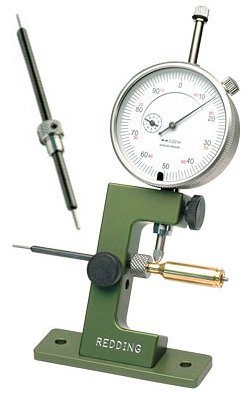
If you want to measure AND immediately visualize any problem areas, get the Redding Case Neck Concentricity Guage. A good Mitutoyo Spherical Anvil Tube Micrometer is wonderful, but mine rarely comes out to play any more now that I have the Redding Neck Guage.

I use the 21st Century Neck Turning Lathe. I thought it was going to be gimmicky but it works amazingly well, absolutely superb in fact. One caveat is that if you want to turn right to the shoulder and not have to watch every piece as you machine the neck, you MUST neck bump the brass and trim to length at a minimum since the 'stop' is the top end of the neck of the brass on the end of the turning mandrel. In other words, the neck of each piece of brass must be the exact same length.

Since I neck turn only after first firing and when absolutely necessary after that, my neck turning work flow is deprime & clean brass, full length resize, neck size in the Lee collet die, (expand the neck if necessary with 21st Century Expander mandrel), trim and chamfer the brass, clean the primer pocket, then finally, turn the neck. I neck size with the Lee Collet Die as it seems to make the brass concentric and irons out any imperfections in the neck including removing both internal and external donuts; leaving the neck internally centered, sized and ready to turn. So far, with my .223 and 6.5CM, it turns out that the 21st Century expander mandrel is the exact same size as the Lee mandrel in the Lee Collet Die, meaning that it is about 0.002 under bullet size. This means expansion is not required and I can go directly from the Lee Collet Die to turning the brass on the 21st Century Lathe. I use the titanium turning mandrels. After 400 .223 there isn't a scratch to be seen on it. John (21st C) makes some super nice equipment.
 
I have a RCBS ball micrometer and use my Redding neck thickness gauge far more. With one twist of the wrist you will see the minimum and maximum neck thickness and know about the quality of the case neck and wall thickness.

I buy a lot of bulk Lake City 5.56 and 7.62 cases and use the Redding gauge for sorting cases and not have to neck turn. The best cases are used for precision ammo and the rejects are used for blasting ammo.

reddingneckgaugex250.jpg


Redding Case Neck Gauge
http://bulletin.accurateshooter.com/2007/07/new-redding-case-neck-gauge/

"Every precision reloader should have a quality tool for measuring case-neck wall thickness. This is essential for those who turn necks–to check the results of your turning. Even if you prefer no-turn necks, a case neck gauge lets you check your neck dimensions and sort cases by neck wall thickness and uniformity. Consistent neck tension is critical for accuracy–but without uniform neck-wall thickness neck tension is hard to control."
 
willyqbc

If you do decide to start neck turning then do yourself a favor and pick up some old range pick up brass to practice on "FIRST".

If you don't turn down far enough on the neck you will get donuts.

If you turn the necks down too far you will thin the neck shoulder junction and the case necks may separate from the shoulder.

Read everything you can about neck turning and be prepared to screw up a few cases until you get the hang of it.

Less is more, meaning only cleaning up 3/4 of the neck is more than good enough.

At Accurate Shooter forums many of the competitive shooters just buy Lapua brass and do "nothing" to it. Meaning Lapua is very uniform brass and neck turning is a waste of time.

Benchrest shooters have custom rifles with tight neck chambers and do anything to their brass to shoot one hole groups.

And what benchrest shooters do is over kill for the average reloader with off the shelf factory rifles with SAAMI chambers.

Below German Salazar from his "The Rifleman's Journal" website is answering a question about "partial full length resizing". And explains why full length resizing is better because the case body does not touch the chamber walls and lets the bullet be self aligning with the bore. And why neck turning in a factory SAAMI chamber can be unnecessary and over kill.

Reloading: Partial Neck Sizing
by German A. Salazar
http://riflemansjournal.########.com/2010/06/reloading-partial-neck-sizing.html

"Now the last scenario, a full-length sized case in which the neck is also fully sized. There is clearance at the neck and in the body of the case, the closest fit anywhere is the bullet in the throat. If the neck to bullet concentricity is good (although it needn't be perfect), then the bullet will find good alignment in the throat and the case body and neck will have minimal influence. Let's not forget that the base of the case is supported by the bolt face or the extractor to a certain degree as well; this is yet another influence on alignment. As you can see, there are several points from base to bullet that can have an effect. My procedure is to minimize the influence of those that I can control, namely the case body and neck, and let the alignment be dictated by the fit of the bullet in the throat and to some extent by the bolt's support of the base. Barring a seriously out of square case head, I don't think the bolt can have a negative effect on alignment, only a slightly positive effect from minimizing "case droop" in the chamber. Given that a resized case will usually have a maximum of 0.001" diametrical clearance at the web, this isn't much of a factor anyway."
 
Last edited:
I would never have dwelved into neck turning if I could have bought 204 Ruger Lapua brass...... A set of Forster full length dies and Lapua brass is all most of us need in my opinion to shoot consistently great groups.
 
Back
Top Bottom