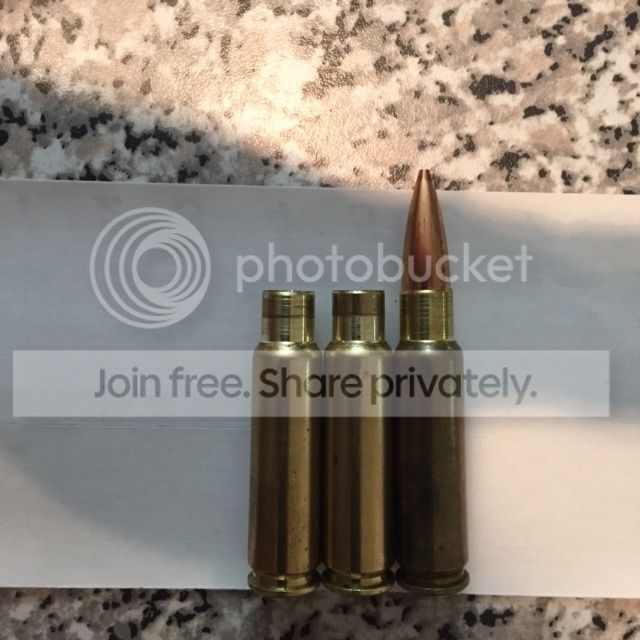
Neck turning question.

Please teach us....not arguing, just asking.

From what I've read of this witchcraft, "skim turn" the entire neck to .012 or .013, and about 1/32" into the shoulder to limit the creation of the "donut".

Now, if you have a custom chamber with a throat of .###x, turn to that.

I spun all of my 6.5 brass like this, and my .300WSM brass, and my .338 brass, so I hope I'm not horribly wrong!!!!

I thought this was common knowledge. I guess not. Custom chamber yes cut to what you need.

Standard chamber....trim as little as possible.

This is cut and paste from Sinclairs website.

"The goal when turning necks on cases for factory or standard cut chambers is to uniform the case necks without removing too much wall thickness. You will not be turning the case neck to a specific dimension. You will be trying to remove the higher or thicker spots on the case neck and get the overall thickness to be fairly uniform. That means on some cases you may not touch parts of the neck with the cutter where the wall thickness is at its thinnest. What you are striving for with standard chambers is to have the neck turning process cleanup approximately 70 to 80% of the neck surface. You really don’t want to remove much more than 0.001” of material. On most tools, setup will be a bit of a trial and error process."

I'm not saying I'm right. I'm just offering my opinion and what I've found improves my runout and makes my brass last.

Short range bench rest guys trim into the neck to uniform neck tension. It's a dangerous game IMO unless the cutter you're using is the correct angled match for your SAMMI chamber.
 
I thought this was common knowledge. I guess not. Custom chamber yes cut to what you need.

Standard chamber....trim as little as possible.

This is cut and paste from Sinclairs website.

"The goal when turning necks on cases for factory or standard cut chambers is to uniform the case necks without removing too much wall thickness. You will not be turning the case neck to a specific dimension. You will be trying to remove the higher or thicker spots on the case neck and get the overall thickness to be fairly uniform. That means on some cases you may not touch parts of the neck with the cutter where the wall thickness is at its thinnest. What you are striving for with standard chambers is to have the neck turning process cleanup approximately 70 to 80% of the neck surface. You really don’t want to remove much more than 0.001” of material. On most tools, setup will be a bit of a trial and error process."

I'm not saying I'm right. I'm just offering my opinion and what I've found improves my runout and makes my brass last.

Short range bench rest guys trim into the neck to uniform neck tension. It's a dangerous game IMO unless the cutter you're using is the correct angled match for your SAMMI chamber.

The 21st system does have carbide cutters that match the shoulder angle of the cartridge.

I've removed a lot more than 0.001. More like .005. From about .018 to .013.

This is absolutely not common knowledge. I bet there's less than 500 people in Canada that turn necks.....maybe 1000.

I too am not saying your wrong, but what I wrote above is what's been suggested to me.

Does a thinner neck mean shorter brass life?? I dunno.....does it???

Does a complete "skim turn" were you see newly exposed shiny brass over the entire neck when you're done mean more uniform tension over the full circumference of the neck?? I would guess yes, but I don't know for sure.

Does shiny newly exposed brass all over with wall thickness of .013 or .012 = good runout?? Not sure yet. What I do know is that my Redding seater, BEFORE I started turning, gave me runout of about .001. The Forster's that I've bought since are .004-ish. Does that matter?? Jerry says no. Does it make me fret - a little.

SO MANY FACTORS TO CONSIDER!!!! aaaaaahhhgggg!!!!!

Good fun.
 
Pics as promised...

GGG looks like an little too much off the shoulders that is way more than the 1/32"(~0.030"). The OP's turned brass is about the limits of what the shoulders should be touched. I turn just to the neck and shoulder junction to i say a third maybe even less of the OP's shoulder cut. I'm more inline to yodave's neck turning description.
 
GGG looks like an little too much off the shoulders that is way more than the 1/32"(~0.030"). The OP's turned brass is about the limits of what the shoulders should be touched. I turn just to the neck and shoulder junction to i say a third maybe even less of the OP's shoulder cut. I'm more inline to yodave's neck turning description.

If they blow up I'll let you know.....fingers crossed.

-J.
 
Hi guys,

I'm beginning to do some neck turning with my lapua cases and I've notice some irregularities inside the neck of the cases.
The outside looks great, but the inside... that's another story. I'm using a 21st century lathe, cordless drill (not too fast) and some dry neck lube from Imperial.
All my neck are pretty consistent when measure after. Am I missing something? Do you think it could have an effect on the neck tension (I'm neck sizing my cases).
Thanks

View attachment 52599View attachment 52600View attachment 52601

Assuming you are turning Lapua brass? If yes, you need to expand LARGER then the mandrel... like 1/2 caliber bigger... then resize to mandrel size.

Case neck tension is extremely high out of the box. even with a "to fit" expander, the spring back is huge. Why I strongly recommend just fireforming with COW method before any case tweaks.

You need to expand that neck alot and that stretches the alloy so that when you size later, it will not have alot of spring back.

I would also suggest slowing down the RPM and taking light cuts. Better to make 3 passes, then 1 big one and chew up the neck. You can still use these cases but it will make them rougher and may increase seating force until the necks wear in. I would size better to stop this from happening.

GGG, nice turning.... going into the necks like that is not going to hurt and no donuts for you. If for some bizarre reason, you actually get a neck split around the base, then back off a smidge but I go into the necks too (not as much mind you) and ZERO issues.

If you ever have a dead case, cut it so you can see how thick that neck shoulder junction is... if the necks don't split at 12/13 thou... how does the shoulder split when it is so much thicker?

Jerry
 
If they blow up I'll let you know.....fingers crossed.

-J.

they won't blow up, but after you shoot and extract the empty case just make sure the neck is on the case and not in the chamber.

Skim turn for factory or large chambers........what does that mean?? well it means uniforming the wall thickness without compromising the neck clearance. how do we know how much is to much? well measure a fired round, figure about 1 thou bounce back, 2 to 3 thou neck clearance is about right, turn until a loaded round measures 2-4 thou smaller then a fired case, okay so you say you can't get enough uniform brass from one box of new brass to make this happen, well the fix to this is to stockpile brass all from the same lot number, weight them, turn them, segregate them and group them until you have enough that are all the same to shoot an entire match with max allowable sighters and factor in your mandatory sample rounds if required, figure out what is match brass, practice rounds and fouler rounds, buy lots of ammo boxes, keep lots of notes
 
good idea. I killed a couple of 1F .338 cases - one that was so thin I was able to squish it like paper!!! I'll split those for learnin' purposes....
 
OP, no intention to hijack the thread but I would like to add to it.

I am neck turning for the first time tonight. Using K&M system and coincidentally I got on the forum tonight to find out about cutting into the neck shoulder junction.

Using brass from my WTF pile to practice. This is just a first pass to remove .001 and gain some experience.

Here's a picture of what I am doing...going 1/64 or about .015 thou into the shoulder. This article from accurate shooter is what I am basing on...except for 1/32. http://www.accurateshooter.com/technical-articles/reloading/complete-precision-case-prep/ However I am seeing a ledge forming and not a more gradual transition. Don't know if you can make that out in the pictures.

I don't think I have the cutting blade orientation wrong because it seems to be cutting fine but I'm not sure this looks right. Any comments?

Other data, imperial sizing wax, 7mm-08 and FEDERAL BRASS :eek: and Makita drill set to low RPM like I have seen. (Federal from factory loads...I didn't go out and purchase.)

Another question I have is if premium priced brass like Lapua and Norma would have more consistency when comparing material removal, I am surprised at the inconsistencies in the neck surfaces indicating irregularities...I guess that's why this is done. And differences from cartridge to cartridge...kind of shocking at least for me.

Regards
Ron

29570pk.jpg
 
there will always be that one piece of thick brass in a box of 100, we turn all of them to find it.........looks good RonR but your deeper into the shoulder then I would ever go, but again that's me
 
my cutters match my shoulder angle so close that I find it unnecessary to cut into the shoulder, and as you can see by the necks on these three brass the varying degree of neck thickness, one piece got just a skim at the base, the other from tip to shoulder and the third a really good cut all the way around and down, I can sleep well knowing they are as uniform as I could get them, and they are now parts of lot numbers 1,2 and 3 and have separate ammo boxes, it may take me 450 pieces of brass to make a lot of 100 pieces, and that's only until they get weight sorted..........

neck%20turn_zps0y5itrg1.jpg
 
Yodave...OMG...So that's what I have to look forward to if I ever get into competitive shooting :d

Truth be told I'm just trying to make the most of my hunting rifle and reloading is just too addictive. I want to improve my long range shooting and be more consistent for the times when needed. There is always room for improvement so to speak.

I understand more and am continuing with more confidence with neck turning. Thanks all. GGG keep up the good questions.

Regards
Ron
 
my cutters match my shoulder angle so close that I find it unnecessary to cut into the shoulder, and as you can see by the necks on these three brass the varying degree of neck thickness, one piece got just a skim at the base, the other from tip to shoulder and the third a really good cut all the way around and down, I can sleep well knowing they are as uniform as I could get them, and they are now parts of lot numbers 1,2 and 3 and have separate ammo boxes, it may take me 450 pieces of brass to make a lot of 100 pieces, and that's only until they get weight sorted..........

neck%20turn_zps0y5itrg1.jpg

I thought the point of cutting into the shoulder was to thin the shoulder/neck interface a bit to limit the formation of the donut?

Ron, I don't think the "ledge" your talking about is a problem....or at least I hope it's not cause I have 300 pieces of brass downstairs with it!!!!! Also, you need a target rifle....sorry man, but this much effort at the bench, and you're gonna burn up the barrel on your hunting gun!!! You don't have to spend 1000's, but something with a fat barrel that you can chip away at accurizing. ......bedding here, a trigger there

Oh, and don't forget that if you're carrying this ammo around hunting that some healthy neck tension is a good thing.....
 
Last edited:
Hi guys,
Wow, I woke up this morning with 4 pages of comments! Thanks all for your answers. My problem was the dry lube. I tried 2 cases with a different lube and everything went fine, and my cases are not hot anymore and the inside of the neck is perfect. For your information, I was turning the neck of some lapua cases that were fired 7 times. I'm turning them to 0,013 and I'm using bushing die for the neck sizing.
 
Nice!!

Glad that fixed it up for you.

Have you chosen a bushing size yet? That math gets fun fast too, trying to guess what you'll need..... It usually results in a week delay between turning and further loading while the box from X-reload makes its way from QC!!!
 
If they blow up I'll let you know.....fingers crossed.

-J.

Shoot far away from others, blow ups occur and hurt people and not only the ones that are doing the shooting.

Some may say that it is OK to go into the shoulders but I am not one of them and limit my cutter to just a slight kiss barely touching, you should adjust your cutter stop to avoid deep shoulder cuts, a kiss is one thing but when you have more than that, where do you draw the line, save yourself the headache and play it safe.
I always say that if there is any danger of separation then discard the case, separations can happen anywhere where there are thin walls. I have seen a neck completely separated from the case at the shoulder and it was a bugger to get out in the field.
Good Luck
bb
 
Shoot far away from others, blow ups occur and hurt people and not only the ones that are doing the shooting.

Some may say that it is OK to go into the shoulders but I am not one of them and limit my cutter to just a slight kiss barely touching, you should adjust your cutter stop to avoid deep shoulder cuts, a kiss is one thing but when you have more than that, where do you draw the line, save yourself the headache and play it safe.
I always say that if there is any danger of separation then discard the case, separations can happen anywhere where there are thin walls. I have seen a neck completely separated from the case at the shoulder and it was a bugger to get out in the field.
Good Luck
bb

It would appear that there is a mixed bag of opinions on my neck turning.

There are not only some say that it's ok to go into the shoulder, but some even say you have to!!!
 
Nice!!

Glad that fixed it up for you.

Have you chosen a bushing size yet? That math gets fun fast too, trying to guess what you'll need..... It usually results in a week delay between turning and further loading while the box from X-reload makes its way from QC!!!

I was already using a bushing of .336 before my neck turning (the brass was between 0,014 and 0,016). I'm actually at 0,013 after neck sizing. I was planing on using the same. Do you think I should go down to .334? Honestly, I don't know!
 
I was already using a bushing of .336 before my neck turning (the brass was between 0,014 and 0,016). I'm actually at 0,013 after neck sizing. I was planing on using the same. Do you think I should go down to .334? Honestly, I don't know!

shoot 3 five shot groups, 1,2 and 3 thou neck tension, one of them will stand out. I would also shoot them over a crony and keep an eye on the ES and SD
 
I was already using a bushing of .336 before my neck turning (the brass was between 0,014 and 0,016). I'm actually at 0,013 after neck sizing. I was planing on using the same. Do you think I should go down to .334? Honestly, I don't know!

Other than what Dave said, I've read to push a bullet into your beauty new turned neck, lay the calipers on it, and subtract .002 or .003. That's the bushing you want.....now, I may go type A when I order the bushing(s) and get +\- .001 to do daves test...
 
It would appear that there is a mixed bag of opinions on my neck turning.

There are not only some say that it's ok to go into the shoulder, but some even say you have to!!!

It's true some would say that, like I said just kiss the shoulder, I can see how it can get very confusing for a new reloader.
Get out there and shoot, you will have your answers soon enough.
Cheers
bb
 
Back
Top Bottom