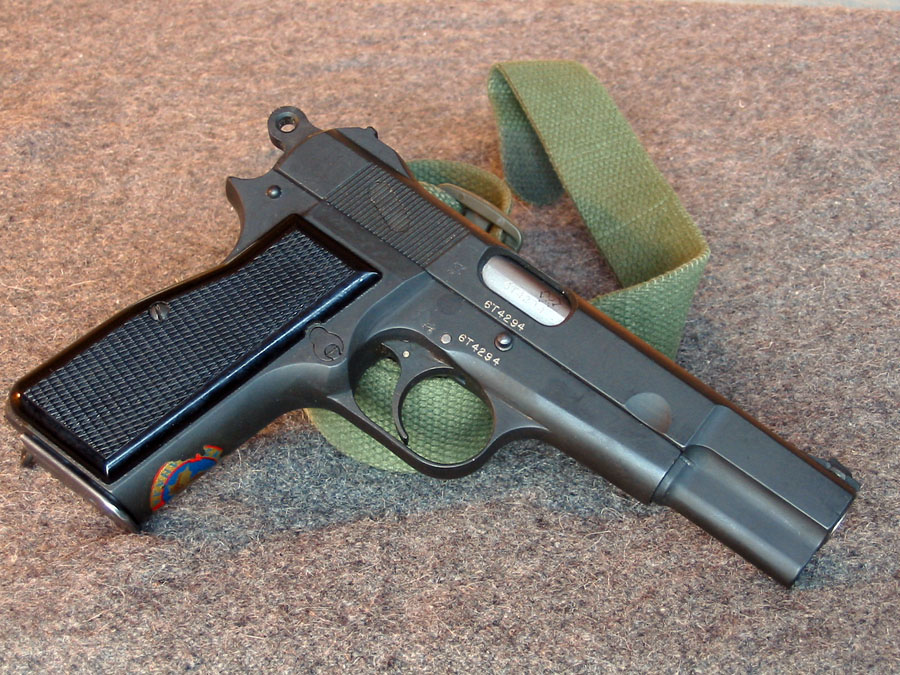
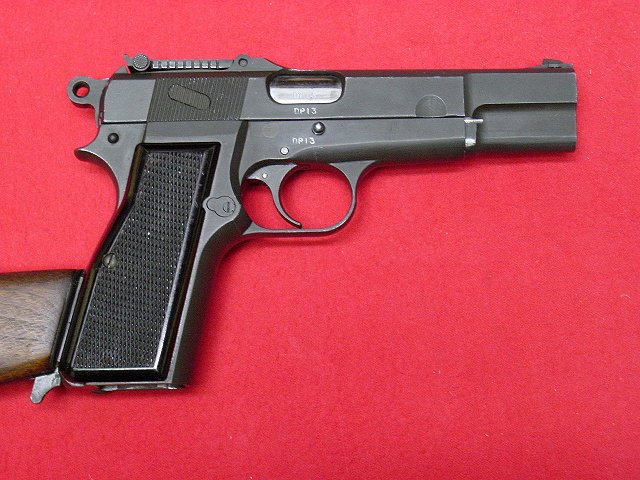
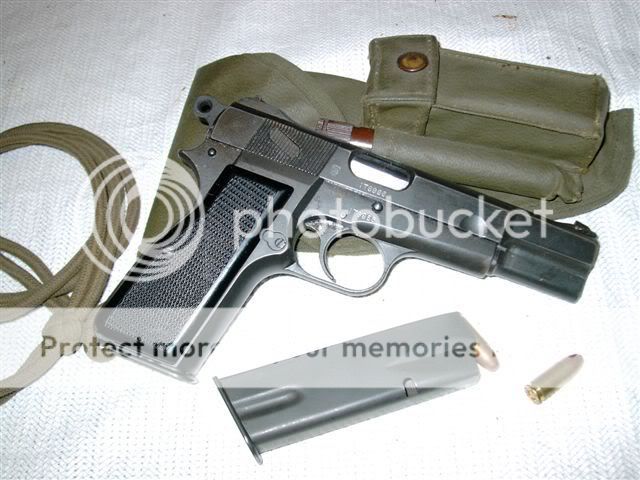
Requesting your expertise to help me statute whether a recently purchased Inglis Browning is an original or a cheap clone (e.g. from Indian Ordnance Factories). I've posted some close-ups on the following link:
http://s1080.photobucket.com/albums/j340/Jeanfo9/Inglis%20for%20real%20or%20clone/?albumview=slideshow
I have a large collection of military pistols from the Mauser C-96 to the recent SIGs. Many are excellent condition but most are seasoned with all the normal marks of time or service. Upon reception, what drew my suspicion on this Inglis No.1 (Chinese contract) is the outstanding mechanical condition as if it was freshly out of arsenal refurbishment. In fact, it's almost like new in the following aspects: hardly any wear marks on slide, frame; barrel is almost pristine (probably saw very low count of rounds). Tangent sight is unworn, with very snug/stiff fit. Firing pin, spring, locking plate like new.
However, the finish is very uneven in colour and shine. Some areas of the frame are polished, others show evidence of abrasion an buffing. There is porosity evidence on some surface areas (the metallurgist is speaking here), which is often a telltale of lower quality steel. Absolutely none of that on my 1979 FN Browning.
I was not aware that there existed cheap copies of Inglis, as there are for say, the M1911A1 from Norinco. The seller is requesting feedback to close the sale loop. My local club specialist being out of town, I searched the Internet today and found out about Indian Ordnance Factories.
I have never seen a Inglis Browning "in person" except a long time ago in Ottawa War Museum. So I have no reference. I beleive the Inglis never reached the quality finish of FN in Herstall (certainly not of the recent ones and probably not of the old WWII examples from Belgium). But how rough is the normal rough finish of a run of the mill Inglis?. See the pictures. The three S/N imprints correspond (barrel, slide and frame) although the depth and uniformity of the numerals are uneven and very shallow. The imprints do not show the regularity and straight alignment that I see in the pictures of the excellent Historical Arms Series no. 15 "The Inglis Browning Hi-Power Pistol". The "Canadian "crossed flags" proof mark is barely visible.
Refurbished original or cheap clone? You know what they say: "If it's looks too good to be true, it's probably not." Have not shot it yet and will not if it's a clone...
Thanks for your kind attention and advice. Gefreiter.
http://s1080.photobucket.com/albums/j340/Jeanfo9/Inglis%20for%20real%20or%20clone/?albumview=slideshow
I have a large collection of military pistols from the Mauser C-96 to the recent SIGs. Many are excellent condition but most are seasoned with all the normal marks of time or service. Upon reception, what drew my suspicion on this Inglis No.1 (Chinese contract) is the outstanding mechanical condition as if it was freshly out of arsenal refurbishment. In fact, it's almost like new in the following aspects: hardly any wear marks on slide, frame; barrel is almost pristine (probably saw very low count of rounds). Tangent sight is unworn, with very snug/stiff fit. Firing pin, spring, locking plate like new.
However, the finish is very uneven in colour and shine. Some areas of the frame are polished, others show evidence of abrasion an buffing. There is porosity evidence on some surface areas (the metallurgist is speaking here), which is often a telltale of lower quality steel. Absolutely none of that on my 1979 FN Browning.
I was not aware that there existed cheap copies of Inglis, as there are for say, the M1911A1 from Norinco. The seller is requesting feedback to close the sale loop. My local club specialist being out of town, I searched the Internet today and found out about Indian Ordnance Factories.
I have never seen a Inglis Browning "in person" except a long time ago in Ottawa War Museum. So I have no reference. I beleive the Inglis never reached the quality finish of FN in Herstall (certainly not of the recent ones and probably not of the old WWII examples from Belgium). But how rough is the normal rough finish of a run of the mill Inglis?. See the pictures. The three S/N imprints correspond (barrel, slide and frame) although the depth and uniformity of the numerals are uneven and very shallow. The imprints do not show the regularity and straight alignment that I see in the pictures of the excellent Historical Arms Series no. 15 "The Inglis Browning Hi-Power Pistol". The "Canadian "crossed flags" proof mark is barely visible.
Refurbished original or cheap clone? You know what they say: "If it's looks too good to be true, it's probably not." Have not shot it yet and will not if it's a clone...
Thanks for your kind attention and advice. Gefreiter.
Last edited: