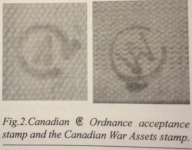
Need A Little Help Identifying A Stamp

B_noser

CGN Regular
Rating - 100%
67   0   0
Location
Eastern Canada
Howdy,
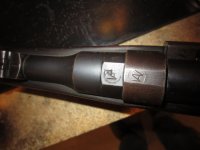
I need a little help identifying this intertwined "WA" stamp. I believe it is a Canadian war asset stamp, but have not seen another to compare to. The War Assets Corporation was created in 1944 and was the forerunner to our latter day Crown Assets. The Corporation disposed of surplus war assets and placed the "WA" stamp on at least some of them to signify official dispersal. Kind of like the commonly seen opposing broad arrows. Just to complicate things, at one time, Western Australia also placed a "WA" stamp on some of their military assets. I am pretty certain this is a Canadian rifle. It also has the opposing broad arrow stamp and the butt disc is marked DC over I(or T)CA over 251.
Any and all assistance appreciated.
Click on the image to enlarge.
 

Attachments

  • IMG_3976.JPG
    IMG_3976.JPG
    64 KB · Views: 110
Thanks for the confirmation! It is a bog standard 1898 LEC1 with bobbed fore wood. In great condition otherwise. And now for the big question: Why would an 1898 LEC1 still be in military stores at or after the end of WW II?
 
I do not believe there is any chance the stamp is anything other than genuine. This is a bog standard sporterized LEC. I have owned, handled and restored dozens of such rifles over the years. Does anyone really believe that, back in the day, someone would sporterize one of these carbines and then make a copy of the stamp and apply it to the gun. I don't think so! Why on earth would someone do that?
 
During WWII they asked for any civilian firearm available to be turned in for the war effort. ‘Modern cartridges’ were preferred (.303, 9mm lugers, etc.). Units like the home guard were issued ‘substitute’ standard arms (even lever actions).

Could be this rifle was one of those, just gathered up, put in storage as a ‘just in case’ or issued to a local defence unit of some sort.
 
That would seem to be a logical explanation. Wonder if such donated civilian arms did receive the CWA stamp on disposal. If so, one would think the CWA stamp on civilian arms might be occasionally encountered. Have not seen or heard of other CWA-marked civilian arms.
 
I do not believe there is any chance the stamp is anything other than genuine. This is a bog standard sporterized LEC. I have owned, handled and restored dozens of such rifles over the years. Does anyone really believe that, back in the day, someone would sporterize one of these carbines and then make a copy of the stamp and apply it to the gun. I don't think so! Why on earth would someone do that?
How long have you owned it? If you bought it yesterday, that stamp could have been added on Saturday.
 
MAN, there are times when a good dose of skepticism over stamps is well justified, such as some Nazi markings , but this is absolutely ridiculous. I can assure you buddy down the road is NOT putting fake stamps on his old hunting rifle before unloading it. To give a more direct answer to that pointed question and insinuation - I have owned it for quite a few years and it did NOT come from the collecting or trading community.
 
MAN, there are times when a good dose of skepticism over stamps is well justified, such as some Nazi markings , but this is absolutely ridiculous. I can assure you buddy down the road is NOT putting fake stamps on his old hunting rifle before unloading it. To give a more direct answer to that pointed question and insinuation - I have owned it for quite a few years and it did NOT come from the collecting or trading community.
I agree with you^^^. The collectors of the world lust after firearms and trinkets with highly tradeable markings and provenance. Units with battle lore would be more desirable than a bog standard, line infantry, Commonwealth rifle. Sniper rifles can be faked, but I see no value in designing, sourcing, and smacking particular piece as sold-out-of-service.

Cynics are requested to move along.
 
Unfortunately I have seen enough cases where fake markings were applied without any financial considerations, almost like out of passion of doing stupid chit. I would still agree that profit is the most common motivation for fakers. At the end of the day motives are irrelevant, but facts do matter.
 
Back
Top Bottom