thanks again! I am saving all you posts for my project. 
Last question(I think). when you said the 550b will stick out 6.5", are you talking about mounting with or without the strong mount option? from the video I see, with strong mount, it doesn't stick out. I guess with the strong mount, is wider top, but less height for extra shelf. without the strong mount, the top will be narrow, but I gain 8.5"(strong mount height)x16" for at least one shelf space which is quite useful. not to mention save the money on the mount.
Last question(I think). when you said the 550b will stick out 6.5", are you talking about mounting with or without the strong mount option? from the video I see, with strong mount, it doesn't stick out. I guess with the strong mount, is wider top, but less height for extra shelf. without the strong mount, the top will be narrow, but I gain 8.5"(strong mount height)x16" for at least one shelf space which is quite useful. not to mention save the money on the mount.
I want to say go for plywood. But the truth is that a top this narrow can be made from almost anything and be strong and stiff enough. Note that I separate "strong" and "stiff". By now I hope you and the others looking for advice here understand the difference. We want both at once for a good reloading bench top.
Since you don't want a whole lot of left overs I won't mention the plywood option. It's silly to cut this small a work top from a full sheet of plywood. Instead I'd look for some sort of prefinished shelving that you can laminate two layers together to get a good work top.
Since the top will likely be finished already forget about glue working on it. Instead I'd go with drilling a pattern of holes in the lower layer and screw up into the top layer with drywall screws. To effectively "sew" the two layers together go for 4 rows of holes with the holes spaced 4 to 5 inches apart. You want a "grid" of screws that effectively lock the two layers together as if they were glued. The outer rows would run about an inch in from the front and rear edges. Then over the remaining width on the 16 inch width shelving stock run two more rows. You will want to drill and countersink for the screws so you don't have them sticking out below and catching on anything for any reason.
Go for the good finish on the shelving. If you're going to avoid varnishing it should be with something that doesn't mark or stain easily and certainly something water proof.
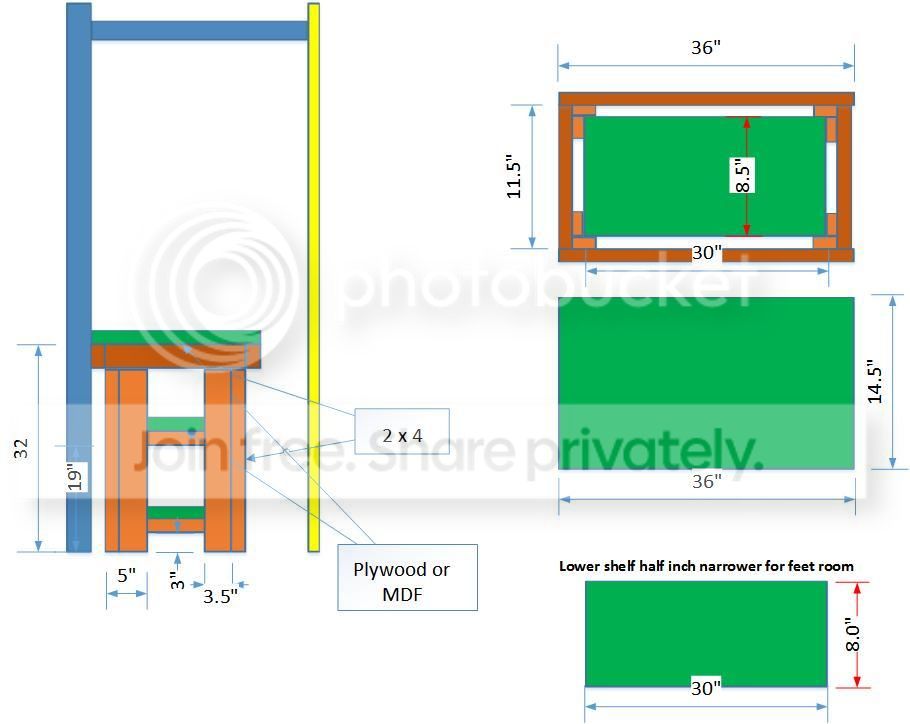
We didn't talk about it yet but I'd also add enough extras to build on a shelf or two for holding your supplies below the working area. I've found that because the presses stick out from the edge of the table and we need to be back a little to get a good swing on the arm that there's just no need for leg clearance below the table. So spacing the front legs from the wall such that a couple or three of 12 inch wide shelves can be included is a great option.
Last edited: