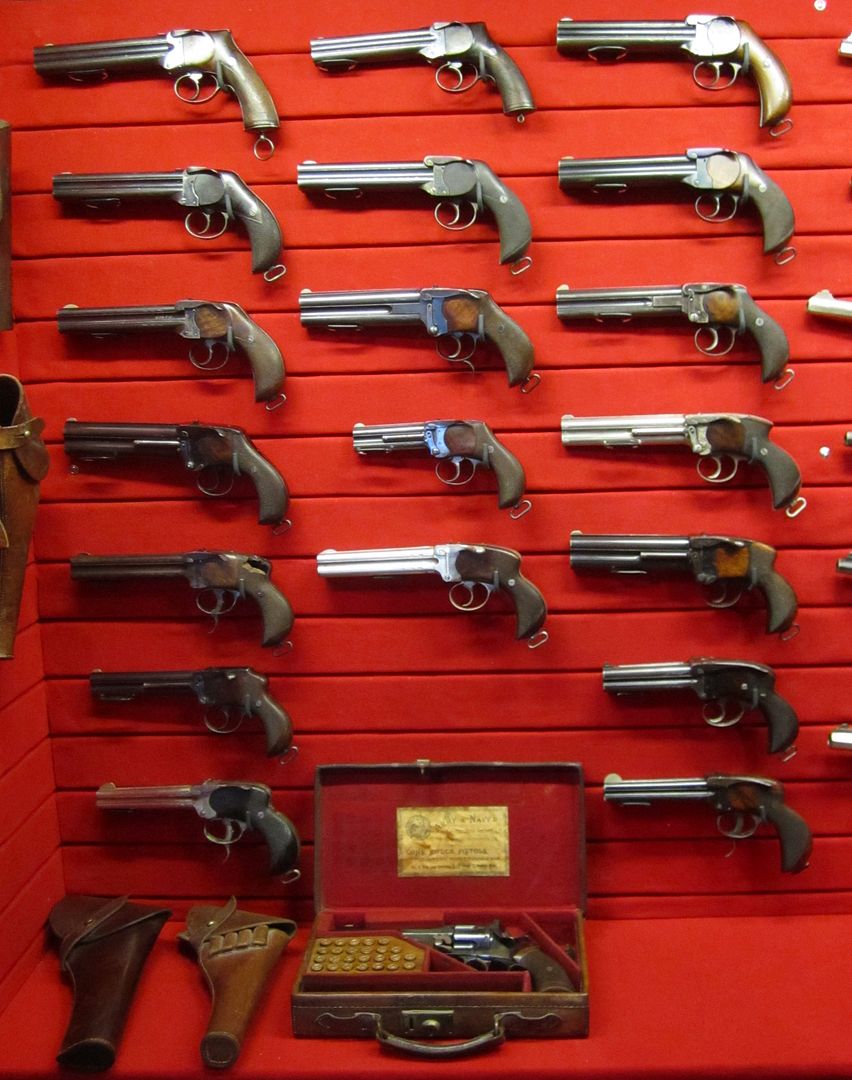
Great love to come by and see them. Hope you don't mind the past of what it is, I went of an Googled to find out more, must know every thing

.
The
Lancaster Pistol was a multi-barrelled (either 2 or 4 barrels)
handgun produced in England in the mid-late 19th century,[SUP]
[1][/SUP] chambered in a variety of centrefire pistol calibres—chiefly .380",
.450 Adams,
.455 Webley, and .577 calibre.[SUP]
[2]
[/SUP]
It was a modernised version of the
pepper-box pistol popular in the early-mid 19th century.[SUP]
[3][/SUP] Unlike these earlier guns, which had
percussion cap ignition the Lancaster was chambered for the more modern brass cartridges. It had a faster rate of fire than the standard-issue
Adams revolver and was often fitted with a
Tranter-type trigger to overcome the heavy pull of the revolving striker.[SUP]
[3]
[/SUP]
Sometimes classified as a
Howdah pistol, the Lancaster pistol enjoyed popularity with British officers in
India and
Africa during the
British Raj owing to its faster rate of fire and increased reliability over contemporary revolvers.
Its ammunition had greater stopping-power than the contemporary
Beaumont-Adams and
Colt Navy revolvers, making it ideal for colonial warfare. When facing charging tribesmen like the
Zulus or
Dervishes more modern ammunition tended to go straight through the enemy who would keep going. What was needed was a heavy lead bullet that would lodge in their body and bring them down.[SUP]
[3]
[/SUP]
It was eventually displaced by the various
Webley revolvers in the late 19th century, as revolvers became more reliable and faster to reload, thus removing many of the advantages of the multi-barrel design. A few were still in use as late as
World War I, and they were well known to be solidly built and easy to maintain.