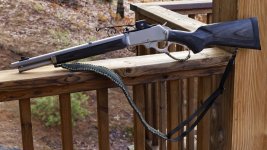
New to Levers and Questions...

LesPT

Member
Rating - 0%
0   0   0
Just got my new Trapper and its action is a bit stiff as one might expect. Stripped her down after finding an amazing 1895 gunsmith disassembly video, gave her a light CLP massage and now I am wondering... Is it recommended or would it hurt at all to regularly cycle the action to break it in? Does it matter if it is with or without rounds? I have ordered 6 snap rounds regardless as they were an Amazon sale. Does different ammo result in a smoother cycle? If so... what is recommended? What should be avoided? Additional tips? Thanks ahead.

d0797824-7646-42f3-90d1-c71f4aeed965-DeNoiseAI-standard.jpg
 
LesPT: Marlin rifles like yours are generally a bit stiff when new and can benefit from a little extra care. It does not hurt the rifle to cycle it repeatedly. Running the rifle through it's full cycle, including firing it (with snap caps), is ideal. This will also help familiarize yourself with the rifle's operation and build muscle memory.
As others have already recommended. there is no need to baby the rifle. Marlins are very robust rifles, that hold up well to hard use. Run it the same way you would, when hunting, etc.

After cycling the rifle for a hundred or so times, disassemble it and check all the bearing surfaces on the bolt, lever, etc. Then, gently polish any areas where you see scuff marks. The use of fine, gunsmithing stones is recommended. But if none available, wrapping a strip of sandpaper securely around a small, flat sanding block, file, etc., also works well.

Note: The idea is to polish out any irregularities (usually tool marks), etc., on the bearing surfaces, ONLY. Do not alter the profile of parts, or remove any significant amount of metal.
Start with 400-600 grit wet/dry sandpaper. Then, when the surface is smooth, finish with 800-1000 grit. Lube and re-assemble the rifle. The difference in ease of cycling should be apparent.

You could also replace the mainspring, etc., to lighten the amount of force needed to cycle the action. There are complete spring kits available, for just this purpose. I recommend leaving that until later though, once the rifle's action has been worked in a little.

Some rifles do prefer different ammo. With overall cartridge length and bullet profile being the most common cause of poor feeding. Round nosed or round nosed flat point bullets in particular(in tube-fed lever rifles), being the ideal choice. Though you will find many Marlin rifles are not particularly picky about bullet shape and often will feed semi-wadcutters, etc., without problems.

Al
ps: Initially, a simple field strip of the rifle is usually all that is needed...ie: remove bolt, lever, etc. No need to strip the rifle further.

 
Last edited:
Definite just needs a good working in. As for ammo/snap caps, not necessarily, you’re just trying to work in the tolerances, everything in the action aside from the extractor is still doing its job in an empty rifle. I just de-#### and lower the hammer manually so I’m not dry firing. That said snap caps are fun too.
 
LesPT: Marlin rifles like yours are generally a bit stiff when new and can benefit from a little extra care. It does not hurt the rifle to cycle it repeatedly. Running the rifle through it's full cycle, including firing it (with snap caps), is ideal. This will also help familiarize yourself with the rifle's operation and build muscle memory.
As others have already recommended. there is no need to baby the rifle. Marlins are very robust rifles, that hold up well to hard use. Run it the same way you would, when hunting, etc.

After cycling the rifle for a hundred or so times, disassemble it and check all the bearing surfaces on the bolt, lever, etc. Then, gently polish any areas where you see scuff marks. The use of fine, gunsmithing stones is recommended. But if none available, wrapping a strip of sandpaper securely around a small, flat sanding block, file, etc., also works well.

Note: The idea is to polish out any irregularities (usually tool marks), etc., on the bearing surfaces, ONLY. Do not alter the profile of parts, or remove any significant amount of metal.
Start with 400-600 grit wet/dry sandpaper. Then, when the surface is smooth, finish with 800-1000 grit. Lube and re-assemble the rifle. The difference in ease of cycling should be apparent.

You could also replace the mainspring, etc., to lighten the amount of force needed to cycle the action. There are complete spring kits available, for just this purpose. I recommend leaving that until later though, once the rifle's action has been worked in a little.

Some rifles do prefer different ammo. With overall cartridge length and bullet profile being the most common cause of poor feeding. Round nosed or round nosed flat point bullets in particular(in tube-fed lever rifles), being the ideal choice. Though you will find many Marlin rifles are not particularly picky about bullet shape and often will feed semi-wadcutters, etc., without problems.

Al
ps: Initially, a simple field strip of the rifle is usually all that is needed...ie: remove bolt, lever, etc. No need to strip the rifle further.

Thanks for that and couldn't resist being an old army guy. Broke her right down within a few days. Was a ##### getting that trigger spring back in place but we got there. Thanks for the detailed right up... I'll take a closer look now.
 
LesPT: Trigger return springs can be a pain, at times. Still, there are a few tricks that make the job go easier. For trigger return/ lever safety bar spring for example: When installing this spring, it helps to first hold the replacement spring in place with a slave pin. Then, tap in the pivot pin. One pin simply follows closely behind the other. All the while keeping the spring under pressure. Quick and easy.

When considering replacement spring kits, etc. : Shotgun Boogie Gun Works, in the U.S., is a good source. Have had no problems ordering from this shop in the near past. But, recent developments here in Canada may have changed this situation.

Another Canadians source which may be helpful: Rusty Wood Trading. Highly recommend this shop. Good service. There may be other equally good sources, here in Canada. I'm sure someone on this forum will provide that info.

Al
ps: I can't resist stripping new guns down completely, either.

 
Last edited:
My '94 Winchester was quite tight when I bought it new 50 odd years ago. I worked that action hundreds of times with no ammo, and fired it lots too. It didn't take long to loosen up, and now it's very smooth. Same could be said of a Baikal side by side I acquired at the same time. Use it, it'll get better.

 
I don’t know about the spring mods, but generally speaking I feel like stainless steel (and any metal that has a propensity to gall like aluminum, and unlike steel) tends to break in differently in this application.

Some parts you can polish with a stone on rotating surfaces, but brass sleeve inserts on stainless fasteners help but are kind of unnecessary for your application.

I would use an abrasive compound like jewellers rouge or valve lapping compound anywhere that might not be smooth and break things in, and/or the can old John Deere graphite paint to coat locations that seem to be a bit restrictive, and finally lube on top of that.
 
I dont worry about lowering the hammer too much on a lever. Generally don't dry fire, and don't have any snap caps.


On a new gun, I'll just cycle it awhile dry generally, without dropping the hammer, or firing pin.

So far I haven't been too tempted to do an in-depth polish job.
 
Love that gun. I really wanted one but lost interest when I seen the 3 grand price tag lol
I literally hunted this down watching every sale thread. I ended up grabbing it in a FTF exchange for less than one would pay base price taxes in... much closer to 2K than 3. There is anotherr in Orillia going at a 2k range (maybe lower) with few rounds through it as well. He didn't renew his advert but I have his number if you are interested. That would have been my second choice if I hadn't found this one which was still BNIB.
 
Back
Top Bottom