New to rifle reloading..having problems

Brewster20

CGN frequent flyer
Super GunNutz
Rating - 100%
161   0   0
Location
Ontario
OK, so I have loaded literally thousands of .32, .38, 357 and 45's, all straight walled cases, but I have very little experience with rifle (bottleneck) reloading. I am just starting the process to load some .223 Rem. I'm using Redding deluxe dies, resizing the necks only. (at this point all of my reloads will be fired from 1 rifle, all casings are fireformed from that gun.) (CZ 527) I have shot 2 types of .223, Winchester 55Gr and American Eagle .55 Gr.
I have wet tumbled the cases, and ran them through the neck resizer die, no problems so far. Now I'm about to trim the casings. My Hornady Reloading Guide states that the maximum case length is 1.760" and a trim to length of 1.750" (I am assuming that I trim all cases to 1.750") Now here is my confusion, the Winchester fired cases are averaging 1.7520", but the American Eagle fired cases are 1.7425" (the new American Eagle unfired cases are 1.7375) The American Eagle cases are therefore impossible to trim to 1.750 ? I don't get it !
PS the AE cases also have crimped primers, which are a pain in the a** to ream out.
What am I doing wrong ???
I have read and re read the ABCs of Reloading, no help !
 
Ya don't worry if some cases are shorter than the stated max length. Crimped primers are a pain as you found out, i'm dealing with a large batch myself this winter. May break down and buy the Dillon tool but it isn't cheap either.
 
Exactly. Don't worry about it too much, after you fire each case a couple of times it'll "stretch" enough to trim them all to the same length.

Had the same concern comparing 3 different brands of .303 brass when I first started, not a big deal
 
If you’re crimping into a bullet cannelure your cases have to be the same length.
Some say using the Lee factory crimp die will make identical lengths of cartridge cases less critical.
I don’t know how that theory proves out in practice.
If your cases are too long they will wedge in the front of the chamber and cause high pressures and the gun might not even cycle.
 
I've noticed that all Federal .223 commercial grade brass is short, usually around 1.740-1.745". After the second firing and resizing most of them will have stretched out enough to trim. If you're only neck sizing it might take a couple more. I find the federal brass to be relatively poor quality, most of it is short, primer holes are off-center, and it varies alot in weight from case to case. It will still cycle fine but I generally leave the FC brass for cheap plinking loads.

Also, reaming primers is a futile effort and generally results in a loose primer pocket and popped primers. I would strongly recommend a primer pocket swaging tool, I use the RCBS one. Swaging is also a bit of a pain but it results in a stronger, tighter primer pocket and if you lube your cases well its generally not too bad for 5.56 and is much faster than reaming.
 
If you’re crimping into a bullet cannelure your cases have to be the same length.
Some say using the Lee factory crimp die will make identical lengths of cartridge cases less critical.
I don’t know how that theory proves out in practice.
If your cases are too long they will wedge in the front of the chamber and cause high pressures and the gun might not even cycle.
They work, different style of crimp, not a fan of them myself thoguh.
 
Last edited:
At this point I may scrap the American Eagle cases, I used a Lyman Deluxe Case tool, the powered one with all the tool heads) the reamed primer pockets look quite large, and with a fairly deep edge taper...compared to the Winchester primer pockets !
 
We use a dedicated Lee depriming die.
That thing has a pretty robust pin which will punch just about any primer out crimped or not.
We don’t ream primer pockets. We brush them out.
We do uniform flash holes from inside the case with a special tool that removes the burrs with new cases.
I find that in some cases (pun intended) the Lee case trimming tool with the cutting head and round specific arbor gets them the same length every time.
 
I think the reason your cases are shorter than expected is because you're neck sizing only. The cases have stretched, but not length-wise, instead they're larger around than they used to be. That makes them shorter, since the extra diameter has to come from somewhere.
I suspect if you were to run a FL sizing die over them, they would elongate by 0.005"-0.006". I've noticed that with my .243 brass, they're always longer after being FL sized.
It's not a problem, they will eventually get longer with each successive firing as the brass gets thinner, and will require trimming.
I've zero experience with crimped primer pockets..
 
Trim all cases to the same length provided the shortest in still in spec. 1.73 you should be good. As you fire them and resize they will stretch. As for crimped primer...a Lyman primer pocket swag and a cordless drill. Only takes second or 2 per case.

Make sure you buy a swag that has a removable tip. The Lyman one with the orange handle does.
YouTube is a good resource for case prep.
 
All good info here..... my bet is if these loads are all going in the same rifle and you are only neck sizing ( which is a good thing) you will Be able to get 4-5 times reloaded before trimming the brass. If you full length resize you will trim more often as you are really working the brass. Also you may find after firing the same case multiple times and resizing just the neck that the brass becomes hard to manipulate in your sizing die. At that point case annealing is a good idea
 
You could trim them all to the length of the shortest brand of case. Case does not headspace on mouth, so short does not matter much. All the same length makes crimping easier, if you crimp. I don't for a bolt gun.

A very fast and easy way to de-crimp primer pockets is with a a counter sink tool on an electric drill. It costs about $7.00 at the hardware store.

It will breeze though a bucket of cases very quickly. It is easier if you can lock the drill in a vice, but this only works if the drill has a lock function to keep it running. If it does not, a big radiator hose clamp can be attached to keep the trigger pulled.

Just touch the tool to each pocket to ream off the top lip.
 
You have mixed brass and a factory SAAMI chamber and as you can see you are having case length problems caused by neck sizing only.

Buy a Forster full length benchrest die with their high mounted floating expander and give your cases some "wiggle room" in the chamber to let the bullet be self aligning with the bore.

At the Whidden custom die website they tell you they get the most concentric cases using non-bushing full length dies.

When you full length resize, the recessed bolt face holds and centers the rear of the case, and front of the case is centered by bullet in the throat. Meaning the case body and case neck do not touch the chamber walls and the only part of the case that touches is the shoulder of the case.

Below German Salazar a national competitive shooter from his old website "The Rifleman's Journal" is answering a question about "Partial Full Length Resizing". And why you want "wiggle room" of the cartridge in the chamber. The reason for this is not all cases have equal case wall thickness and the thin side of the case expands more when fired and the case warps. This causes the bullet to be out of alignment with the axis of the bore when neck sizing. And full length resizing eliminates the case body alignment errors in the chamber.

Reloading: Partial Neck Sizing
by German A. Salazar
http://riflemansjournal.########.com/2010/06/reloading-partial-neck-sizing.html

"Now the last scenario, a full-length sized case in which the neck is also fully sized. There is clearance at the neck and in the body of the case, the closest fit anywhere is the bullet in the throat. If the neck to bullet concentricity is good (although it needn't be perfect), then the bullet will find good alignment in the throat and the case body and neck will have minimal influence. Let's not forget that the base of the case is supported by the bolt face or the extractor to a certain degree as well; this is yet another influence on alignment. As you can see, there are several points from base to bullet that can have an effect. My procedure is to minimize the influence of those that I can control, namely the case body and neck, and let the alignment be dictated by the fit of the bullet in the throat and to some extent by the bolt's support of the base. Barring a seriously out of square case head, I don't think the bolt can have a negative effect on alignment, only a slightly positive effect from minimizing "case droop" in the chamber. Given that a resized case will usually have a maximum of 0.001" diametrical clearance at the web, this isn't much of a factor anyway."


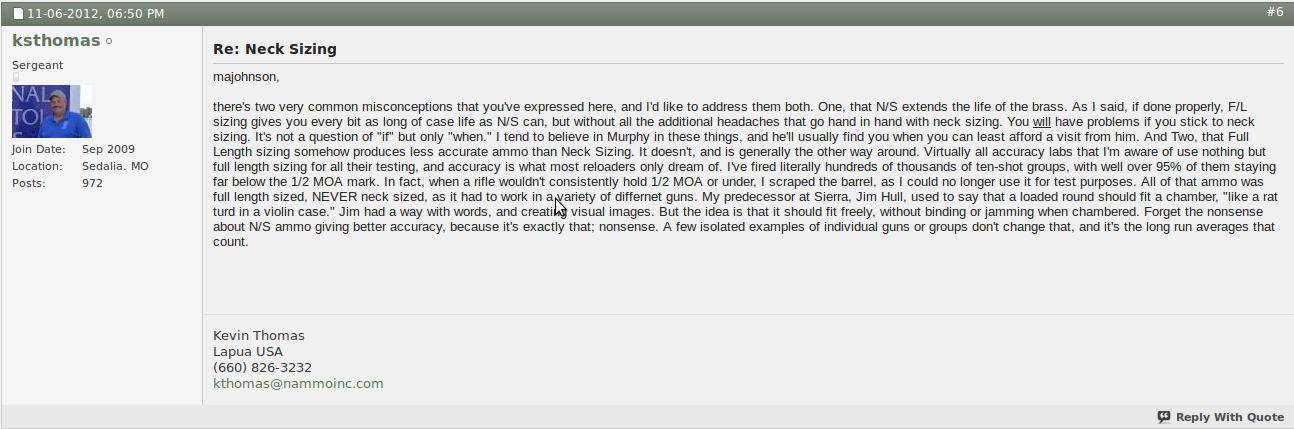
Below Kevin Thomas and Erik Cortina of "Team Lapua USA" give advice about full length resizing. So join the "Rat turd in the violin case" club like the pros.

Y3IiYL5.jpg


Back in the day, when I picked up range brass and tried to be economical, I found that the crimped .223 were, in fact .556 brass that had been used in an AR platform by some LEO's who were using the range for training purposes. Many law enforcement cases as well as all military surplus cases were crimped AND measured under the book trim to length. I swaged the crimp out and used the brass, but was dissatisfied with many of the results. .223 brass is inexpensive enough to purchase new when required. (About $50/100 or 30/100 once fired)
 
Back
Top Bottom