Newbie scope question.... elevation...

nonsubscriber

New member
Rating - 0%
0   0   0
Greetings.

I reach the furthest UP elevation my cheap scope will allow. I've a bore site and a red dot. Even if I were to find and use the lowest profile rings the elevation is still way off and I'd have to have the ocular end way back which is no good.

This is a PPC so the barrel bore distance to scope is maybe more than typical? Or is this a limitation maybe of the cheap scope?


Thanks for any help!


So far as I know, within "normal" reason, the height of the rings are about irrelevant to "sight in" - is the "tilt" between the scope line of sight and the flight of bullet that counts - that "tilt", if needed, is usually found in the base height, not within the ring pairs - is often assumed that the centre of the bore is also the centre of bullet path, but is not always so, once bullet leaves the barrel - can be "thrown off" by various things, including uneven muzzle crown, and, of course, gravity. I did discover, on some bolt actions - that height of rings DO matter when installing a scope - have to be high enough to allow the bolt handle to clearance the eye bell when cycling the bolt handle, or re-shape / bend the bolt handle, which often requires the stock cutout for that bolt handle to also be re-done. I have also noticed that the shooter's head position on the comb of the stock might influence the height of rings that the shooter prefers to use.
 
cheap scopes usually have limited/small elevation adjustment range. How much more elevation is required??

Get a set of either 1inch or 30mm burris signature zee rings with the plastic offset inserts. They will allow you to "add" up to 30moa of adjustment.
###X the 30mm set comes with the extra offset inserts, for the 1inch set the offset insert pack is sold separately.
If you need more, get the burris signature xtr rings with up to 40moa offset.

if thats still not enough, find a rail with built in 20moa adjustment. Just do a search on your rifle and scope mount/rails to find who makes some.
 
Thank you guys for the replies.

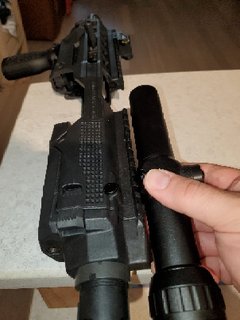
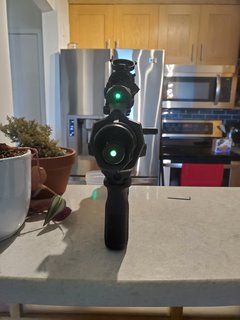
Saddly I'm not completely following but I've got some more info/pics.


a) If I understand correctly elevation adjustment adjusts the "innards" of the scope. The optics sight angel does not change just the vertical distance between the scope and everything else... remaining perpendicular?

b) Offset rings would make one end of the scope elevated differently than the other end? So in my case the rear of the scope would be elevated slightly more (and somehow the rings made to accept this uneven angel.) Scope would then be angled sloping downward? I must have this wrong... seems like a terrible idea?


So the gun bore center is about 3" from the center of the objective lens.

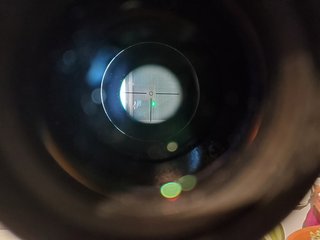
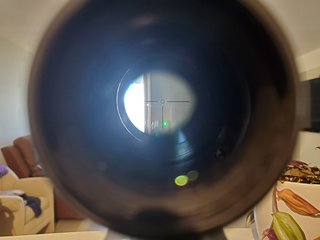
In the first pics the elevation is adjusted fully up. In the last pic the elevation is adjusted fully down. I have intentionally offset the windage and the elevation slightly for the green dot. Top greendot is the bore site, bottom is the green dot.


Elevation adjusted fully up


Elevation adjusted fully down


Thanks for any more help!
 
Hi
Your aiming point is too close even if the laser is pointing correctly.(they rarely do)
At close range (10yds or less) your 3 inch difference between the bore and center of the scope would take around 30moa minimum correction up.
This means your scope would need at least 60 total moa if it started out centered in its range.
I would center it left and right, and go to the center of your elevation range, and shoot it at 25yards.
See where it hits and go from there.
 
Hi
Your aiming point is too close even if the laser is pointing correctly.(they rarely do)
At close range (10yds or less) your 3 inch difference between the bore and center of the scope would take around 30moa minimum correction up.
This means your scope would need at least 60 total moa if it started out centered in its range.
I would center it left and right, and go to the center of your elevation range, and shoot it at 25yards.
See where it hits and go from there.


LOL thanks. Feel dumb. But you know I had talked to an "expert" at work and asked if maybe this was just a distance thing and that at appropriate scope ranges this should balance out but he disagreed and said everything even at close range should line up...
 
Hi Non, Flyr has it right, you're way too close (how I know...) - what I've done is go outside after dark (easier to see the laser at distance) and aim the laser at something 20 or more yards away, then adjust your scope to that. That should get you on paper when you get to a range, then adjust from there.
That's what I've done for most of my rifles - just watch out for neighbours !!! I have a fenced back yard.
 
...

b) Offset rings would make one end of the scope elevated differently than the other end? So in my case the rear of the scope would be elevated slightly more (and somehow the rings made to accept this uneven angel.) Scope would then be angled sloping downward? I must have this wrong... seems like a terrible idea?

...

I do not know what you have been sold - "offset" rings should be exactly same height as regular rings - only they allow the scope to be mounted more forward or more rearward. For example, on a Ruger #1 rifle - the standard rear #4 ring ("Medium height") would hit the turret, before the scope was back far enough for me - so I purchased a #4 off set ring - that allowed the scope to be moved rearward almost another 1/2 inch. No change in scope height.

It might help to understand that a bullet will fly in an arc. Your line of sight through the scope will be a straight line - hence, can only have a straight line intersect an arc at maximum two places - one near and one far - in between, the bullet will be above the line of sight - up close and very far away, the bullet will be lower than your line of sight. Hence that laser thing that you are using is misleading you perhaps - that is NOT the bullet path, except for perhaps 2 or 3 meters from your muzzle. The higher that you mount the centre of your scope above the bore line, the greater is that maximum two points thing - is "normal" for many ballistic tables to assume that centre of scope is about 1.5" above the barrel bore line - for a typical hunting rifle - sounds like you are about double that? Will still work - you likely need to fire it - see bullet holes - instead of relying on your laser thing.

Assume that your closest "sighting in" point is 20 meters - from muzzle to that distance, your bullet should strike below that line of sight. Bullet strike will be exactly "on" at your sighting in range of 20 meters - after that it will strike higher than your crosshair. Until bullet drops back down to intersect the second time - so is a second point - out there - perhaps 150 meters - that you will also be "on" - after that, your bullet will strike low.

Perhaps a learning exercise for you - how I "sight in" my centre fire hunting scopes - so sandbags, shooting table, etc. - target at perhaps 20 meter - big target - say 60 cm x 60 cm - aiming point is a dot or cross - dead centre in that big target - aim at it and fire twice - want to see two holes pretty much touching, somewhere on that big target. Then measure or whatever - adjust the turrets - fire twice again - repeat - want to eventually get a pair to be perfect left / right, and perhaps "on" or a cm or two low of the aiming point. Then move target to 100 meters or where-ever you want your long distance sighting - you will be "on paper", if you did the first part - but might have to do "fine tuning" to get holes where you want them to land. I do not use a bore-sighter thing - is how I do it, and it works. My "big target" is just plain cardboard salvaged from a shipping box - aiming point is made with a jiffy marker.

If holes are not close to touching at 20 meters, is something very wrong with your rifle, your scope mounting or with your shooting ability - if the first holes are several inches apart, not much point in continuing, until you figure out and correct what is wrong.

Do not discount "shooter's ability" - below is picture of "big target" - range was about 20 meters - middle of May this year - the three holes fired by my grand-daughter aimed at the "+" - I then fired the three holes aimed at the dot, higher up. Same rifle, same box of ammo, same scope setting - was a left hand Savage 93 in 22 Magnum - I shoot right handed; she wants to shoot left handed. Rifle forearm was supported on sand bags. These are the first 6 rounds that were fired that day - her shots were the first three. I had no clue until then, whether the new-to-me scope was aligned with the new-to-me rifle. (Note - loading this picture to this website, it went sideways - in real life, what you see as "left" should be "up" - I do not know how to fix that ...)

449B4D8B-73CC-4559-863B-C3D770102CA6.jpg
 

Attachments

  • 449B4D8B-73CC-4559-863B-C3D770102CA6.jpg
    449B4D8B-73CC-4559-863B-C3D770102CA6.jpg
    72.2 KB · Views: 69
Last edited:
I think the rings Left was meaning are these - http s://www.burrisoptics.com/mounting-systems/rings/xtr-signature-rings
They allow variations of MOA offset. They may help,if your 'dot has trouble getting aligned. One of mine did, but I just changed it to a diff rifle.
P'miner is right about the 'offset' that gives forward or backward adjustments w/o MOA changes. Those are often referred to a 'cantilever' rather than offset..
AS WELL as ALL his advice for Z-ing your rifle.
 
Last edited:
I think the rings Left was meaning are these - http s://www.burrisoptics.com/mounting-systems/rings/xtr-signature-rings
They allow variations of MOA offset. They may help,if your 'dot has trouble getting aligned. One of mine did, but I just changed it to a diff rifle.
P'miner is right about the 'offset' that gives forward or backward adjustments w/o MOA changes. Those are often referred to a 'cantilever' rather than offset..
AS WELL as ALL his advice for Z-ing your rifle.


Thank you all again for taking the time to reply.

So finally correct me if I'm wrong in this lesson.... I originally believed that the line of sight through a scope sitting on a flat/default 0 MOA rail is almost perfectly perpendicular to the bore. The lesson is this is incorrect... scopes are tilted slight downward so that at a set distance (say 100yrd) the vertical center is hence lowered (to at least partially estimate bullet drop.) Or did I mess this up?

 
Not sure of your word meaning - "perpendicular to the bore" - means to me "vertically in line" with the bore - I was meaning "parallel" to the bore - imagine looking at the assembly from left or right side - when "sighted in", the line through centre of the bore is pointed high and the line of sight through the scope is tilted down - those two lines will intersect once. Your line of sight is sort of related to the scope's body, but can have a modern scope body perfectly level to centre of bore, yet internally that scope is pointed up or down - that is the line of sight. When the bullet leaves your muzzle, is immediately acted on by gravity - to pull it down - so travels in an arc. Normally, that bullet intersects line of sight maybe 4 or 5 meters from muzzle, then again intersects "way out there" - once that bullet "arcs" down and again crosses your sight line. Is possible, I suppose, to "sight in" at specific range - to make line of sight tangent to that arc - so is only one distance that line of sight and bullet intersect - at all other distances, the bullet would be lower than line of sight. I have never tried that. As mostly hunter, I am concerned with the far "way out there" intersection - say 100 or 200 yards - I want to know where my bullet will strike, when target is "way out there", in relation to where the scope cross hairs are. Bullet strike will be higher before that range, and lower after that range.

Relationship of the line of sight through scope and the centre of bore line might be easier to visualize with old school systems that had NO adjustment within the scope, at all - was completely done with the mounting - so rear one was higher than front one - to be sighted in very long range - like 500 yards, rear one was much higher than the front one. I do not have a completely "naked scope" - although an acquaintance does, but I do have a Wetzlar brand scope with no windage turret - windage can only be set by the mounting system - have to align the scope body left or right to get the line of sight to line up with the bullet strike. My acquaintance has to align both his windage and his elevation with his mounts, only - is no internal adjustment within his scope, at all.
 
Last edited:
Not sure of your word meaning - "perpendicular to the bore" - means to me "vertically in line" with the bore - I was meaning "parallel" to the bore - imagine looking at the assembly from left or right side - when "sighted in", the line through centre of the bore is pointed high and the line of sight through the scope is tilted down - those two lines will intersect once. Your line of sight is sort of related to the scope's body, but can have a modern scope body perfectly level to centre of bore, yet internally that scope is pointed up or down - that is the line of sight. When the bullet leaves your muzzle, is immediately acted on by gravity - to pull it down - so travels in an arc. Normally, that bullet intersects line of sight maybe 4 or 5 meters from muzzle, then again intersects "way out there" - once that bullet "arcs" down and again crosses your sight line. Is possible, I suppose, to "sight in" at specific range - to make line of sight tangent to that arc - so is only one distance that line of sight and bullet intersect - at all other distances, the bullet would be lower than line of sight. I have never tried that. As mostly hunter, I am concerned with the far "way out there" intersection - say 100 or 200 yards - I want to know where my bullet will strike, when target is "way out there", in relation to where the scope cross hairs are. Bullet strike will be higher before that range, and lower after that range.

Relationship of the line of sight through scope and the centre of bore line might be easier to visualize with old school systems that had NO adjustment within the scope, at all - was completely done with the mounting - so rear one was higher than front one - to be sighted in very long range - like 500 yards, rear one was much higher than the front one. I do not have a completely "naked scope" - although an acquaintance does, but I do have a Wetzlar brand scope with no windage turret - windage can only be set by the mounting system - have to align the scope body left or right to get the line of sight to line up with the bullet strike. My acquaintance has to align both his windage and his elevation with his mounts, only - is no internal adjustment within his scope, at all.


Thanks lol @ me mixing up perpendicular with parallel duh. Thanks!
 
As mentioned - in the past, I tried various bore sighter things - some went into the chamber, some into rifle's muzzle - I could make the indicator point to different places if I rotated that bore sighter thing - so I no longer use them at all - maybe modern ones are made "better". I found is "good enough" to remove bolt - eyeball down centre of rifle bore at something about 15 or 20 yards away, then adjust scope cross hair, so they also intersect that same thing - rifle sitting on sand bags or in a vice fixture for that. Then 24" x 24" (60 cm x 60 cm) target - set up shooting table, sandbags, etc. - target stand about 15 or 20 meters away and shoot - see where holes end up and adjust cross hairs as needed - then back out to 100 yards or wherever and repeat. "Bore sighting" is a rough alignment technique - your rifle is NOT sighted in unless you have shot it on a target and got the bullets holes where you wanted them to be - no bore sighting tool can do that for you. Likely was different - I read of WWII / Korea / Vietnam artilleryman looking down bore of their howitzer from the rear of it - seeing bad guys, and letting rip with high explosive or other types of rounds - apparently, that, or similar, was true "bore sighting" - so typically very short range, not using the sights at all - like when the camp or emplacement is being overrun.

 
Back
Top Bottom