Next thing you knowI own a Sharps

yerflib

New member
EE Expired
Rating - 100%
35   0   0
A member at our club pass away and his family is selling his gun collection. I walked into the room and Saw an 1866 C Sharps Conversion hanging in the cupboard. I bought it. It fires a 50 70 cartridge. I have know idea what it is worth if I can shoot it.

When I went back hanging in another cupboard was a Winchester 1873 Musket in 40 60 I guess this too is a black powder gun. I am not sure as yet what I have paid for these guns there were a bunch of people in the room when I was first there and I just put what I wanted on the table to be put into my name next week we will settle up on price. I also got a Steyr 1911 and a Colt D.A. 1898 in this deal. Boy talk about getting into antiques by chance.
 
73

A member at our club pass away and his family is selling his gun collection. I walked into the room and Saw an 1866 C Sharps Conversion hanging in the cupboard. I bought it. It fires a 50 70 cartridge. I have know idea what it is worth if I can shoot it.

When I went back hanging in another cupboard was a Winchester 1873 Musket in 40 60 I guess this too is a black powder gun. I am not sure as yet what I have paid for these guns there were a bunch of people in the room when I was first there and I just put what I wanted on the table to be put into my name next week we will settle up on price. I also got a Steyr 1911 and a Colt D.A. 1898 in this deal. Boy talk about getting into antiques by chance.

If it is in 40-60 I assume is is an 1876.Any other Winchesters for sale let me know
Meanea
 
Yeah, the 40/60 is a non-starter as the '73 was only made in pistol length carts.
The value of the Sharps in good condition is $2500 although that price may be easier to get in the States where Sharps is King. I don't know all the model #s that were converted to 50/70 so i could be off, but those types of Sharps go for that on the US auction sites. A decent '74 Sharps will go for more and a decent '78 Sharps goes for less. The 50/70 can be fired with BP loads only unless you have a gunsmith inspect and give his blessing to anything else. Check for excessive play of block/s in their mortices, which could cause headspace concerns, etc. 50/70 can be reloaded easily, usually without dies, cases avail. from Buffalo Arms in USA, bullets avail. in Canada from MT Chambers' supply amoung others.
 
The concern with smokeless powder is that virtually all original 1800's vintage cartridge guns used large firing pins around 1/8" diameter. Modern firing pins are more in the range of .070". That means that the large firing pins leave a lot of unsupported primer and under smokeless pressures you can get a ruptured primer.

cheers mooncoon
 
I've been shooting an antique 50-70 rifle, with BP loads. I would not shoot it with smokeless. BP works great in the single shot antique rifles, so why would you risk smokeless? I know a lot of people have differing opinions on this, but to me its a no brainer. You can send me a PM if you want more info.
 
Winchester 76

Thanks for the info on the Winchester. It has a full forearm I saw one and it was a musket it also has a saddle ring. I only saw the gun for a short time as it was very busy in the place.

I am only going to shoot BP in these guns I am learning to load it know for my modern C Sharps I know Buffalo arms site so I will check there.

Cheers
 
The "firing pin" on the sharps is a rather convoluted affair that is held captive by the block and the mortise cut and I believe that it is not as susceptable to the large firing pin/blow by problem. IMHO as I'm not a gunsmith.
 
The concern with smokeless powder is that virtually all original 1800's vintage cartridge guns used large firing pins around 1/8" diameter. Modern firing pins are more in the range of .070". That means that the large firing pins leave a lot of unsupported primer and under smokeless pressures you can get a ruptured primer.
cheers mooncoon

If a person uses smokeless powders slower than 2400 and sticks to original black powder velocities, the pressures of smokeless will actually be lower than black powder. I've shot a lot of smokeless (1,000's of rounds) in a lot of different 1800's era black powder guns and have never once had a ruptured primer. The key, however, is to stay at or below original black powder velocities for the same bullet weight and to use slower smokeless powders. To be easy on my antiques, I use slower smokeless powders. However, black powder is more fun to shoot and more in keeping with the way these old guns were actually used. If you just want to shoot an old rifle, smokeless does just fine. But if you want to recreate the way it actually was, black powder is the only way to go.
 
Last edited:
Why would you want to shoot white powder when black powder smells so fine?
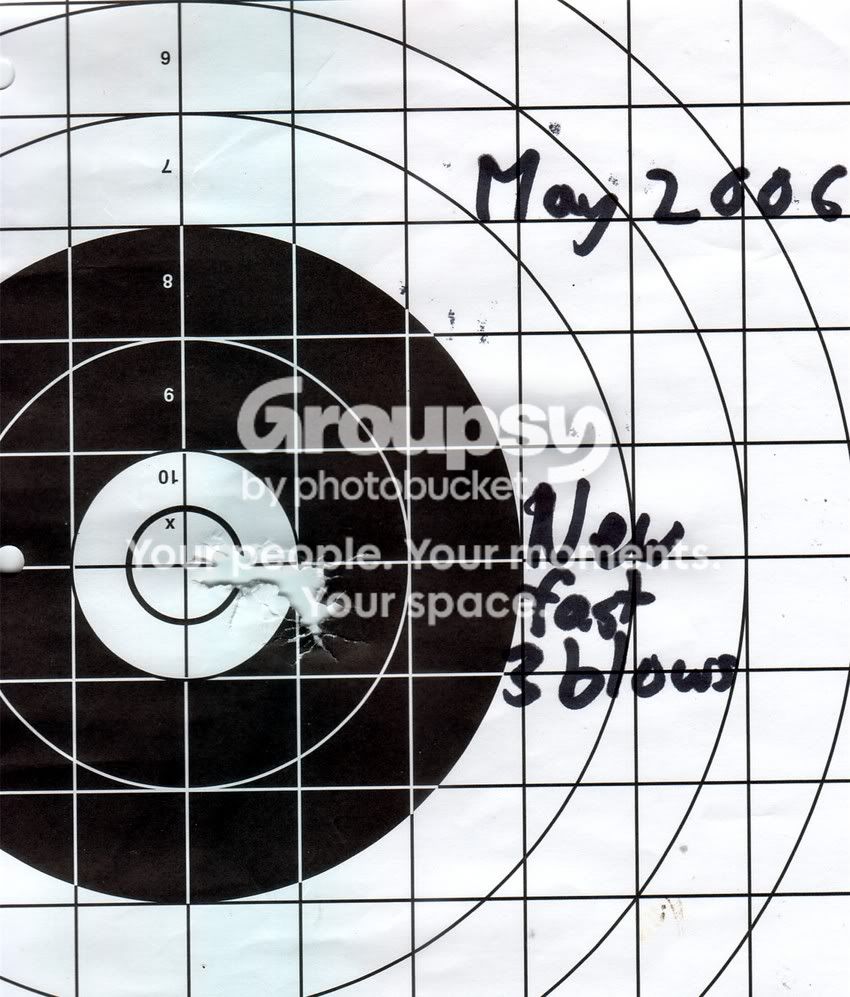
And you can get some good groups too.
45-90May06c.jpg
 
Back
Top Bottom