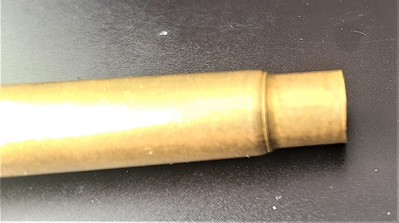
No4 Enfield Severe Overpressure

I can't recall seeing or hearing of a catastrophic receiver destruction of a Lee Enfield. It might be damaged and rendered unsafe to use, but they seem to remain "intact".

The same rear locking bolt that "flexs" upon firing and then allows for a temporary increase in headspace and cartridge stretching, also seems to flex back even more upon overcharge and vent pressure around the bolthead and thus focus damage on that area.

Is the bolt still straight?

You will probably never know for certain what happened.
 
Gives cause for reconsideration with regards to firing my old milsurps without a real close inspection. I have been shooting some of my rifles for many years, although the round count likely isn't that high for any one in particular.

Thanks for posting the pictures and the details.
 
No problem for the photos. The bolt itself seems straight when placed on a granite block. It's currently gone into the shop for inspection, I'll see what happens. Gunsmith has never in his 50 years seen a blow up on an enfield like that. usually burst barrels. I'm feeling the same, some proper inspection is in order for sure especially on some of the way older stuff like the sniders and martini's
 
I've seen them with a lot more damage than the one in your pics and still function safely.

I sincerely doubt that small crack around the extractor is going anywhere or that the receiver has been weakened.

As for the bolt, it's likely just as cheap to replace the whole bolt as to source and mail parts.

Those bolts are tough and the surfaces of the lugs are hardened, as are the lug recesses.

It's hard to make out from your pics, but that "shiny" portion on the lug face looks like not much more than the finish being worn off and getting a bit of a polish from the overpressure.

Personally, if that were my rifle, I would just replace the missing parts and check the headspace, after reassembling. If there isn't any measureable stretch, I would continue shooting it.

This is of course my personal opinion and if you're the least bit uncomfortable with it, strip down the rifle for parts and sell them off.

You should be able to recoup a very decent portion of the cost of a replacement rifle.

Or, you could use the parts to "restore" a sporter to military issue configuration.
 
Bloke on the range use to have video of a Lee enfield chambered in 308 Norma that they do some destruction testing on. They do this by lubing the round before inserting it to increase bolt thrust. The a smaller bolt lug is what failed, it remained in the action but sheared. The fact that your bolt lug is still attached leads me to believe something failed up front first. Could be case head failure venting pressure out the side where the extractor groove is, could be a partial barrel obstruction causing a spike in pressure blowing out the case head on the weaker extractor side. Could be a combination of the two. Also since a 303 head spaces on the rim head space can be good and support the rim but I am not aware of a set of head space gauge that check the diameter of the chamber just above the rim (you would have to do a cast) where the the case head being mostly solid doesn’t expand well. Not saying it is the issue but most milsurps have generous chambers.
 
Update from the gunsmith. The barrel is hooped, there is a bulge in the chamber at the base of the case neck. However, the reciever checked out fine with no stretch or damage, and the bolt has minimal damage on the lugs that can be easily repaired propely. Looks like i'm gonna try to find a nice NO4 barrel to replace on the gun, give it a second life at the very least. Thankfully not all bad news
 
Update from the gunsmith. The barrel is hooped, there is a bulge in the chamber at the base of the case neck. However, the reciever checked out fine with no stretch or damage, and the bolt has minimal damage on the lugs that can be easily repaired propely. Looks like i'm gonna try to find a nice NO4 barrel to replace on the gun, give it a second life at the very least. Thankfully not all bad news

Wierd - the brass is not deformed there.
 
I though so too, but under further inspection ther is a thin ring clearly in the brass right at the case shoulder where it meets the neck.
51831494450_8b06f3d00d_w.jpg
 
No, nothing measurable on the outside, only visible on this case, the chamber cast, and via camera in the bore. first time the gunsmith has seen one in that place
 
I though so too, but under further inspection ther is a thin ring clearly in the brass right at the case shoulder where it meets the neck.
51831494450_8b06f3d00d_w.jpg

Lots of irregular stretch on that neck. How do the others shot that day look up close?

I'm not a gunsmith and haven't seen the gun, but I'd be reluctant to rush to a rebarrel given how small that ring is and that it's not noticeable on the outside of the barrel.
 
receiver would be a good candidate for conversion to 45ACP

too bad, that is a pretty looking stock

you may be able to sell off the stock set to offset the purchase of a 45ACP conversion, then a bit of wood work from salvaged sporter stocks and you would have a shooter.
 
Odd mark on the case. Is the bulge evident on the exterior of the barrel?

That ring is from the bolt springing back IMHO.

OP, glad it isn't a total loss.

I'm surprised the chamber bulged, usually happens appx six inches or more down the bore, where there's less metal.

What's the possibility you didn't get a full charge of powder in the case??? Do you use a thrower for your powder charges or weigh each charge seperately?

Chamber expansions usually indicate an extreme pressure spike at moment of ignition, which could be because instead of a controlled burn, you got a detonation.

Seeing that swollen chamber wouldn't be possible until the wood was removed. Good on you for taking it to someone with more experience.
 
I do normally use the thrower to put charges, but only after checking and weighing the first 5-10 charges to confirm the throw is correct. Your suspicion of a partial charge is also what i'm starting to lean towards. due to some discussions elsewhere i started to do a CAD model and simulation of how the bolt would interact with the locking seats. It is interesting that the enfield bolt lugs always will bear un evenly under high pressure as the stress exerted on the shorter lug is significantly higher. I can post some screenshots if anyone else is interested in the nerdy details!
 
I do normally use the thrower to put charges, but only after checking and weighing the first 5-10 charges to confirm the throw is correct. Your suspicion of a partial charge is also what i'm starting to lean towards. due to some discussions elsewhere i started to do a CAD model and simulation of how the bolt would interact with the locking seats. It is interesting that the enfield bolt lugs always will bear un evenly under high pressure as the stress exerted on the shorter lug is significantly higher. I can post some screenshots if anyone else is interested in the nerdy details!

The Theory of Detonation has thus far restricted the phenonenom to "slow rifle powders", 4350 being the common dividing line. Reduced charges of pistol powders have never been included and your D5744 (AA5744 equivalent) is a pistol powder (albeit on the slow end - call it avery fast rifle powder if you wish) and very commonly used with cast bullets. There are many published loads for 5744 that show a range of 60% between Start and Max (e.g. 26.0 and 44.0), the lower and upper limits being determined by pressure constraints - the low end for reliable ignition and the high end on what cast bullets can stand. No pun intended, but suggest that low charges of pistol powders can cause detonation, and you'll send "shock waves" through the casting community.

Bits of info have been eaked out of this thread and as I said, you'll likely never know what happened, but I'd dismiss the theory of detonation, particularly since your chronograph showed the MV as the same as the previous shots, which further suggests that all loads were very close to the same.

I'd still like to see some pics of the neck area of some of the other cartridges fired that day, and to see measurements of the damaged one and others to see if they had thinned in the area that failed.

I don't HAVE to be correct (good thing as I'm often wrong), but I'd like to see if a bit more can be gleaned from this experience that you have so generously and patiently shared.
 
Thanks for that Andy.

I agree with the "pistol powder," mostly, but explain why pistols will Kaboom with squib loads.

I watched a very nice S&W 38 special set up for double action target shooting, lose its top strap and the decision on the reason was a powder charge about half of prescribed minimum.

I agree, we will likely never know what happened here.

Good on you for catching that the velocity was in line with the other shots. That would put a lot of backing to your statement.
 
Thanks for that Andy.

I agree with the "pistol powder," mostly, but explain why pistols will Kaboom with squib loads.

I watched a very nice S&W 38 special set up for double action target shooting, lose its top strap and the decision on the reason was a powder charge about half of prescribed minimum.

I agree, we will likely never know what happened here.

Good on you for catching that the velocity was in line with the other shots. That would put a lot of backing to your statement.

I believe the OP mentioned that only the first 10 rounds were chronographed,and not the last ones where the problem happened....catnip
 
I believe the OP mentioned that only the first 10 rounds were chronographed,and not the last ones where the problem happened....catnip

His OP doesn't say he chronied all of his shots. Maybe he can clear that up????

I usually check velocities on 3-5 rounds and label the rest of the box with the average of them.
 
Back
Top Bottom