













































A few weeks ago, while I was taking my black badge course, my cheapo Norinco 1911 that I was using began malfunctioning. When the grip safety was applied, the safety would flip on. Thre trigger pull was also so heavy (12 lbs), and with so much creep and overtravel, that I was having problems with accuracy.
Here is a good example of what the finish looked like. (Not my gun) You can see that the finish is wearing in places and looks kind of crappy to begin with.

This was pretty unnerving for me, as a first time IPSC guy, so I decided to shelf the gun for the day and borrow sombodys spare 1911. I finished the course with no problem, but when I went home, I decided to do a complete refinishing of the gun and the internals. I figure there is no better way to learn how to learn about your gun then to jump into it and learn about how all the components work and fit together.
Let me state that before I did this, I was by no means a professional gunsmith, but I sure did learn alot through this whole process.
I detail stipped the gun, and save the springs, placed all the components in a bath of white vinegar to strip the finish off. Within 5 minutes, the finish turned a bright orange, and I was able to wipe the finish off with paper towel. Next I put the parts in a water bath to wash off the excess vinegar, and was left with a rough steel finish.
I spent a few hours wet-sanding the parts down with 400 grit sandpaper, and I was left with a nice, clean looking 1911.

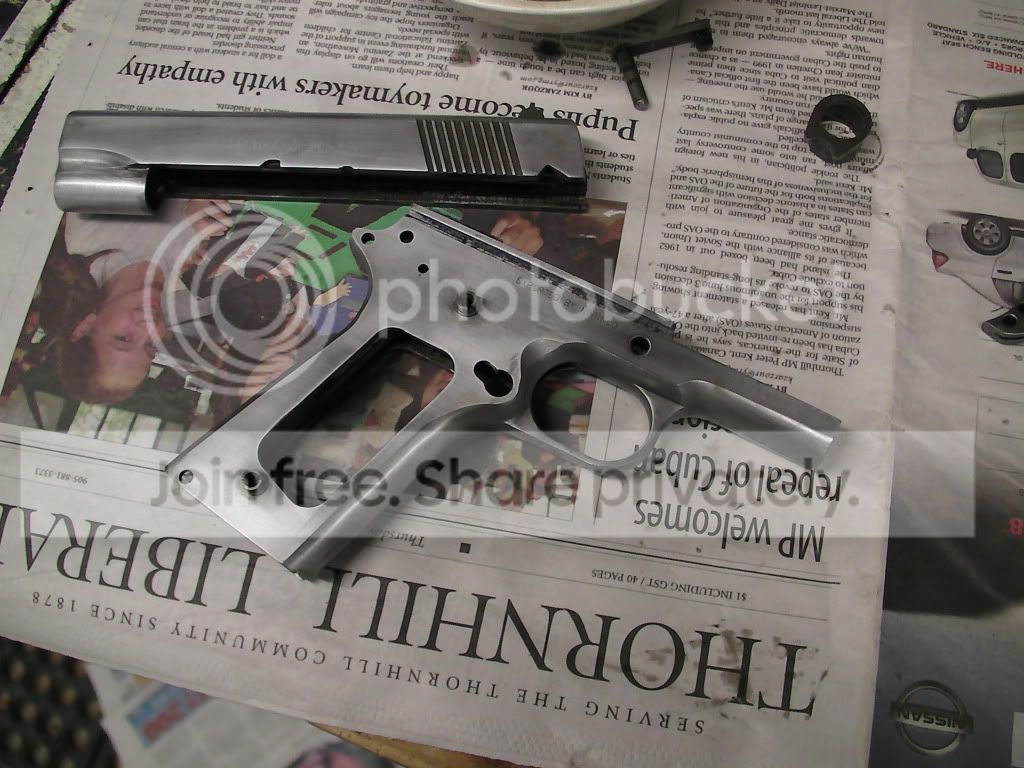

After finishing this, I set about polishing all the moving components of the gun in the same manner to get everything as smooth as possible. I snipped two coils off the hammer spring to allow for a slightly lighter cocking effort while not needing to worry about light primer stikes.
Finally, I set about doing a trigger job. I roughened the rear of the trigger arm with 100 grit sandpaper, and put on a spot of industrial strength metal epoxy about an Eighth of an inch thick. I allowed it to dry for two days, and using 600 grit sandpaper, I slowly shaped it to take just about all of the creep and overtravel out of the trigger pull, while still allowing the sear to catch after every cycle of the slide.
Once this was done, I played around with the leaf springs to attain a 3.5 lb trigger pull, using a trigger pull scale to measure it. (Previous pull was 12 lb)
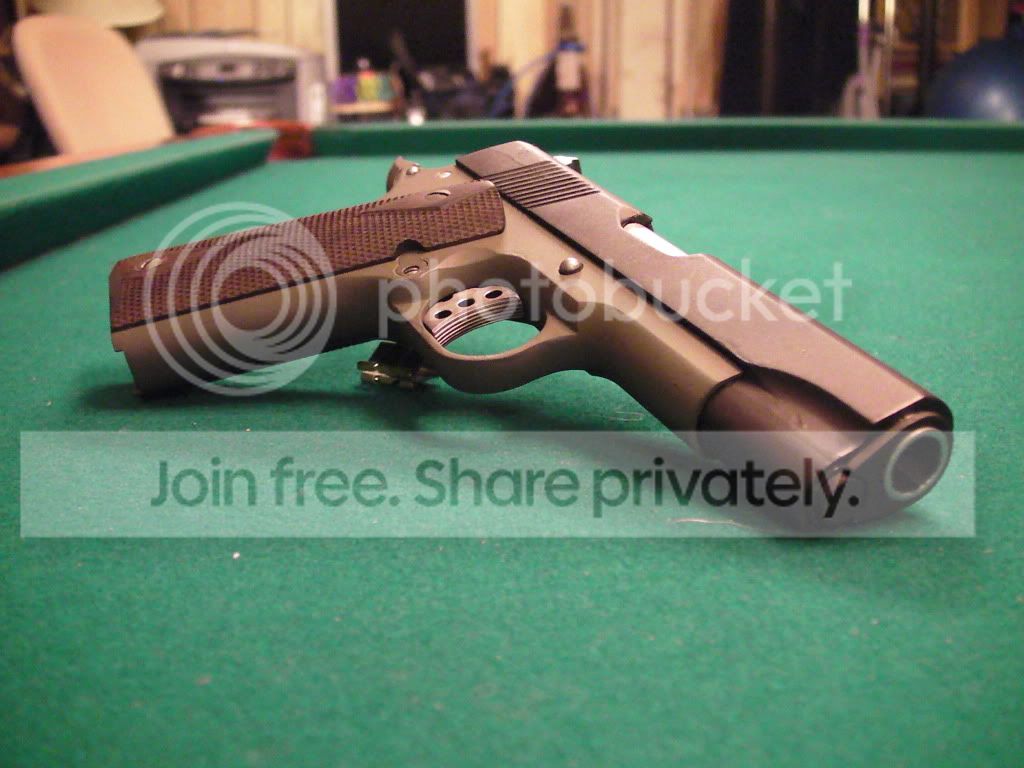
Finally, I decided to paint the gun. I applied a grey primer on all of the visible surfaces (including what shows when the slide is back). I left the barrel, rear sight, and trigger stainless in the hopes of providing an interesting set of colours.
I got an OD green spraypaint for the frame, grip safety, trigger housing, safety, hammer, mag release, and slide release. I used a matte black for the slide, extractor, firing pin cover, bushing, and the button cover for the slide spring. I know that with it being spraypaint, it will probably wear off pretty fast, but as it was my first time, I wanted to learn the basics of what to do and what not to do before using somthing like guncoat or duracoat.
I took it to the range last weekend, and started with mags loaded with two rounds. (In case I did a bad trigger job) Everything went perfectly, and there were no problems. Once I gained confidence in the trigger job, I began using to full mags, and still no problems. The trigger was holding up perfectly, and I noticed a big increase in my accuracy, holding a 4-6 inch group at 15 meters.
Needless to say I was and am still very pleased that this was a successful project.
Here is the finished product of all my hard work.


Let me know what you think I can do to improve it or my methods.
Here is a good example of what the finish looked like. (Not my gun) You can see that the finish is wearing in places and looks kind of crappy to begin with.
This was pretty unnerving for me, as a first time IPSC guy, so I decided to shelf the gun for the day and borrow sombodys spare 1911. I finished the course with no problem, but when I went home, I decided to do a complete refinishing of the gun and the internals. I figure there is no better way to learn how to learn about your gun then to jump into it and learn about how all the components work and fit together.
Let me state that before I did this, I was by no means a professional gunsmith, but I sure did learn alot through this whole process.
I detail stipped the gun, and save the springs, placed all the components in a bath of white vinegar to strip the finish off. Within 5 minutes, the finish turned a bright orange, and I was able to wipe the finish off with paper towel. Next I put the parts in a water bath to wash off the excess vinegar, and was left with a rough steel finish.
I spent a few hours wet-sanding the parts down with 400 grit sandpaper, and I was left with a nice, clean looking 1911.
After finishing this, I set about polishing all the moving components of the gun in the same manner to get everything as smooth as possible. I snipped two coils off the hammer spring to allow for a slightly lighter cocking effort while not needing to worry about light primer stikes.
Finally, I set about doing a trigger job. I roughened the rear of the trigger arm with 100 grit sandpaper, and put on a spot of industrial strength metal epoxy about an Eighth of an inch thick. I allowed it to dry for two days, and using 600 grit sandpaper, I slowly shaped it to take just about all of the creep and overtravel out of the trigger pull, while still allowing the sear to catch after every cycle of the slide.
Once this was done, I played around with the leaf springs to attain a 3.5 lb trigger pull, using a trigger pull scale to measure it. (Previous pull was 12 lb)
Finally, I decided to paint the gun. I applied a grey primer on all of the visible surfaces (including what shows when the slide is back). I left the barrel, rear sight, and trigger stainless in the hopes of providing an interesting set of colours.
I got an OD green spraypaint for the frame, grip safety, trigger housing, safety, hammer, mag release, and slide release. I used a matte black for the slide, extractor, firing pin cover, bushing, and the button cover for the slide spring. I know that with it being spraypaint, it will probably wear off pretty fast, but as it was my first time, I wanted to learn the basics of what to do and what not to do before using somthing like guncoat or duracoat.
I took it to the range last weekend, and started with mags loaded with two rounds. (In case I did a bad trigger job) Everything went perfectly, and there were no problems. Once I gained confidence in the trigger job, I began using to full mags, and still no problems. The trigger was holding up perfectly, and I noticed a big increase in my accuracy, holding a 4-6 inch group at 15 meters.
Needless to say I was and am still very pleased that this was a successful project.
Here is the finished product of all my hard work.
Let me know what you think I can do to improve it or my methods.
























