Nosler updates ABLR BC's

Hand Skills

CGN Regular
Rating - 100%
139   0   0
https://www.nosler.com/accubond-long-range-bullet/

"New for 2018, we have had the Ballistic Coefficients (BC’s) of our AccuBond-Long Range (ABLR) bullets tested and verified with Doppler radar. This has resulted in a revision of our published BC numbers to more accurately match real-world flight characteristics. Using Doppler radar to verify our BC’s allows us to provide the most accurate BC numbers to our customers while increasing the accuracy of long range ballistics calculations. To perform this critical testing, we selected the Energetic Materials Research and Testing Center (EMRTC) at the New Mexico Institute of Mining and Technology. EMRTC is the largest privately owned ordnance and ballistic test facility outside the government, encompassing 40 square miles and over 30 test ranges. EMRTC is internationally recognized as a center for excellence in energetics and ballistics research and testing. We are pleased to provide these highly accurate BC numbers and feel confident that they will bring a new degree of precision to your long-range ballistics calculations. For the utmost accuracy, we recommend using the G7 BC when calculating trajectories with the ABLR bullet line."

Good job, Nosler
 
Last edited:
165gr AB: b.c. = 0.475 (G1 value).

168gr AB LR: b.c = 0.265, G7 value recommended by Nosler for calculating trajectories/downrange speeds.


38983951275_3e65417818.jpg
38983955635_c415940f0f_z.jpg
 
Last edited:

G1 and G7 Ballistic Coefficients use very different "standard projectiles". Berger bullets site has quite good explanation. G1 standard looks like a cannon shell - short ogive, straight sides, flat base. G7 looks very much like modern boat tail. Different numbers result from comparing the sample bullet's predicted performance against different standards
 
Interesting. Whether to use the G1 or G7 value depends on what program is used according to the Berger website -

"G7 is an updated equation and the better system of measuring a ballistic coefficient. It provides more accurate and reliable results when calculating trajectory using a ballistics program that allows for a G7 to be used."

http://www.bergerbullets.com/information/faq-frequently-asked-questions/
 
A few facts;

Ballistic coefficient is an index describing a bullet's ability to overcome air resistance in flight. This value is not a constant, it varies with velocity, rate of twist and environmentals (air pressure and density). It is not uncommon for shooters to 'tweak' the BC in their firing solution to more accurately predict their flight path. This is because even with known environmentals, differences in muzzle velocity and twist rate make each shooter's case somewhat unique.

The G1 standard came out of the 1880's, and was based on the standard artillery projectile shape at that time.

There are many other standards, based on different projectile geometries, but G7 most closely resembles the 'tangent ogive/boat tail' geometry of our modern 'low drag' target, and more recently hunting bullets.

Obviously if your firing solution only supports G1, there is no choice. If your firing solution supports more than one standard, pick the standard which most closely resembles the geometry of the projectile you are using. This may be G1 or G7 depending on the shape of the bullet you are shooting.

Nosler contracted 'state of the art' Doppler Radar measurements on these projectiles, but keep in mind not only is this an averaged value, but just like load data - every rifle is a little different. My point is, if one is looking for first round hits to 'any' distance, it's going to take some work testing and tweaking the published BC to find the 'average' BC for your load in your gun.

Another consideration is stabilization. These high BC bullets require faster than normal twist rates to properly stabilize in many cases. Berger (with the help of Bryan Litz / Applied Ballistics) has been very open with their data;

http://www.bergerbullets.com/twist-rate-calculator/

Many bullet manufacturers are providing suggested or minimum required twist rates with their projectiles. This holds especially true for monolithic copper bullets which have a lower density, and thus need to be spun faster to reach a given gyroscopic inertia (stability). This is something to be aware of, especially for hunters who count on their bullet penetrating to do its job.

Ballistic science has become exceedingly advanced, but it offers no shortcuts - it's still up to the shooter to verify the trajectory of their load in their rifle, at their altitude.
 
I ran tbe numbers with the old and new BCs of the 265 gr ABLR. It's worth 1/10 MOA at 500 and 1/2 MOA at 1000.

I'm really upset about the 500 yard thing because I wouldn't have a click small enough fix it. ;)

I wish my 1000 yard drops would stay within 1/2 MOA throughout the day never mind work out that close to theory.
 
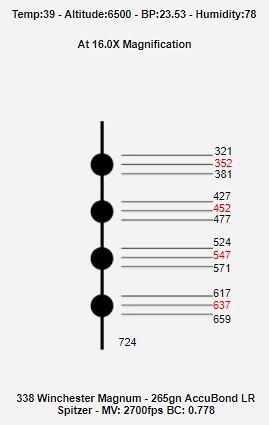
I am intrigued by the 338 caliber 265gr AB LR bullets. :p I shall endeavor to secure a supply of these for my 338 WM.

39033303855_bcb9829142_z.jpg


A review of the downrange ballistics at 2700 fps MV for the old wrong and revised corrected G1 ballistic coefficients using the handloads.com ballistic calculator which uses the G1 equation.

2700 fps MV should be easily achievable from my 24" 1:10 twist barrel Ruger Hawkeye with powders I have on hand.

39221257234_c580cc5bb1_z.jpg


old wrong G1 b.c.
39033295035_7058e5ac77_b.jpg


revised corrected G1 b.c.
26059000848_f9e7f87c35_b.jpg


For a 250 yard zero, the corrected 500 yard drop is 34.91" vs. 35.46" for the old wrong G1 b.c., and corrected speed is 2222 fps vs. 2249 fps. BFD. :p

For comparison, here are the downrange ballistics using the Berger more accurate G7 ballistic calculator with the G7 b.c. of 0.369 -

39033299165_2ab2cd744a_z.jpg
39033301695_60fa4fcc54_z.jpg


So at 1000 yards the difference between using G1 instead of G7 will result in hitting the target (247.59 - 245.11) = 2.48 inches higher than expected. ;)
 
I was going 1/2 minute on the difference between the old and new, and your 2 inches on the difference between G1 and G7. Probably shouldn't have lumped them altogether into the same sentence though.;)


The 190s in my 300 Wins fly so much flatter than even the old numbers would predict that it would take an insane amount of BC increase to make a program work. Easier to make up a velocity number.
 
Interesting to see if the 338 caliber 265gr AB LR's will shoot as predicted out to extended ranges. My Nikon Monarch 3 Mildot 4-16x42mm would be the appropriate scope to use. :cool:

39227609824_d0bcd487e7_b.jpg
39905971322_36f40b480d.jpg
 
Last edited:

Back
Top Bottom