Not Decapping

Shooterjimi

New member
Rating - 0%
0   0   0
Location
Annapolis Valley
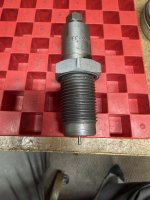
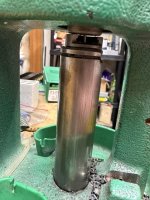
Hi all, I have a lee pacesetter die in 30-06, the re-sizing/decapper die is not decapping. I used case lube, adjusted as per instructions and watched a few youtube videos. I am using the Lyman all American 8, but I cannot get the primers to come out at all. One was nearly stuck in the die but after some fiddling was able to get it off the die. Tumbled for 2.5 hours and then lubed and attempted the sizing/decap. Not specifics in the instructions on what to do if the primers don't come out.

Any help is appreciated.

 
Pics would help…. It sounds like your decapping pin is set too high..

Your decapping pin should protrude around 1/4” to 3/8” (10mm)

Like this

1775961726587.jpeg


Your die should sit just off the shell holder to touching the shell holder depending if you are full on full length sizing(hardly ever do) or like in the photo below for minimal shoulder bump, but that is determined by checking shoulder bump, and will vary between rifles.

1775961980957.jpeg
 
Last edited:
Yeah, sounds like the decapping pin is set too high, or the locknut is too loose. Reset the decapping pin with about 1/8” clearance from the expander ball to the base of the die and lock it down hard. I found that the decapping rod doesn’t have threads on it, it’s more like ridges, takes a bit more on the nut to hold things in place
 
The decapping pin on lee dies is held in with a collet and they need to be cranked super tight or the pin will slide up into the die.
Loosen the nut on the top and push the pin down until it protrudes out the bottom as in the D1ck pics (sorry couldn't hep myself) above, then crank that nut on the top of the die tight.

Sam
This^.

The decapping pin is held in the die by friction from the collet. If the decapping nut is not tight enough, the pin will push up into the die instead of pushing the primer out. If tightening the nut more doesn't work you might need to disassemble and degrease the pin and collet. Oil on the pin can make it too slippery for the collet to grip.
 
Last edited:
For rifle cartridges I have found that de-capping in a separate operation is easier than the combined operation. Especially for range brass that may have crimped primer pockets, the lee de capping pin may bend or break. A hardened steel nail works well and is much cheaper than a lee pin.
 
For rifle cartridges I have found that de-capping in a separate operation is easier than the combined operation. Especially for range brass that may have crimped primer pockets, the lee de capping pin may bend or break. A hardened steel nail works well and is much cheaper than a lee pin.
The Lee Universal decapping die is good for that. You can deprime brass before cleaning it and not be messing up your resizing dies.


Last edited:
Work flow approaches being offered here... I am still using the ol' walnut/corn cob media for cleaning purposes, followed by a bath in citric acid to clean up any remaining tarnish and passivate the surface of the casings. You can store brass for a long time without any tarnishing setting in after that last step.

I also do all my decapping with Lee's universal decapping die. The difference is I do the decapping after the brass comes out of the tumbler, not before. The tumbling media doesn't get into the primer pockets sufficiently well enough to clean the pockets, but it usually manages to get one kernel jammed into the flash hole. You can pick those out with one of the dental explorers that you hit your dentist up for on your regular visits or do another pass through the decapping die.

But I prefer not to have to deal with that, especially with long rifle cases like 220 Swift. If I transitioned to metallic pin tumbling media, perhaps I would find it better to do things differently.

From my perspective the workflow is: tumble, deprime, citrus bath, then clean up any remaining residue in the primer pocketd if you think it will make a difference with the caliber you are reloading.
 
Work flow approaches being offered here... I am still using the ol' walnut/corn cob media for cleaning purposes, followed by a bath in citric acid to clean up any remaining tarnish and passivate the surface of the casings. You can store brass for a long time without any tarnishing setting in after that last step.

I also do all my decapping with Lee's universal decapping die. The difference is I do the decapping after the brass comes out of the tumbler, not before. The tumbling media doesn't get into the primer pockets sufficiently well enough to clean the pockets, but it usually manages to get one kernel jammed into the flash hole. You can pick those out with one of the dental explorers that you hit your dentist up for on your regular visits or do another pass through the decapping die.

But I prefer not to have to deal with that, especially with long rifle cases like 220 Swift. If I transitioned to metallic pin tumbling media, perhaps I would find it better to do things differently.

From my perspective the workflow is: tumble, deprime, citrus bath, then clean up any remaining residue in the primer pocketd if you think it will make a difference with the caliber you are reloading.
Leave the decapping pin in the sizing die and it will clean the primer hole without needing to check each piece or use a dental pick.
Deprime-clean-resize-prime.
 
OP:

When you resize a casing that fails to de-prime, does the decapping rod move up in the collet?
If so, the decapping rod is loose and should be tightened. IIRC, a 3/4" open end wrench for the die body, and a 1/2" box end for the collet.
You need to make sure the die body doesn't move while you're adjusting the decapper collet, or your die setting will get messed up.
 
Back
Top Bottom