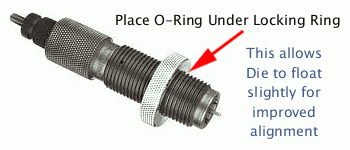
O-ring trick?

TrxR

CGN Ultra frequent flyer
Rating - 100%
22   0   0
Location
Sussex, NB
Who here uses a O-ring under the locking ring on their dies?

Also who here uses an O-ring to hold in their shell holder instead of the original retaining clip?

Do you notice any difference ? Whats your opinion?

I believe the O-ring sizes are #17 and #13.

Thanks
 
Most of my dies are Lee. The o-rings come standard on their lock nuts. They seem to have worked just fine for me over the last 35 years.

Auggie D.
 
I only use the hornady clamp style lock rings,
would an o-ring not create flex and inconsistent seating or crimping?

My understanding is the o ring helps let the die float and center with the ram. It shouldn't add any flex as the threads are what are keeping the die from moving up.
 
I had only used RCBS dies until I bought a set of Lee's for 45 ACP because of the factory crimp die. I did not like the O rings so I took them off and drilled and tapped the lock nuts for a set screw. The O rings are stored away in case I or someone else needs them. I suspect it is just what you are used to.
 
My opinion

if using a single Stage press .... the set screw is great ... you have 360 deg access

using a progressive you do not .... that is where the o ring lock nuts come in handy

the threads on the die is what centers the die ... the lock nut is only there to stop it rotating / moving
 
I change all of my rings to the Hornady lock rings. I'd prefer a solid seating of the die against the press. With a good lock ring that seated position is simple and repeatable. Variation in bullet seating depth and sizing is <0.001" between loading/sizing sessions. Usually there is no change at all.
 
Pretty sure I had read article that the "O-ring trick" was used, maybe invented, or possibly promoted (?) by U.S. Army Marksmanship Team. Was about improving or holding concentricity of re-sized case and neck; then concentricity of bullet seating into that case neck - so, about run-out, not repeatable Cartridge Over All Length. Usually have to measure for runout to know whether you have it or not - that U.S. Army Marksmanship Team seems to care about it, or, at least their guys that were loading the ammo did ...
 
My understanding is the o ring helps let the die float and center with the ram. It shouldn't add any flex as the threads are what are keeping the die from moving up.

This was my understanding too.

As mentioned above, Lee uses O-rings on their dies. Others dont. I've used both Lee with the factory lock ring/o-ring setup, and also RCBS dies with Hornady lock rings (and I've used RCBS dies with the factory rings, which I don't like nearly as much). I cannot tell any real difference between any of them, but I reload for hunting mainly not extreme accuracy so I'm not checking things like runout.
 
It is possible when tightening down the lock ring that the die will be off center. The No.9 Speer manual has a section on making more concentric ammo. This is done by sizing a case and then tightening the lock ring. This ensures the die will be centered in the press threads and ensuring better concentricity. The rubber o-ring does the same thing by allowing the die to float and self center during the sizing operation.


O-Rings on Dies May Reduce Run-Out
https://www.accurateshooter.com/technical-articles/reloading/o-rings-on-dies-may-reduce-run-out/

oring2x350op.png


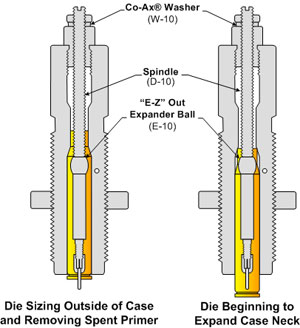
Forster full length dies with their high mounted expander have thick rubber washer (W10) that allows the expander to self-center and reduce neck runout.
The case neck is held and centered in the neck of the die when the floating expander enters the case neck.

Y7Iyv8o.jpg
 
Last edited:
I want to control other things over possible concentricity differences. When you tighten the o-ring dies down, they have up and down movement, I'm not a fan. If the die manufactures would make the threads much finer it would help some.
 
I had wondered if Lee used any other way to hold the lock nuts on their dies in place besides the O-ring. I've never owned a Lee die, obviously.
So, you have to adjust the die height every time you remove and install it?
Maybe I'm missing something, but that seems like a pain.
I use RCBS dies, their use of a set screw into the die threads isn't much better.
I've switched out the soft brass set screw for a steel one in all my dies, with a piece of #2 lead shot between the flat tip of the set screw and the die threads.
It's worked well for me.
The Hornady lock rings work well too once you have them set.
 
The only thing the lock ring is really there for is to keep the die from turning. The threads control the up and down movement. The oring from my understanding will not induce any up and down movement but will all the die to center in the threads. The o ring should actualy help keep upward tension on the threads to make things more consistent.
 
I had wondered if Lee used any other way to hold the lock nuts on their dies in place besides the O-ring. I've never owned a Lee die, obviously.
So, you have to adjust the die height every time you remove and install it?
Maybe I'm missing something, but that seems like a pain.
I use RCBS dies, their use of a set screw into the die threads isn't much better.
I've switched out the soft brass set screw for a steel one in all my dies, with a piece of #2 lead shot between the flat tip of the set screw and the die threads.
It's worked well for me.
The Hornady lock rings work well too once you have them set.

You don't HAVE to adjust the die every time with a Lee die if you're careful. I've heard of people marking the die/ring with a marker so they can visually tell if the lock ring has moved from where its supposed to be.
 
I've heard of people marking the die/ring with a marker so they can visually tell if the lock ring has moved from where its supposed to be.

I do that when I adjust new dies. The alignment marks give me a reference as to how much I've moved the lock ring.
Often the width of a line is all that's needed to move the shoulder a couple thou of an inch.
 
The amount of interference fit or slopieness in the die thread is controlled by the minor diameter of the press threads. Tap drills almost never will allow a full height thread to be cut. I am not saying press threads are tapped as they are probably machined at less than a full thread. The die should self centre into press and the lock nut maintains that position. Putting a o ring in there is the same as a lock washer and the final position will be determined by how much torque you apply. Without an o ring the position will be the same each time.
The way I see it.
 
Back
Top Bottom