Oberndorf guns – the C96 Mauser in 7.63x25 and the H&K USP in 40 S&W
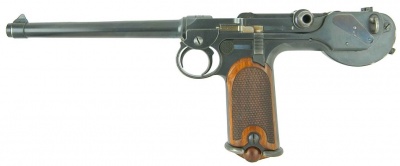
They have been designing an producing innovative, well-made guns in Oberndorf, Germany for over 200 years (since Friedrich I of Württemberg installed the first armaments factory, in a disused Augustine monastery, in 1811). That would actually be Oberndorf on the Neckar (river) - to distinguish this city from the two or three other Oberndorfs, in Germany. The first gun everyone thinks about, made here is the venerable C96 Broomhandle Mauser - which prominently had/ has “Obdendoff ab (‘on the’) Neckar” stamped on pretty well every one of the nearly 1 million C96’s, Bolos, 1920s (reworks) as well as the Model 1930 and M1932 M712, etc. produced – from 1896 to 1932.
Let’s compare this gun to a worthy, partial successor - the H&K USP – specifically our sample unit, recently made in 40 S&SW. CLICK ON THE PICTURE BELOW TO ENLARGE
 ,
,
To be clear, H&K (Heckler & Koch GmbH) isn’t a direct corporate descendant of Waffefabrik Mauser. Instead, in the hiatus after WW2, a three of the engineer/ employees of the former, massive Waffefabrik Mauser operation, in Oberndorf a.N. got together to form H&K Those guys were Edmund Heckler, Theodor Koch, and Alex Seidel. They saved what they could from the Mauser factory - which was been confiscated and shipped in pieces around the World by the allies after WW2. What these three salvaged was used to start a machine tool plant in the vacant factory.
The same “think-outside-the-box” thinking which found its way into the C96 (the World’s first commercially successful semi auto pistol), found its way into H&K’s DNA - and they came-up with the G3/ G11 the MP5 and variants and some wildly different semi auto pistol designs - like the P9, the VP70 (the Wold’s first polymer framed pistol) the P7 and P13, etc., etc. The H&K USP in our comparison comes way closer to a conventionally designed pistol than those recent predecessors.
There is more than a 100 years that separate the H&K USP we are testing and the pre WW1 C96 pistol reviewed here but, IMO, both are epic guns.
The C96 was designed in by the Feederle brothers (Fidel, Friedrich, and Josef), in a fairly brief period in 1895; supposedly with little knowledge or consent from their employer, Paul Mauser. The C96 has been featured in Westerns (Joey Kidd), went into battle in the Boer war, was issued as an official alternate pistol by the Germans in WW1, and also was taking into battle by many British officers, in WW1 - who procured theirs privately. My Grandfather briefly carried a captured one in battle in “the Great war” - until he met a similar fate to its German, previous owner.
Winston Churchill was fond of the Mauser C96 - and used one at the 1898 Battle of Omdurman and during the Second Boer War. Lawrence of Arabia also carried a Mauser C96 for a period during his time in the Middle East. Churchill further supposedly carried a concealed(!) C96 for personal protection, during WW2. The C96 is often compared to the P08 Luger, but it actually has more in common with the artillery Luger; given its long sighting radius, its range graduated rear sight and its frequent use with a nice detachable holster/ stock which, when attached to the grip of the gun, turns the unit into a pretty respectable little short-to-medium range carbine.
The Luger packs 8 rounds in a hard-to-load, detachable box magazine and the C96 is fed from the top - by stripper clips. In the case of a C96, the gun racks closed smartly after you strip 10 rounds into the fixed box magazine – then locks open again when empty - to be quickly replenished by another stripper clip. You could carry many loaded C96 stripper clips into battle. Only the gun’s lousy ergonomics held it back from being and epic combat pistol.
Here’s the thing there. It is obvious that extreme engineering efforts went into designing and perfecting the gun’s lock works – but, by contrast, the grip design of this gun seems to have been a random afterthought.
Sorry but the grip is just plain goofy. I have always imagined that the Feederle brothers were engineering perfectionists – who must have winced when Paul Mauser assigned the task of designing the gun’s “Broomhandle” grip to his re-tard nephew. While we are on the subject, the design of the holster shoulder stock is also mostly brilliant - but the same re-tard nephew also presumable designed how it connects to the grip – with the result that there is no place for your thumb to go where it won’t be clobbered by the huge hammer.
You can make your own ergonomic grips for the gun, like those of an aftermarket AR-15 grip etc. and suddenly this gun is just right in your hand! You can also undercut the wood and metal on an readily-obtained and cheap aftermarket repro holster stock, to provide a recess for your thumb and bingo!, you have just perfected the ergonomics of the C96. You now have a super little carbine (with the stock attached) which - in the case of our test C96 test gun, allows you to hit a 6 inch plate off-hand at 50 yards, over and over again. TO ENLARGE CLICK ON THE PICTURE BELOW!
 ,
,
That kind of accuracy is not common in 100+ year old Broomhandles, but this gun has that capability because it has been professionally relined. It also delivers offhand groups, at 25 years, on a par with the 40 S&W USP. However, even with its refreshed barrel, the C96 is harder to shoot well because of its military trigger. The H&K’s trigger is great.
The H&K fits your hand perfectly right out-of-the box. The controls are right where they should be and the ambidextrous mag release - which works with a slight down stroke, not the pushing in of the mag release button - is brilliant. Mags down free cleanly, out-of-the-box. If you are an ISPC or action shooter, you will appreciate that you can start with the holstered USP in either a SA-type locked-and-cocked position or a hammer down, DA configuration.
The H&K sights are ISPC perfect, while the C96 ones give you too small a blade and notch for fast shooting; but, of course, the C96 tangent sights make up for this by being really precise on well-aimed shots and with the shoulder stock attached.
The 7.63x25 cartridge spoils you if you like long range shooting. It rips out an 86 bullet at about 1,410 FPS with the original factory loading and its bullet drop is just about half that of 9mm or 40 S&W. The World would have to wait nearly half a century for anything to match the C96s in the velocity department – that is, until the .357 Magnum came out, in 1935. As a matter of fact, there was a rare C96, chambered in its own proprietary cartridge 9x25mm (not the latter Dillion version) A.K.A 9mm Mauser that came close to matching 357 magnum ballistics overall. This was called 9mm Mauser Export - since it was favoured by African hunters, in the early days of the 20th century.
These two Oberndorf guns rock.
They have been designing an producing innovative, well-made guns in Oberndorf, Germany for over 200 years (since Friedrich I of Württemberg installed the first armaments factory, in a disused Augustine monastery, in 1811). That would actually be Oberndorf on the Neckar (river) - to distinguish this city from the two or three other Oberndorfs, in Germany. The first gun everyone thinks about, made here is the venerable C96 Broomhandle Mauser - which prominently had/ has “Obdendoff ab (‘on the’) Neckar” stamped on pretty well every one of the nearly 1 million C96’s, Bolos, 1920s (reworks) as well as the Model 1930 and M1932 M712, etc. produced – from 1896 to 1932.
Let’s compare this gun to a worthy, partial successor - the H&K USP – specifically our sample unit, recently made in 40 S&SW. CLICK ON THE PICTURE BELOW TO ENLARGE
 ,
, To be clear, H&K (Heckler & Koch GmbH) isn’t a direct corporate descendant of Waffefabrik Mauser. Instead, in the hiatus after WW2, a three of the engineer/ employees of the former, massive Waffefabrik Mauser operation, in Oberndorf a.N. got together to form H&K Those guys were Edmund Heckler, Theodor Koch, and Alex Seidel. They saved what they could from the Mauser factory - which was been confiscated and shipped in pieces around the World by the allies after WW2. What these three salvaged was used to start a machine tool plant in the vacant factory.
The same “think-outside-the-box” thinking which found its way into the C96 (the World’s first commercially successful semi auto pistol), found its way into H&K’s DNA - and they came-up with the G3/ G11 the MP5 and variants and some wildly different semi auto pistol designs - like the P9, the VP70 (the Wold’s first polymer framed pistol) the P7 and P13, etc., etc. The H&K USP in our comparison comes way closer to a conventionally designed pistol than those recent predecessors.
There is more than a 100 years that separate the H&K USP we are testing and the pre WW1 C96 pistol reviewed here but, IMO, both are epic guns.
The C96 was designed in by the Feederle brothers (Fidel, Friedrich, and Josef), in a fairly brief period in 1895; supposedly with little knowledge or consent from their employer, Paul Mauser. The C96 has been featured in Westerns (Joey Kidd), went into battle in the Boer war, was issued as an official alternate pistol by the Germans in WW1, and also was taking into battle by many British officers, in WW1 - who procured theirs privately. My Grandfather briefly carried a captured one in battle in “the Great war” - until he met a similar fate to its German, previous owner.
Winston Churchill was fond of the Mauser C96 - and used one at the 1898 Battle of Omdurman and during the Second Boer War. Lawrence of Arabia also carried a Mauser C96 for a period during his time in the Middle East. Churchill further supposedly carried a concealed(!) C96 for personal protection, during WW2. The C96 is often compared to the P08 Luger, but it actually has more in common with the artillery Luger; given its long sighting radius, its range graduated rear sight and its frequent use with a nice detachable holster/ stock which, when attached to the grip of the gun, turns the unit into a pretty respectable little short-to-medium range carbine.
The Luger packs 8 rounds in a hard-to-load, detachable box magazine and the C96 is fed from the top - by stripper clips. In the case of a C96, the gun racks closed smartly after you strip 10 rounds into the fixed box magazine – then locks open again when empty - to be quickly replenished by another stripper clip. You could carry many loaded C96 stripper clips into battle. Only the gun’s lousy ergonomics held it back from being and epic combat pistol.
Here’s the thing there. It is obvious that extreme engineering efforts went into designing and perfecting the gun’s lock works – but, by contrast, the grip design of this gun seems to have been a random afterthought.
Sorry but the grip is just plain goofy. I have always imagined that the Feederle brothers were engineering perfectionists – who must have winced when Paul Mauser assigned the task of designing the gun’s “Broomhandle” grip to his re-tard nephew. While we are on the subject, the design of the holster shoulder stock is also mostly brilliant - but the same re-tard nephew also presumable designed how it connects to the grip – with the result that there is no place for your thumb to go where it won’t be clobbered by the huge hammer.
You can make your own ergonomic grips for the gun, like those of an aftermarket AR-15 grip etc. and suddenly this gun is just right in your hand! You can also undercut the wood and metal on an readily-obtained and cheap aftermarket repro holster stock, to provide a recess for your thumb and bingo!, you have just perfected the ergonomics of the C96. You now have a super little carbine (with the stock attached) which - in the case of our test C96 test gun, allows you to hit a 6 inch plate off-hand at 50 yards, over and over again. TO ENLARGE CLICK ON THE PICTURE BELOW!
 ,
, That kind of accuracy is not common in 100+ year old Broomhandles, but this gun has that capability because it has been professionally relined. It also delivers offhand groups, at 25 years, on a par with the 40 S&W USP. However, even with its refreshed barrel, the C96 is harder to shoot well because of its military trigger. The H&K’s trigger is great.
The H&K fits your hand perfectly right out-of-the box. The controls are right where they should be and the ambidextrous mag release - which works with a slight down stroke, not the pushing in of the mag release button - is brilliant. Mags down free cleanly, out-of-the-box. If you are an ISPC or action shooter, you will appreciate that you can start with the holstered USP in either a SA-type locked-and-cocked position or a hammer down, DA configuration.
The H&K sights are ISPC perfect, while the C96 ones give you too small a blade and notch for fast shooting; but, of course, the C96 tangent sights make up for this by being really precise on well-aimed shots and with the shoulder stock attached.
The 7.63x25 cartridge spoils you if you like long range shooting. It rips out an 86 bullet at about 1,410 FPS with the original factory loading and its bullet drop is just about half that of 9mm or 40 S&W. The World would have to wait nearly half a century for anything to match the C96s in the velocity department – that is, until the .357 Magnum came out, in 1935. As a matter of fact, there was a rare C96, chambered in its own proprietary cartridge 9x25mm (not the latter Dillion version) A.K.A 9mm Mauser that came close to matching 357 magnum ballistics overall. This was called 9mm Mauser Export - since it was favoured by African hunters, in the early days of the 20th century.
These two Oberndorf guns rock.