Odd NWMP tunic

Kirk1701

Regular
Rating - 100%
15   0   0
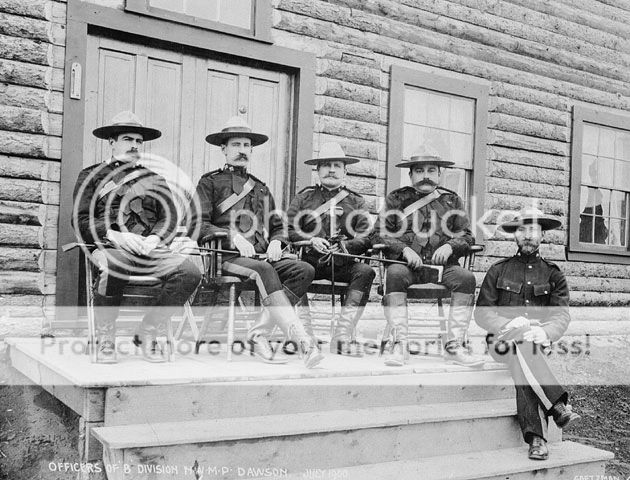
This may be the wrong forum, but seeing as how the NWMP/RNWMP/RCMP are paramilitary, I feel it applies. I'm sure you've all seen this photo of a squad of NWMP. What's odd to me is the tunic worn by the gents in the chairs. It looks almost Dragoon-like or even Hussar. What precisely is it? The slightly efite-looking fellow (who is likely the most dangerous of the bunch to run afoul of) seated at their feet is wearing what appears to be the traditional red serge in contrast.

 
Hmm, Well this is from the Yukon Gold rush uniform days. So first off that Stetson hat wasn't actually regulation uniform at that time although it was used by everyone. Generally considered something Sam Steele brought to the force.

The uniforms the guys in the back are wearing are Patterned after the British Army lancer pattern. I believe that was only worn by the Officers and it was dark blue.

...His uniform shows the changes that were introduced for officers about 1880. Patterned after the British Army lancer pattern, this uniform
is dark blue with black trim. Rank badges are worn on the collar
. From the below site.

http://www.glenbow.org/media/Archival%20Photos_NWMP.pdf

On a side note they were considered Dragoons. In fact the current RCMP holds the distinction of being a regiment of dragoons.
 
Last edited:
Hmm, Well this is from the Yukon Gold rush uniform days. So first off that Stetson hat wasn't actually regulation uniform at that time although it was used by everyone. Generally considered something Sam Steele brought to the force.

The uniforms the guys in the back are wearing are Patterned after the British Army lancer pattern. I believe that was only worn by the Officers and it was dark blue.

. From the below site.

http://www.glenbow.org/media/Archival%20Photos_NWMP.pdf

On a side note they were considered Dragoons. In fact the current RCMP holds the distinction of being a regiment of dragoons.

That's very interesting. I've read that the early officer's dress uniform was to be dragoon pattern. But the lancer pattern makes equal sense as many of the musical ride drills are lance patterns.

I wasn't aware the Stetson wasn't regulation yet. But that makes sense considering that all but one of them is wearing it in the incorrect American fashion, with the crease indentations to the side.

On a side note, I was going to join the RCMP a few years back. I had passed my P.A.R.E. (physical), but there were...complications on my background check (*coughweedcough). Oh well, after the last few years of news, I feel like I dodged a bullet.

The history is interesting though.
 
The photo you show is reproduced in Osprey Publishing Men-at-Arms Series No. 197 - "The Royal Canadian Mounted Police, 1873-1987" with the following caption -
NWMPphotocaption_zps0c4cbf59.jpg


This type of garment (referred to in the British Army as a "patrol jacket" - and actually in fairly universal use by officers on campaign and for "undress wear .... not just in the cavalry) was termed by the NWMP Dress Regulations as their "undress tunic". This detail from a colour plate from the same Osprey volume shows the officer's version worn by a Superintendent, on the left, and the NCO's undress tunic worn by a Sergean-Major -
NWMP1886PatternUndressTunics_zps25b5e9a0.jpg


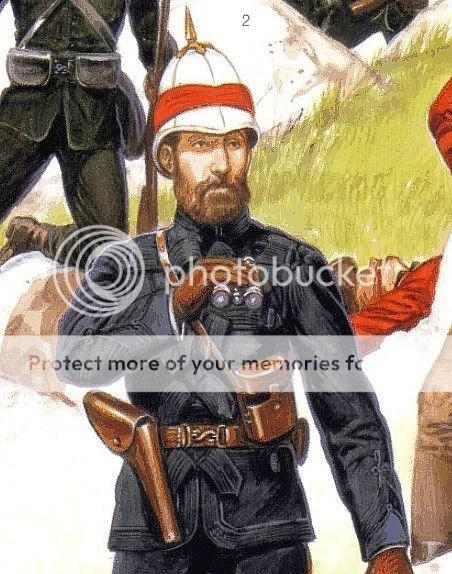
From another Osprey Men-At-Arms number on the First Anglo-Boer War (1880-81) depicting British General Sir George Colley wearing such a patrol jacket on campaign -
GenSirGeorgeColley1881.jpg

(Colley was killed during the disastrous British defeat at the Battle of Majuba Hill, 27 February 1881.)

As already noted, the peaked stetson was in common use from at least the early 1890's, although not officially adopted as the Force's dress headgear until 1904. However, it had already become sufficiently iconic that it was the only headwear used by the official NWMP contingent sent to London for Queen Victoria's Diamond Jubilee (commemorating the 60th year of her reign) in 1897 -
NWMP1897contingent02_zps74b61993.jpg

NWMP1897contingent01_zpse8d9dae1.jpg


(Clearly the stetson was already a standardized item for issue in the Force .... it simply wasn't formally adopted as the dress headgear until later.)

 
Last edited:
Back
Top Bottom