












































You are using an out of date browser. It may not display this or other websites correctly.
You should upgrade or use an alternative browser.
You should upgrade or use an alternative browser.
Old SxS shotgun revival?
- Thread starter Carborundum
- Start date
- Status
- Not open for further replies.


Tell us more about the gun, Carborundum. A home refurbishing job might be the way to go, or you might erase all value from an otherwise highly valuable item. Until we know more about what you have, any advice would be meaningless, and possibly destructive. Posting pictures will give you the best advice on steps forward. If you are too new a member to have photo posting privileges, PM a member who could post pictures for you.Hi all,
Have the GF's Dad's very old SxS 12ga.
The external barrel finish is 97% gone.
Been "archived" with WD 40 for years.
Was thinking of re-bluing it myself (temporary), or perhaps professionally rust blue/blackening/Parkerizing, but not sure if it'$ worth it.
Has anyone used a phosphoric acid etch & /or blue black?
TIA!

Just out of curiosity, does the newb photo ban also affect linking to pics on a third party hosting site?If you are too new a member to have photo posting privileges, PM a member who could post pictures for you.
OP, I second Stephen Nash's suggestions. The gun could be very valuable or worth nothing and that matters a great deal in how you tackle the problem.
Mark

Has anyone used a phosphoric acid etch & /or blue black?
Many, many times. The process is very straightforward and requires no specialized equipment (leastways with the product that I use). As far as being worth it, perhaps not if you pay to have it done. If you DIY, the cost is negligible, but the results are limited by your expertise and your effort.
Here’s a few examples of some shotguns I’ve done. (NOTE: I typically include a proprietary stock treatment I call Walnutz). It’s essentially fake figure on the stocks. Some members here really hate the concept, likely because if the finish gets damaged, they have no way to fix it. Obviously, I can fix it, so I don’t worry about that. Anyway, you asked about bluing/blacking, not stock finishes.)
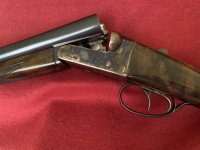
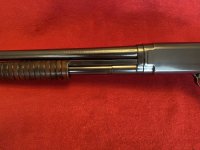
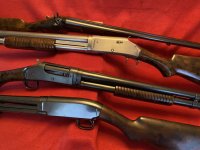
I don't suppose you would share that with us? Do you have any threads showing how you do yours?The process is very straightforward and requires no specialized equipment (leastways with the product that I use).
Mark
I’ve been asked that question a lot. At first I was very possessive of the process because it took hard work and ingenuity to perfect it and I didn’t want to just give it away. I’m in my 70’s now and I worry that the details will die with me. The truth is it’s all about the methodology, not the products. To make matters worse, the instructions that come with the products are total BS. If you follow the instructions, you will end up with a botch job for sure.
So here’s my dilemma: Communicating all the important details would require writing a multi-page manual with photos. If I were gifted a studio crew and an appropriate set, I’d be all for it. I’d be able to demonstrate in great detail and the production and post-production crews could turn it into a video course. But, that’s dreaming in technicolour.
People who are interested in this sort of work or hobby need to be at least amateur gunsmiths. You can’t properly blue a gun without completely disassembling it. This must be done without damaging any parts. Once this is accomplished, you should clean, and in some cases, polish the parts. Sometimes parts are so worn that they need to be refurbished or made from scratch. Then, the work can proceed. Lastly, the gun must be reassembled properly and restored to full function. Done right, the gun will look at least as good as new and probably function better than new. I could include training on that aspect also, but I have no official training. I apprenticed under myself.
Further, I share Stephen Nash’s respect for the great master makers. Some guns ought not to be worked on by anyone of lesser abilities and experience than Chris Dawe. Along with enough skills to be dangerous, one needs to be imbued with that same respect.
So you see the challenge. Anybody see a solution?
So here’s my dilemma: Communicating all the important details would require writing a multi-page manual with photos. If I were gifted a studio crew and an appropriate set, I’d be all for it. I’d be able to demonstrate in great detail and the production and post-production crews could turn it into a video course. But, that’s dreaming in technicolour.
People who are interested in this sort of work or hobby need to be at least amateur gunsmiths. You can’t properly blue a gun without completely disassembling it. This must be done without damaging any parts. Once this is accomplished, you should clean, and in some cases, polish the parts. Sometimes parts are so worn that they need to be refurbished or made from scratch. Then, the work can proceed. Lastly, the gun must be reassembled properly and restored to full function. Done right, the gun will look at least as good as new and probably function better than new. I could include training on that aspect also, but I have no official training. I apprenticed under myself.
Further, I share Stephen Nash’s respect for the great master makers. Some guns ought not to be worked on by anyone of lesser abilities and experience than Chris Dawe. Along with enough skills to be dangerous, one needs to be imbued with that same respect.
So you see the challenge. Anybody see a solution?
The 5100 is a frame variant of the Savage/Stevens 311. It was sold primarily in the 1940s and is a good candidate for refurbishing but not worth having it restored professionally. So, you don’t run the risk of defacing a priceless heirloom.
Whatever you do, do not use any power tools. Polishing and carding must be done by hand using 000 or 0000 steel wool. If you refinish the stocks, remove remaining finish with chemical paint remover not sandpaper. After the old finish has been removed, fix cracks with thin, clear adhesives like gorilla glue. Carpenter’s glue and paper glues turn black and exaggerate cracks rather than hiding them. Dents can be raised using steam. A very light sanding is the last step, but use only the finest grits like 220 gr and higher.
That’s only touching on the most common mistakes. As mentioned above, the correct methodologies are too detailed to describe here.
Please keep us informed of your decision and, the results.
Whatever you do, do not use any power tools. Polishing and carding must be done by hand using 000 or 0000 steel wool. If you refinish the stocks, remove remaining finish with chemical paint remover not sandpaper. After the old finish has been removed, fix cracks with thin, clear adhesives like gorilla glue. Carpenter’s glue and paper glues turn black and exaggerate cracks rather than hiding them. Dents can be raised using steam. A very light sanding is the last step, but use only the finest grits like 220 gr and higher.
That’s only touching on the most common mistakes. As mentioned above, the correct methodologies are too detailed to describe here.
Please keep us informed of your decision and, the results.
Ah, so it's a process and not a product. That is tougher to pass along.The truth is it’s all about the methodology, not the products. To make matters worse, the instructions that come with the products are total BS. If you follow the instructions, you will end up with a botch job for sure.
If it were me I would make a thread detailing what you do and the products you use along with any pictures you can add and go from there. I agree video would be better, but that is a significant undertaking and I understand not being equipped to do that nor wanting to spend that much time on it.
Mark
Don't remember where I saw them, but within the past week I viewed photos of a Savage/Stevens double that someone had extensively reworked and refinished. Reshaped the receiver. Turned the forend into a "splinter" style. Straight grip stock. Classic trigger guard. Looked really good.
I reworked a Brazilian .410 double ages ago. Straight grip, etc. Really changed the gun, made it quite appealing.
Your gun is a good one to work on, do as little or as much as you choose. Basic cleanup, repair of that crack would be the minimum.
I reworked a Brazilian .410 double ages ago. Straight grip, etc. Really changed the gun, made it quite appealing.
Your gun is a good one to work on, do as little or as much as you choose. Basic cleanup, repair of that crack would be the minimum.
Last edited:
My first double was a gussied up variant of this very design - a Savage Fox Model B. It was unnecessarily bulky and swung like a 2x4. However, I was a novice and I shot it reasonably well.
It is/was the worst gun of any and all action types that I’ve ever owned when it came to reliability. It broke down in the field 4 times during the time I had it. However, each time this happened I set out to fix it myself. This turned out to be the spark that started my foray into amateur gunsmithing. It also was where my tastes evolved to reject semi or full beaver tail fore ends in favour of splinter fore ends. The stark comparison between that gun and your average British or Spanish boxlock or sidelock conclusively made the case for straight hand English stocks for hunting rather than pistol grips and even Prince of Wales grips. The same comparisons cemented the value of a well balanced gun.
At the time, I was an American-made guns collector and shooter. I owned a graded Ainsley H Fox (touted as the best gun in the world), a Parker, a Baker (who designed the original Bakers, L C Smiths, and Ithacas if you’re not familiar with him), a Lefevre, a Browning Citori, a Steven’s 311 20 ga, a Browning Superposed, and even a Tobin. I’ve since sold every single one of them except the Baker and it would be gone, too, if someone offered me what it’s worth.
My collection now features British guns including a WW Greener and Spanish guns such as AyA and Arizaga. Incredibly even to me, I have a relatively new American double - a Savage Fox A Grade in 20 ga, which is made by CSMC. They are not your average American maker. Even so, if I wasn’t so poor, I’d far sooner have bought a round action Dickson or a MacNaughton.
So, have fun fixing up the old girl - you have nothing to lose and a whole world of knowledge and fun ahead of you.
It is/was the worst gun of any and all action types that I’ve ever owned when it came to reliability. It broke down in the field 4 times during the time I had it. However, each time this happened I set out to fix it myself. This turned out to be the spark that started my foray into amateur gunsmithing. It also was where my tastes evolved to reject semi or full beaver tail fore ends in favour of splinter fore ends. The stark comparison between that gun and your average British or Spanish boxlock or sidelock conclusively made the case for straight hand English stocks for hunting rather than pistol grips and even Prince of Wales grips. The same comparisons cemented the value of a well balanced gun.
At the time, I was an American-made guns collector and shooter. I owned a graded Ainsley H Fox (touted as the best gun in the world), a Parker, a Baker (who designed the original Bakers, L C Smiths, and Ithacas if you’re not familiar with him), a Lefevre, a Browning Citori, a Steven’s 311 20 ga, a Browning Superposed, and even a Tobin. I’ve since sold every single one of them except the Baker and it would be gone, too, if someone offered me what it’s worth.
My collection now features British guns including a WW Greener and Spanish guns such as AyA and Arizaga. Incredibly even to me, I have a relatively new American double - a Savage Fox A Grade in 20 ga, which is made by CSMC. They are not your average American maker. Even so, if I wasn’t so poor, I’d far sooner have bought a round action Dickson or a MacNaughton.
So, have fun fixing up the old girl - you have nothing to lose and a whole world of knowledge and fun ahead of you.
Last edited:
Yes!So, have fun fixing up the old girl - you have nothing to lose and a whole world of knowledge and fun ahead of you.
I have an ultrasonic cleaner, but the only thing I’ve ever used in it is degreaser. This is the first time I’ve heard of using WD-40 as a storage medium. It could be that the combination of WD-40 with other products causes them to congeal.
All solvents are degreasers, but that doesn’t mean they’re all suitable for all applications.
Can we assume when the light spray was applied and the drips wiped away immediately that there was no sign of the jellified goo?
Can we assume when the light spray was applied and the drips wiped away immediately that there was no sign of the jellified goo?
Amateur gunsmith, and now, insensitive clod. My resume continues to expand. My apologies, I did not seek to embarrass. My goal was to help find the origin of the goo.
Logic is a valuable tool, but it is not always reversible. Monty Python said it best when they wrote:
“Just because Alma Cogan is dead doesn’t mean all the dead are Alma Cogan.”
Logic is a valuable tool, but it is not always reversible. Monty Python said it best when they wrote:
“Just because Alma Cogan is dead doesn’t mean all the dead are Alma Cogan.”
- Status
- Not open for further replies.





















