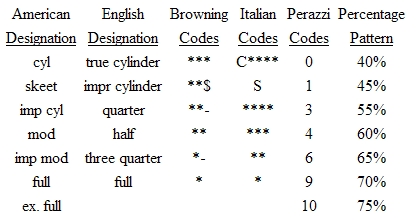
Potashminer you are correct. The concept of choke, a narrowing of the shotgun muzzle to concentrate the shot pattern, goes back to at least the 1860’s and possibly earlier. It seems to be a simple concept but in fact it isn’t a precise fixed formula and can be very confusing. Although 12 gauge diameter was standardized at .729” over a hundred years ago in Britain not all countries followed this lead. Add to this the fact that many manufacturers have historically used their own interpretation ( Beretta traditionally had tighter bores around .725”, Belgian Brownings were similar, Japanese made guns like Citori tend larger, typically over .730”) so there is no true international fixed measurement for 12 gauge. Choke constriction is not a fixed measurement, the degree or points of choke is the difference between the actual bore size and the actual choke measurement, expressed in thousanths of an inch in Britain and North America, metric equivalent in Europe. Therefore the actual measurement of a choke, either fixed or a removable is mostly an approximation. In North America we give specific amounts of choke names, Brits and Europeans express this as fractions. Cylinder choke of course is true bore diameter, 0 choke. Improved Cylinder ( 1/4 choke) became set at or near .010” constriction, Modified was .020” (1/2 choke), Improved Modified (3/4 choke) was .030” and Full Choke was .040” constriction, although many gun makers varied this slightly. All this worked reasonably well with most ammunition available until newer ammunition types with plastic wads incorporating shotcups that protected the outer layers of shot from barrel wall induced damage resulted in much tighter patterns.with this newer high tech ammo that eventually became the standard and many guns were throwing patterns a full choke degree tighter than before. Eventually gun manufacturers were forced to use a more open constriction to achieve a desired degree of choke. The use of the word choke as a measurement is only a guide. Full choke will normally throw tighter patterns than Modified which in turn throw tighter patterns than Improved Cylinder but the differences can vary greatly depending on many factors. The bore size of the barrel, bore profile, length of the initial forcing cone, choke length and profile all affect patterns ( actual amount of choke). And ammo….wad type, velocity, shot size, shot hardness, all interact in different ways with the different barrel factors to give a nearly infinite amount of varying results. I know it drives some people nuts but it ain’t precise repeatable science folks, each individual gun and ammunition combination is it’s own unique absolute.