












































You are using an out of date browser. It may not display this or other websites correctly.
You should upgrade or use an alternative browser.
You should upgrade or use an alternative browser.
On the Lands, or even Jammed
- Thread starter track
- Start date


I always load with a bit of jump to the lands. The theoretical gain in accuracy isn't worth the potential loss of reliability. I seem to recall a few years ago a member out hunting with his bullets jammed to the lands, and wound up with a bullet stuck in the throat. I can't recall if it ended his day, or ended his hunt altogether.

FirearmsEnthusiast
CGN frequent flyer
- Location
- Kingston, ON
Also be careful with ammo sitting right on the lands or jammed - pressures can be higher than ammo with the projectile set-back. I always back my powder charges down by 10% and approach at-lands or jammed seating depths as a new load when compared to SAAMI or 10-20 thou off the lands.
FirearmsEnthusiast
CGN frequent flyer
- Location
- Kingston, ON
It's foolish to have hunting ammo that engages the lands when chambered
Or even jammed loads at target shooting events. A good way to end up with an action full of powder and a projectile to tap out of the barrel/action if you have to unload a chambered round...
Mystic Precision
CGN Ultra frequent flyer
- Location
- Summerland, BC
ALL and I do mean ALL bullets can be made to work OFF the lands. If a bullet works well with an on the lands load, there will be an off the lands load that works exactly the same.
There is no benefit to risk function in a hunting rifle.
Jerry
There is no benefit to risk function in a hunting rifle.
Jerry

It's foolish to have hunting ammo that engages the lands when chambered
Spoken for truth!

Many of my loads are on the lands and I routinely start there. Bear in mind that one guy's "on the lands" is the next guy's "jammed 30 -50 thousandths". Done properly you won't debullet anything; with the benefit that if you then decide to experiment with COL there is only one way to go.

358Rooster
CGN Regular
- Location
- Central Saskatchewan
Many of my loads are on the lands and I routinely start there. Bear in mind that one guy's "on the lands" is the next guy's "jammed 30 -50 thousandths". Done properly you won't debullet anything; with the benefit that if you then decide to experiment with COL there is only one way to go.
Spoken for quantified logic!

there is no right or wrong answer to your question as every gun is an individual and should be treated as such, long story short its what the particular gun likes
the chances of having a factory gun with a magazine or top fed max overall length will you ever be able to jam a bullet that functions to come anywhere near the lands
that being said, a touching or a jam bullet does have its merit in the fact that any case neck run out is eliminated, it also increases the pressure required to release the bullet which certain types of powder work best at the higher pressures which can affect accuracy with a finely tuned rifle
If you go down the road of jamming bullets you will need a good quality comparator, a micrometer seating die as well as a highly accurate powder scale, as all these will be critical to producing safe consistent loads
the chances of having a factory gun with a magazine or top fed max overall length will you ever be able to jam a bullet that functions to come anywhere near the lands
that being said, a touching or a jam bullet does have its merit in the fact that any case neck run out is eliminated, it also increases the pressure required to release the bullet which certain types of powder work best at the higher pressures which can affect accuracy with a finely tuned rifle
If you go down the road of jamming bullets you will need a good quality comparator, a micrometer seating die as well as a highly accurate powder scale, as all these will be critical to producing safe consistent loads

The only time I jam my bullets into the lands is to fire form cases and hold the rear of the case against the bolt face.
If you full length resize your cases with .001 to .002 shoulder bump, jamming will push the rear of the case against the bolt face.
Full length resizing with minimum shoulder bump and seating off the lands gives the case wiggle room to let the bullet be self aligning with the bore.
If the case has warped even slightly the first firing from unequal case wall thickness, jam can cause the warped base to cause the bullet to be misaligned with the bore.
I have hunting rifles and not benchrest rifles so benchrest methods do not apply to my rifles. Let the bullet have a running start and some wiggle room before contacting the rifling.
Below Kevin Thomas of "Team Lapua USA" and before that worked in the Sierra ballistics test lab.
Wiggle room = "The loaded round should fit the chamber like a rat turd in a violin case".
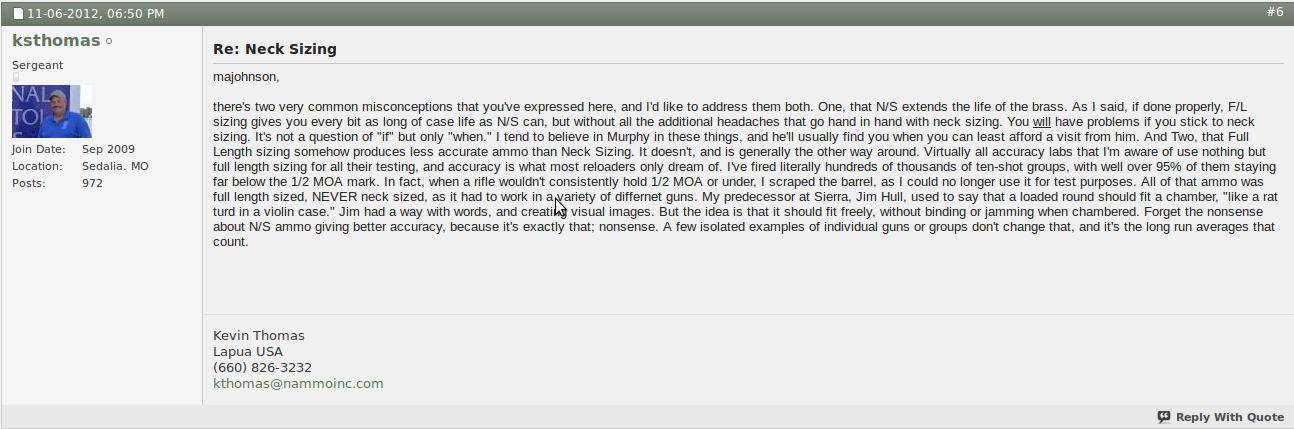
Below is from German Salazar's "The Riflemand Journal" and he is answering a question about Partial full length resizing. And again having some wiggle room and not letting the base of the and case body influence bullet alignment with the bore. And jamming eliminates your wiggle room and can cause the case body to make the bullet tilt in the throat.
Reloading: Partial Neck Sizing
by German A. Salazar
http://riflemansjournal.########.com/2010/06/reloading-partial-neck-sizing.html
"Now the last scenario, a full-length sized case in which the neck is also fully sized. There is clearance at the neck and in the body of the case, the closest fit anywhere is the bullet in the throat. If the neck to bullet concentricity is good (although it needn't be perfect), then the bullet will find good alignment in the throat and the case body and neck will have minimal influence. Let's not forget that the base of the case is supported by the bolt face or the extractor to a certain degree as well; this is yet another influence on alignment. As you can see, there are several points from base to bullet that can have an effect. My procedure is to minimize the influence of those that I can control, namely the case body and neck, and let the alignment be dictated by the fit of the bullet in the throat and to some extent by the bolt's support of the base. Barring a seriously out of square case head, I don't think the bolt can have a negative effect on alignment, only a slightly positive effect from minimizing "case droop" in the chamber. Given that a resized case will usually have a maximum of 0.001" diametrical clearance at the web, this isn't much of a factor anyway."
Below Erik Cortina starts .020 off the lands to find his node and fine tunes from .005 to .040 off the lands. Read the link below for more info.
Long range load development at 100 yards.
Erik Cortina
Team Lapua Brux Borden Captain
http://forum.accurateshooter.com/threads/long-range-load-development-at-100-yards.3814361/
Some of you have asked for more detailed instructions on how I do this. Here they are:
1. Find Jam by seating a bullet long on a dummy piece of brass (no primer nor powder) and apply die wax to the bullet ogive and record it's base to ogive length.
2. Chamber the round and close the bolt.
3. Snap the bolt open and measure the base to ogive measurement. If it is shorter than previous measurement, this is your jam. Do it a few times with different cases to make sure.
4. Load a known powder/primer/bullet combination. I load 4 of each powder charge in 0.5 gr. increments and seat bullets at jam - .020". I use one shot of each to get barrel fouled up and also keep an eye for max pressure at the same time. You can also use these rounds to break in a barrel if you are inclined to. If I encounter pressure on the hotter rounds, I will not shoot groups with the other loaded rounds and will pull bullets when I get back home. Do not shoot in round robin style because position and natural point of aim will be compromised.
5. Shoot 3 shot groups starting from lowest to highest. All groups are shot over a chronograph.
6. Examine target and find the place where consecutive groups line up vertically and ES is the lowest and speed increases the least from one group to the next.
7. Load to the middle of the powder node and do a seating depth test.
8. Load 3 shot groups starting from Jam - 0.005" all the way out to Jam - .040" in .003" increments.Long range load development at 100 yards.
9. When you find the seating depth test that shoots the best, load towards the longest side of the node to allow more room for throat erosion.
10. Final step is to load the new seating depth and load 5 shot groups in 0.1 gr. increments 0.5 gr. on each side of node (if pressure limits are not reached). This will cover an entire grain of powder and you will be able to pinpoint where the powder node starts and ends. In the summer, load towards the low end of the node, and do the opposite in the winter.
If you full length resize your cases with .001 to .002 shoulder bump, jamming will push the rear of the case against the bolt face.
Full length resizing with minimum shoulder bump and seating off the lands gives the case wiggle room to let the bullet be self aligning with the bore.
If the case has warped even slightly the first firing from unequal case wall thickness, jam can cause the warped base to cause the bullet to be misaligned with the bore.
I have hunting rifles and not benchrest rifles so benchrest methods do not apply to my rifles. Let the bullet have a running start and some wiggle room before contacting the rifling.
Below Kevin Thomas of "Team Lapua USA" and before that worked in the Sierra ballistics test lab.
Wiggle room = "The loaded round should fit the chamber like a rat turd in a violin case".
Below is from German Salazar's "The Riflemand Journal" and he is answering a question about Partial full length resizing. And again having some wiggle room and not letting the base of the and case body influence bullet alignment with the bore. And jamming eliminates your wiggle room and can cause the case body to make the bullet tilt in the throat.
Reloading: Partial Neck Sizing
by German A. Salazar
http://riflemansjournal.########.com/2010/06/reloading-partial-neck-sizing.html
"Now the last scenario, a full-length sized case in which the neck is also fully sized. There is clearance at the neck and in the body of the case, the closest fit anywhere is the bullet in the throat. If the neck to bullet concentricity is good (although it needn't be perfect), then the bullet will find good alignment in the throat and the case body and neck will have minimal influence. Let's not forget that the base of the case is supported by the bolt face or the extractor to a certain degree as well; this is yet another influence on alignment. As you can see, there are several points from base to bullet that can have an effect. My procedure is to minimize the influence of those that I can control, namely the case body and neck, and let the alignment be dictated by the fit of the bullet in the throat and to some extent by the bolt's support of the base. Barring a seriously out of square case head, I don't think the bolt can have a negative effect on alignment, only a slightly positive effect from minimizing "case droop" in the chamber. Given that a resized case will usually have a maximum of 0.001" diametrical clearance at the web, this isn't much of a factor anyway."
Below Erik Cortina starts .020 off the lands to find his node and fine tunes from .005 to .040 off the lands. Read the link below for more info.
Long range load development at 100 yards.
Erik Cortina
Team Lapua Brux Borden Captain
http://forum.accurateshooter.com/threads/long-range-load-development-at-100-yards.3814361/
Some of you have asked for more detailed instructions on how I do this. Here they are:
1. Find Jam by seating a bullet long on a dummy piece of brass (no primer nor powder) and apply die wax to the bullet ogive and record it's base to ogive length.
2. Chamber the round and close the bolt.
3. Snap the bolt open and measure the base to ogive measurement. If it is shorter than previous measurement, this is your jam. Do it a few times with different cases to make sure.
4. Load a known powder/primer/bullet combination. I load 4 of each powder charge in 0.5 gr. increments and seat bullets at jam - .020". I use one shot of each to get barrel fouled up and also keep an eye for max pressure at the same time. You can also use these rounds to break in a barrel if you are inclined to. If I encounter pressure on the hotter rounds, I will not shoot groups with the other loaded rounds and will pull bullets when I get back home. Do not shoot in round robin style because position and natural point of aim will be compromised.
5. Shoot 3 shot groups starting from lowest to highest. All groups are shot over a chronograph.
6. Examine target and find the place where consecutive groups line up vertically and ES is the lowest and speed increases the least from one group to the next.
7. Load to the middle of the powder node and do a seating depth test.
8. Load 3 shot groups starting from Jam - 0.005" all the way out to Jam - .040" in .003" increments.Long range load development at 100 yards.
9. When you find the seating depth test that shoots the best, load towards the longest side of the node to allow more room for throat erosion.
10. Final step is to load the new seating depth and load 5 shot groups in 0.1 gr. increments 0.5 gr. on each side of node (if pressure limits are not reached). This will cover an entire grain of powder and you will be able to pinpoint where the powder node starts and ends. In the summer, load towards the low end of the node, and do the opposite in the winter.
Last edited:


It isn't that hard to run every last hunting round through the chamber before it goes hunting.
Yes, I learned this one the hard way. The first round I chambered in my Mini-30 had a bulge and jammed. I had to go back to camp and pound it out. If it had been round #2 of a hunting shot, where I needed it, I would have had a club in my hand. At least a SKS has a bayonet...
I now cycle all the rounds at home, before I pack for the trip. And I would not make hunting ammo near the lands. Just one more thing that could go wrong.

ipscgraz
CGN Ultra frequent flyer
I'm not much of a hunter any more but I remember loading a round, then later unloading that round, then later re-loading the same round, etc. I would not take any chances on a stuck bullet, on a hunt.
It isn't that hard to run every last hunting round through the chamber before it goes hunting.
Yup. This has saved me a couple of times a few years ago. As a relatively new reloader this advice is priceless.
Regards
Ronr





















