









































Overcoming a Training Plateau

morel

New member
Rating - 0%
0   0   0
Although my main interest is hunting, I have been spending a lot of time practicing target shooting to improve my fundamental shooting skills and was hoping for some advice from folks who spend a lot of time thinking about improving their shooting.

I am actually doing most of my practice with a target air rifle since it means I can shoot much more regularly than I could by going to a rifle range. The air rifle is supplemented with time at a rifle range with a .22 and the centerfires I use for hunting and dry fire practice with hunting rifles (yes, I can safely dry fire my .22 - I use #6 drywall plugs as cheap dummy rounds).

To determine if my practice is actually resulting in improvement, I have created simple bullseye targets with scoring rings. The target is a 2.5 cm diameter circular target with scoring rings and a bullseye from 5-10 points. The bullseye is 1mm. I print targets on a single page with 5 targets per row and 4 rows per page (i.e. 20 targets per page). I take only one shot per target (left to right, top row to bottom row) to make scoring easier. I add the scores for each row and for the entire target. My expectation was that more practice should result in progressively higher scores. This has not been the case. Since I started scoring targets the overall score per page (20 targets) has not changed significantly. I have "good" targets where the overall score is high and "crappy" targets where the scores are uncomfortably low along with a lot of "average" targets. Plotting scores by date and performing a linear regression results in a straight line with no significant trend (in my mind, no overall improvement with time). I am interpreting this as a training plateau - more practice is not resulting in improvement.

So, my question is, if you have reached a plateau in your shooting skills, what do you do to move beyond the plateau?

Thanks for the help,
Cheers,
Morel
 
Sounds like your putting to much pressure on yourself! Take a break, sign up for a shooting clinic and realize your growth as a shooter may come in spurts. Be in the moment...
 
I found the first 30 years the hardest. Then, my experience kicked in and I was able to stay on top of most situations.

There are four components to performance.

Equipment and ammo.

Shooting ability. (Breaking perfectly aimed shots)

Wind reading.

Mental control.


The last two are the major ones because the differences in the first two are not all that big between most competitors.

Wind reading comes from training and experience. There is no substitute for experience. Not only is a major wind shift less of a challenge to me than it is to you (I have worked through many of them), but my mental control is such that I will hardly notice the shift.

Mental control. What thoughts are going through your mind during the shooting session? What are you thinking about as you aim and squeeze? What you are think determines the outcome.
 
Have you confirmed what the mechanical accuracy of your rifle is?

You can only shoot as well as the equipment so if the rifle will only average 9's, trying to shoot a clean will be impossible on average as some of the error is mechanical which you cannot overcome.

The answer to improving your score once you have a solid foundation in the fundementals... better gear. Until you KNOW the machine is capable of drilling out the center of the target, you will not be the limiting factor.

Jerry
 
I echo what Jerry has said, plus I'll add my two cents about the fundamentals.

Unless you're actively practicing your fundamentals (and executing them correctly - have someone verify) then your practice will at best allow you to minimally improve and at worst cause you to regress and do worse. This will make it even more difficult to get back on top of your game.
 
Ganderite hit it. The largest gains you will make in improving your scores(if that's all you're after) will come with improving your mental game. Once you know how to think about approaching this, you won't even think about scores. You simply think about making perfect shots. Your score will improve automatically. Focus on you performance and nothing else.
 
First thing you need to do is think about how you are shooting your targets. By starting at the top row and working from left to right you are changing your position left to right 20 times. If you start at the top left hand diagram and work down to the bottom, you are only squirming forward and back to shoot 4 targets, not so much left to right. Then start the next row of targets and work from the bottom to the top, again only squirming forward and back. next row work your way down then from the bottom back to the top on the last row of diagrams.
Less left to right position changes. Buy several different tins of match pellets and see which ones group better in your rifle. Forget scoring for a while and just shoot groups.
 
Mystic,

I have re-confirmed the precision of my rifle from sand bags. The rifle is not the problem shooting from field positions, my main focus has been offhand.

I have not had someone watch me shoot to establish that there are no problems with fundamentals of breathing, trigger control, etc.

Cheers,
 
Maynard,

I have been wondering if this was a potential problem. Shooting single targets solves the problem of scoring or identifying holes that overlap a lot but create a new problem of needing to move left to right or up and down. I will give the top to bottom approach a try.

Longshot,
My interest is improving my shooting not my scores. I see scoring targets as a convenient way of quantitatively measure "improvement". I have used more time consuming methods of determining the exact distance from the centre of the target and calculating deviations etc. A score on a target may be a bit more crude but is a lot faster. However, I do find myself thinking about scoring when shooting e.g. what do I need for the next shot to get you have a better than average score on the row. You are right, rather than focusing on the shot in front of me, I am focusing on the score which is likely the problem.....
 
Maynard,

I have been wondering if this was a potential problem. Shooting single targets solves the problem of scoring or identifying holes that overlap a lot but create a new problem of needing to move left to right or up and down. I will give the top to bottom approach a try.

Longshot,
My interest is improving my shooting not my scores. I see scoring targets as a convenient way of quantitatively measure "improvement". I have used more time consuming methods of determining the exact distance from the centre of the target and calculating deviations etc. A score on a target may be a bit more crude but is a lot faster. However, I do find myself thinking about scoring when shooting e.g. what do I need for the next shot to get you have a better than average score on the row. You are right, rather than focusing on the shot in front of me, I am focusing on the score which is likely the problem.....

Yes. Score is the end result, not the objective of the shot.

Develop a mental program that forces your body to do the right thing, every time, the same way. I have to use a mental mantra to keep the stray thoughts from running around my head. I wear plugs plus muffs so I hear less of other conversations.

The trigger finger will fire the shot at the right moment, subconsciously. This will be between heart beats, something the conscious brain cannot do.

Think of how well your fingers can tie your boot laces, without you having to think about it. You need to train your body to shoot perfectly, without you thinking about it. If you think about the score, this is a vague concept to the subconscious that does not result in a positive action.

Your mental mantra must be positive, like "perfect shot, perfect shot, perfect shot, perfect shot, perfect shot, perfect shot,..." The subconscious can react and take direction from a positive. It cannot react to a negative, like "Don't crossfire." or "Don't jerk."

I don't know about basic shooting training, but I do know that student pilots have "plateaus" where it looks like they have stopped learning. It is just a period of time for the subconscious to take over new tasks.

And remember that you have to get the shot off within 6 seconds, otherwise the sight picture gets burned onto the retina and your eye loses the ability to see a fine sight correction.
 
Last edited:
For me, all I'm looking for is the correct sight picture. So "sight picture" is the only thing on my mind. When the correct sight picture appears, the gun fires itself. For me there is no conscious thought of squeezing the trigger. And that is probably where you need to go next. You need to train to become subconscious on the trigger so that you can take that out of the equation. If you can focus simply on finding the correct sight picture and nothing else, and let the shot go without disturbing that sight picture, the score will take care of itself.

Try this. Shoot standing only. Anyone can shoot off a bench. Standing will magnify whether or not you broke the shot at the right moment. If you have a .22 its perfect for this. Put some small targets out at around 20y. Look through whatever sight system you are using. The instant the cross hairs or sights line up on the correct place on the target, I want you to just pull the trigger no matter how conscious it is. Bad trigger control and all. Don't worry about it at this point. Shoot 5 shots on each target resting a little between each shot. Don't keep the rifle in the aim for more than one shot at a time. Load each shot individually even if you have a magazine on the gun. Repeat it as many times as possible focusing on just breaking the shot when the sight picture is correct. That IS YOUR ONLY JOB, to break that shot when the sight picture is correct. When you find yourself losing concentration, or you shoot a good target towards the end of your training, STOP SHOOTING. As much as you may want to shoot another target after that real nice one don't do it! Stop. Remember how good it felt when you shot that real nice one. At the end of training score your targets. Don't dwell on it much. Look at the targets and see the nice shots that you broke. Ignore the fliers and shots that aren't where you wanted them. Give them no second thought as they do not matter. Only the good ones matter. When you shoot a good shot(a spotting scope will help you see if each shot was good or not) and it lands where you want it to, congratulate yourself. Say nice shot or that was a good one to yourself.

If you can do this at least once a week (preferably a couple or more) you will see pretty rapid improvement in just a couple of weeks. You will also notice that what was originally horrible trigger control has somehow morphed into a soft subconscious squeeze that you don't even realize you are doing.
 
I assume you are using aperture sights?

If so, try a larger front sight. newbies tend to use one that is too small, and the result is a bigger group. You want to see LOTS of white around the bull.

Try a bigger sight. It may look too big, or strange, but shoot a few targets and see if your groups shrink. If it is too small, your plateau is determined by the aperture size.

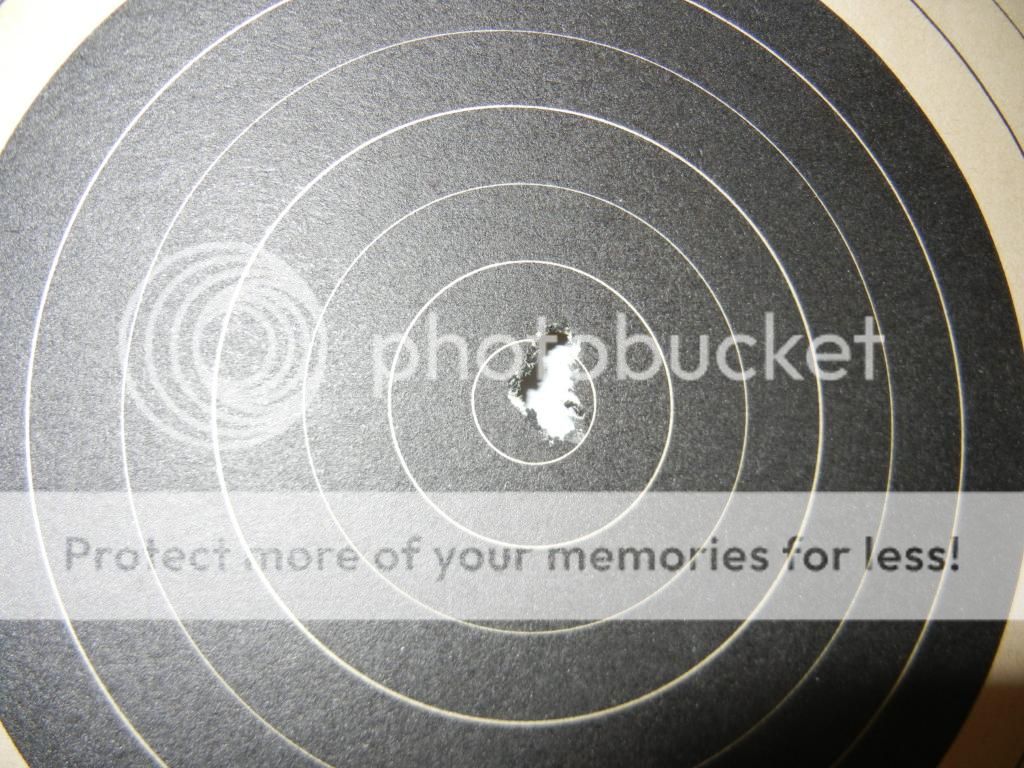
This is 10 shots at 50 meters, outside, with a 22. Off the elbows, sling and irons sights. Front aperture was a 3.5

DSCN9774.jpg
 
Back
Top Bottom