Powder coating lead projectiles.

Tim249

Member
Rating - 100%
10   0   0
Location
Lindsay, Ontario
Hi, I've recently decided to try casting my own projectiles. I have decided to try powder coating my bullets as opposed to grease lubing.

Currently I have a gas check maker on order, I've got some gun show lead ingot, the Lee melting pot, Lee moulds and sizers and a bottle of powder coating dust.

My question is this, when I size my projectiles back in the sizer (.001 usually) do I need a sizing lube, or will the powder coat also work for that? I intend to seat the gas check during the sizing step too if that effects anything.

Thank you!

A respectful note, I'm not really looking to debate powder coat vs traditional grease lube currently, I've read a bit on the forums, and want to give it a go, I may change my mind after trying it, and I may later fully endorse it. I'm mainly wondering about the sizing step now.
 
My question is this, when I size my projectiles back in the sizer (.001 usually) do I need a sizing lube, or will the powder coat also work for that? I intend to seat the gas check during the sizing step too if that effects anything.

Im my experience, powder coated bullets slide through the sizer with no trouble at all, no lube needed.

If you ever get into the position where you are sizing bullets before powder coating them, the bare lead bullets will need some kind of lube.
 
if you powder coat then size ...your gascheck will not go on the bullet base properly if at all......
Yes it will.
0C559A5D-7143-4A63-A007-8EE24D2881D2.jpg
 
G C's are redundant on any powder coated slug either before or after as the PC does what the G C's were invented for...you dont need them at all with PC!! I shoot all my GC based slugs naked, basically a "boat-tail cast slug". I notice no accuracy reduction at all.

You can easily "dry size" any PC'd slug up to .002 oversized, after that they may "smear" a bit, depending on the powder you use or how good your "cook" is. I have shot a few "smeared slugs" rather than re-melt and have noticed no leading or detrimental actions of any kind.

I size all my PC'd slugs after PCing just to re-set perfect roundness & concentricity but lots of folks dont go thru the bother...your choice.
 
If you ordered your gas check maker from the guy in Alberta who sells those kits, you aren't going to have any issues with gas check fit, provided you gave him the proper dimensions for the gas check shanks on the bullets you are casting. I am on the verge of purchasing one of his kits myself to fit my .303 and .35 moulds, just because... But the gas checks I use now work just fine and I don't cast and shoot hundreds of cast bullets every single year.

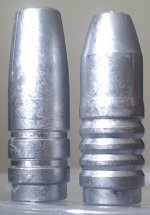
Bullet moulds, powder coating, and gas check fit are tied together due to the dimensional changes from gas coating. I don't know if any of the commercial cast bullet manufacturers offer moulds designed with powder coating in mind.

I purchased my custom moulds from Accurate in the years before powder coating was discovered. They were spec'd from chamber castings to precisely fit the ball seat and lede of the rifles they were intended for. I used to lube them as cast, as they dropped from the mould exactly to size; Tom's moulds are fantastic, and the extra cost for a custom spec'd mould over what you'd pay for one off the store shelf is more than worth it.

Now that I exclusively powder coat, those bullets are now oversize. A pain in the azz that I've compensated to deal with for far too long. I'm going to order replacement moulds with the dimensions reduced by .002", which is what the powder coating has added.

For now, to compensate I run them through my Saeco sizer to reduce the size by a .001", then powder coat and seat gas checks afterwards. Check seating is accompanied by a second trip through a sizer to reduce the dimension to what I'm looking for. I haven't had any problems seating gas checks on the powder coated shanks with the Saeco, but others using different equipment/seating may have a different result.

If you get into bullet casting for rifles serious enough to buy gas check makers, you should consider getting Accurate to make you moulds precisely for your rifle - and adjust the dimensions to account for the increases that the powder coat will introduce.

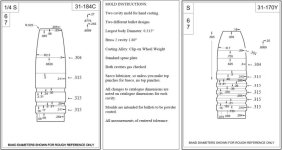
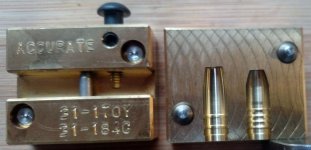
Tom will even put two different designs (or even three) in one set of mould blocks for a slight increase in the cost of the mould. Nice way to try two different designs with just one set of blocks.

5-61.1.JPG

5-2.9.jpg

5-61.jpg

When I got obsessed with obtaining the best grouping possible with cast bullets in my rifles, I used to anneal gas checks on the thought it would help ensure the gas check was firmly seated square to the base of gas check when the bullet with the gas check pressed with finger pressure onto the bullet shank were fed into the Saeco. I don't recall if I found the incidence of fliers dropped.

After a brief debacle where I found my latest boxes of gas checks were not up to spec and weren't flush as I assumed they were to the bullet base before sizing, I ended up with two tools to double-eliminate that happening again.

The first was a tool that slightly chamfers the bottom edge of the heel of the gas check shank to remove any slight flashing that might disturb a flat fit of the check to the shank before feeding it into the Saeco for seating and crimping.

The second is a punch a gunsmith friend made that goes into my Co-ax press and both ensures the bottom of the gas check is perfectly flat and flares the gas check just the tiniest amount. The result is gas checks that aren't loose like the old slip on gas checks that always fell off when I tried them, but gas checks that just firm finger pressure will put in place for their upcoming trip through the Saeco gas check seater.

I know some people have excellent results with starting them base down on a solid surface, put the gas check shank in the check, align the bullet vertical by eye, and giving the nose a bit of a tap with a soft faced hammer. I have never tried that but it must work or they wouldn't still be doing it.

Powder coating powder quality varies, although I have only used two kinds. I use whatever commercial stuff is repackaged and sold by the person using the online name "Smoke". I started out with some I bought at Princess Auto. It works but whatever it is that he sells online results in a thinner and more uniform coat which I believe is better.

I don't think there's a hard number for how high velocities can go with powder coated bullets without requiring a gas check. That probably depends on many things including the alloy and how well the bullet fits the ball seat and lede to begin with. I have seen people saying they have loads at 1800 fps that don't require checks.

My fun loads with the mould above shoot just fine without checks at around 1660 fps with wheel weight. My best grouping full power loads that are running a bit over 2200 fps work just fine with powder coat as the lube and a gas check in place. I don't know at what higher velocities powder coating would be less effective than traditional lubes.

My experiences only; yours and others may be completely different.

 
Last edited:
If you ordered your gas check maker from the guy in Alberta who sells those kits, you aren't going to have any issues with gas check fit, provided you gave him the proper dimensions for the gas check shanks on the bullets you are casting. I am on the verge of purchasing one of his kits myself to fit my .303 and .35 moulds, just because... But the gas checks I use now work just fine and I don't cast and shoot hundreds of cast bullets every single year.

Bullet moulds, powder coating, and gas check fit are tied together due to the dimensional changes from gas coating. I don't know if any of the commercial cast bullet manufacturers offer moulds designed with powder coating in mind.

I purchased my custom moulds from Accurate in the years before powder coating was discovered. They were spec'd from chamber castings to precisely fit the ball seat and lede of the rifles they were intended for. I used to lube them as cast, as they dropped from the mould exactly to size; Tom's moulds are fantastic, and the extra cost for a custom spec'd mould over what you'd pay for one off the store shelf is more than worth it.

Now that I exclusively powder coat, those bullets are now oversize. A pain in the azz that I've compensated to deal with for far too long. I'm going to order replacement moulds with the dimensions reduced by .002", which is what the powder coating has added.

For now, to compensate I run them through my Saeco sizer to reduce the size by a .001", then powder coat and seat gas checks afterwards, adjusting the seating as mentioned above as the bullets are still .001" oversize. Check seating is accompanied by a second trip through a sizer to reduce the dimension to what I'm looking for. I haven't had any problems seating gas checks on the powder coated shanks with the Saeco, but others using different equipment/seating may have a different result.

If you get into bullet casting for rifles serious enough to buy gas check makers, you should consider getting Accurate to make you moulds precisely for your rifle - and adjust the dimensions to account for the increases that the powder coat will introduce.

Tom will even put two different designs (or even three) in one set of mould blocks for a slight increase in the cost of the mould. Nice way to try two different designs with just one set of blocks.

View attachment 1091334

View attachment 1091335

View attachment 1091336

When I got obsessed with obtaining the best grouping possible with cast bullets in my rifles, I used to anneal gas checks on the thought it would help ensure the gas check was firmly seated square to the base of gas check when the bullet with the gas check pressed with finger pressure onto the bullet shank were fed into the Saeco. I don't recall if I found the incidence of fliers dropped.

After a brief debacle where I found my latest boxes of gas checks were not up to spec and weren't flush as I assumed they were to the bullet base before sizing, I ended up with two tools to double-eliminate that happening again.

The first was a tool that slightly chamfers the bottom edge of the heel of the gas check shank to remove any slight flashing that might disturb a flat fit of the check to the shank before feeding it into the Saeco for seating and crimping.

The second is a punch a gunsmith friend made that goes into my Co-ax press and both ensures the bottom of the gas check is perfectly flat and flares the gas check just the tiniest amount. The result is gas checks that aren't loose like the old slip on gas checks that always fell off when I tried them, but gas checks that just firm finger pressure will put in place for their upcoming trip through the Saeco gas check seater.

I know some people have excellent results with starting them base down on a solid surface, put the gas check shank in the check, align the bullet vertical by eye, and giving the nose a bit of a tap with a soft faced hammer. I have never tried that but it must work or they wouldn't still be doing it.

Powder coating powder is of various quality. I use whatever commercial stuff is repackaged and sold by the person using the online name "Smoke" provides. I started out with some I bought at Princess Auto; it worked but whatever it is that he sells results in a thinner and more uniform coat.

I don't think there's a hard number for how high velocities can go with powder coated bullets without requiring a gas check. That probably depends on many things including the alloy and how well the bullet fits the ball seat and lede to begin with. I have seen people saying they have loads at 1800 fps that don't require checks. My fun loads with the mould above shoot just fine without checks at 1660 fps, with wheel weight; the best grouping full power loads that are running a bit over 2200 fps work just fine with powder coat as the lube and a gas check in place. I don't know at what higher velocities powder coating would be less effective than traditional lubes.

My experiences only; yours and others may be completely different.

Colour pigment adds thickness. to avoid thickness, get a clear coat.

PA colours suck. Prismatic powders is the way to go.

I like my jolly-pop colours


lGYGKkM.jpg
 
  • Like
Reactions: DGY
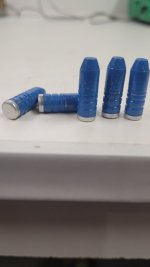
The bullets in the picture in my previous post are already powder coated with clear coat. I also have some black powder coat I bought at the same time from Smoke with the idea I would color code my loads, but I've never got around to actually starting to do that.

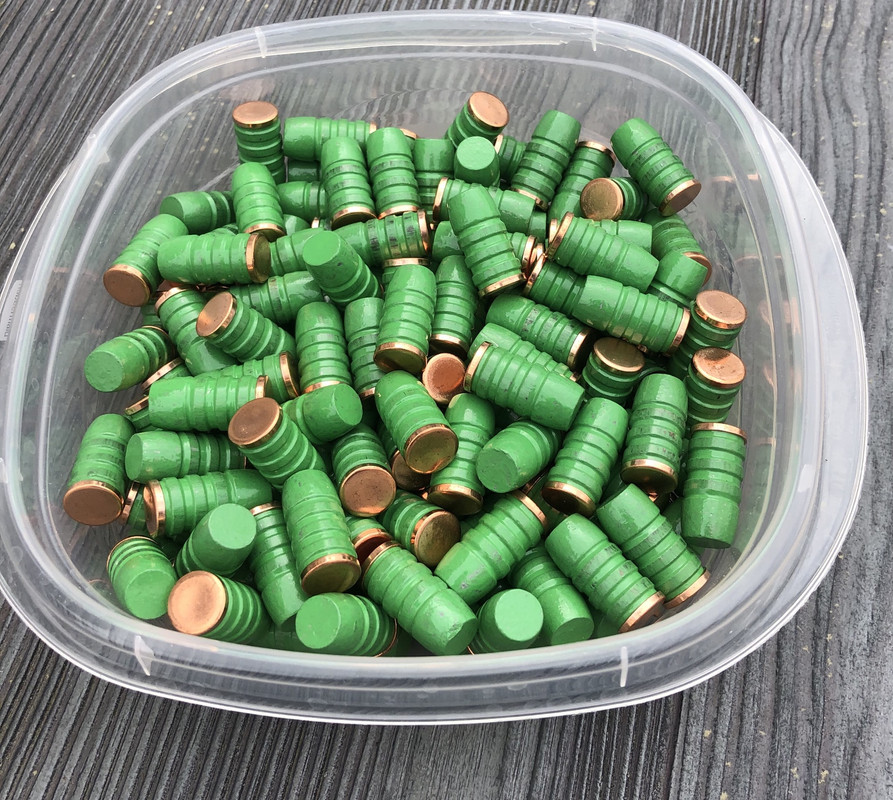
I would assume that the method of applying the powder coating can change the amount the bullet dimensions are increased. By the time I decided to try powder coating, there were far more guys successfully using the simple method of shaking the bullets and powder in a plastic container with airsoft BBs than the guys that originally worked it out using spray guns.

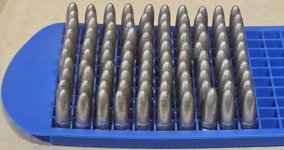
I started with the simple plastic container method and a mini ice cube tray to prevent the bullets from tipping over. That has worked well enough for me that I haven't considered adding the spray equipment to what I've already accumulated after 50+ years of reloading.

00001.1.JPG

I did learn after experimenting with my PID, that the temperature fluctuations in even a higher end quality kitchen oven can fluctuate as much as +/- 30F, so I gave in and added one final piece of equipment - a convection toaster oven.

This summer I may trial some oven baked versus convection toaster oven bullets using a known load, to see if there's any difference between ten shot groups fired with each. I have no explanation for why I've never thought to try that yet. I would be very happy if the toaster oven and the size it takes up could be taken out of my increasingly crowded reloading equipment space.
 
Rick, good detail there TFS
Did you find a best alloy for those higher speed leads?
For rifle bullets, never tried anything other than wheel weight. The guru that kindly interceded to bail me out while I was failing miserably when I started back in the 1980's, Ken Mollohan taught me (among other things) to harden my bullets after casting. Hardening your cast bullets to a Brinell hardness that matches the expected operating pressure of your loads is how to get your best results - rather than trying to find the alloy to start with that leaves you with a hardness you hope works after casting.

Plain old wheelweight can cover a wide range of Brinell hardnesses. (And then you discover that Brinell hardness changes in bullets that have been sitting for years since they were cast and had some sort of heat treatment within the process)

That was somewhere around back in the late 1980's, when Fidonet and long distance phone calls were all we had to learn from distant people before the Web came along. Ken wrote parts of some of the Lyman cast bullet reloading manuals as well as competing in CBA benchrest and writing various articles for their journals. He left a lot of recorded written knowledge behind when he died about ten years ago. If he was alive today, he would probably be all over YouTube; he had a real love of helping others improve their results and teaching what he had learned in his decades of casting and competition.

He and Tom Gray along with a few others developed some traditionally lubed loads that got up around 3,000 fps. If my memory is correct, they published their experiments with the details of what they did and the results in the CBA journal.

I think Ken's high speed loads were out of a 300 Winchester Magnum. He and Tom independently wrote it was possible to develop loads that grouped well at that velocity, but they didn't group as well as the best loads at lower velocity for target competition, and the higher speed didn't do anything for terminal performance if you chose to hunt with those bullets.

Which may be why the higher end in hunting velocities for people in the .30, .303, and .358 crowd is somewhere around 2500 fps at the high end. That varies, but most people doing that are choosing a heavier bullet than they would use in their caliber with jacketed, and then looking for the grouping they want with those heavier bullets at around those speeds. So for a 30/06, they would have something around 180 - 200 grains somewhere at (or most likely below) 2500 fps.

I think I may have posted a graphic of the bullet hardness via heat treating and Brinell hardness to match load pressure here before in years past. Both were developed by Ken in conjunction with Tom Gray and others at the CBA while pursuing winning combinations in the various classes of cast bullet benchrest competition.

Those charts aren't proprietary knowledge - they've probably appeared before in various other places on the Internet. There are at least three Web forums that are completely devoted to all aspects of casting, hunting, and competing with cast bullets. There's an enormous amount of knowledge on those forums, and newer discoveries and techniques usually appear there first before spreading to more general firearms forums.

I check them out regularly to see what's new. That's how I learned about powder coating in the first place after I dropped my membership in the Cast Bullet Association and competing in the Military class with my Long Branch Lee Enfield. They've been publishing a regular journal for at least 30 years; it used to come in the mail, now I think it's in .pdf form.

There's an enormous amount of corporate knowledge there for discovery, just by exploring through the various forums and threads there. I think of my efforts as being mediocre/average when I see what some of the people in those forums are accomplishing regularly with equipment not all that different or more sophisticated than mine.

As far as attempting to get the highest velocity cast bullet loads, I would say that the best chances for success while doing that is taking great care to start with a bullet that precisely fits your rifle's ball seat and lede.

A sloppy fit between bullet and the ball seat/lede that the seated bullet is chambered into is going to be an unending obstacle to success from beginning to end. No matter what lubes, powders and loads you mess around with trying to get good grouping while looking for higher velocities.
 
Back
Top Bottom