Powder Lot Woes

How would you explain the difference in velocities between the frozen powder and that stored at room temperature???

I tried to come up with something at the time but couldn't find anything, other than conjecture.

I'm working on my last container of surplus 4831, which I purchased close to 50 years ago and it's still just as consistent now as it ever was. It was taken out of its original packaging, wood box, tar paper lined, filled with 50 pound pressed paper containers with a white wrapper and a large 4831 on the side. Good powder. Likely won't have to purchase any more of that type, considering what's left and that I don't use it nearly as much as I used to. Now, it resides in amber, glass, one gallon jugs and has done ever since the original container was opened. Didn't know anything about the powder being exposed to air being detrimental at the time, just got the jugs from where I worked and they were much easier to store and handle. Got lucky on that one.

I break drums of powder (45 or 60 pound) down into 8 pound jugs. I use the window washer fluid jugs I collect from the gas station garbage cans. So far the jugs have held up well. Also use milk jugs. So far, so good.
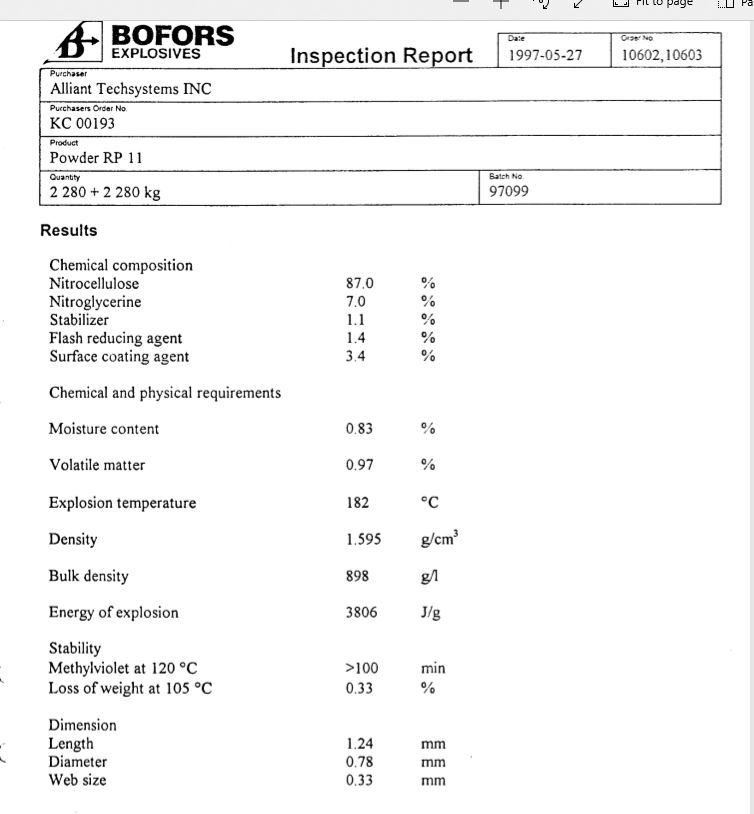
 
Powder Spec sheets

The powder maker supplies a spec sheet with each lot number. The sheets (about 8 pages) show the general specs and then actual loading data for a caliber the powder is suitable for. From that data an ammo maker can tell if it is a bit faster or slower than the last lot.

Here are two powders from Bofors. RP 11 is known to you as ReLoader15. You can see that water content is just under 1%. I know form another maker of powders, that water content is one way they deliberately speed up or slow down a given lot of powder. They warned me about letting powder dry out.


0apX18M.jpg


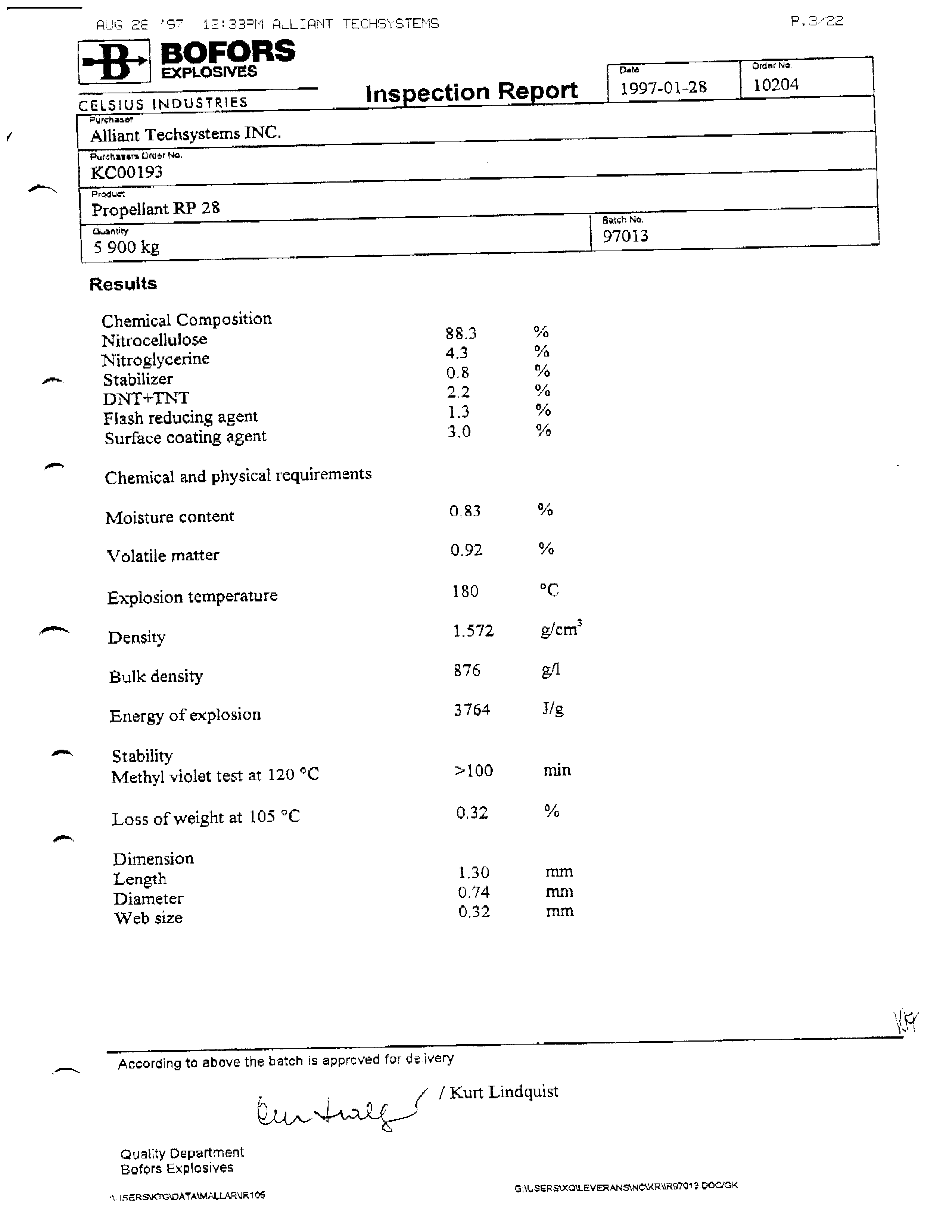
Here is another spec sheet. RP28 is not a canister powder. I found it an excellent powder for police sniper ammo. A little faster than 4895. It produced single digit SDs. Notice it has a flash suppressant.


5NuYOH8.png
 
Thanks Ganderite. Interesting that both powders have exactly the same moisture content. Is it by design? Or is that due to the humidity conditions of where it was made and packaged?
 
Put an open bowl of some powder in a box with an open bowl of water and let it sit for a few months, then test.

I have found that logic does not always work in predicting chemistry and physics outcomes.

But I agree, logic suggests that a powder could pick up moisture. Maybe add a cc of water to a quarter can of powder and see it it will all absorb? or adsorb? Test after a month to see if powder has slowed?
 
I break drums of powder (45 or 60 pound) down into 8 pound jugs. I use the window washer fluid jugs I collect from the gas station garbage cans. So far the jugs have held up well. Also use milk jugs. So far, so good.

Those work fine. I find them a bit on the lite side though. I have been using the four liter liquid laundry soap jugs. Each will easily hold 8 plus pounds. I get mine from a local laundromat. The owner picks up a dozen or so for me, from the garbage, when I ask him to. Usually calls me a week later with them tied together by their handles. I like that they come with pouring spouts and are heavy enough to block light or withstand being dropped.

When I worked in a glass container manufacturing plant, we made up One US Gallon Syrup bottles out of amber glass for A&W and Federated Co-Op. They allowed us to take the blemished jugs free for the taking back then. That's the only reason I went to the extreme of using glass.

As for your test of adding water to see what would happen.

I had some bulk surplus powder that was giving me inconsistent results, so I decided to toss it. I poured it into a bucket of water, thinking I would toss it into my wife's flower bed, until I read a post of your's several years ago, concerning how long it takes for the granules to break down.

I went to the intended flower bed an dug around a bit, only to find granules from the the batch of Bofors #44 powder I had dumped a couple of years earlier.

So, I took the powder in the water and dumped it all into the fire pit, in the back yard and forgot about it. Later, in the fall, I put together a fire. The summer rains had mixed the powder granules well into the ashes and gravel, so I didn't think about it. NO, THERE WASN'T A BIG FLASH, when I lit the fire.

What did happen, as the granules dried out or broke down from the heat, they did burn and create some very red flames for quite a while.

I was surprised, considering they had been unprotected and out in the elements for at least five months.
 
Last edited:
I have had HIGHER velocities in the Winter then in the summer with some powders ! I think tod bartell found the same and maybe other's . RJ

Internal combustion engines have shown significant gains with colder intake air as the oxygen density is increased.
If the air fuel ratio is on richer side it will allow for a little more power.
I’d have to think our barrels are very similar to a combustion chamber in an engine. I’ve found many loads that basically hit a peak and don’t increase velocity with a powder increase. To me that’s the ratio reaching the optimum burn possibility.


<Clearly I’m not a carpenter>
 
Last edited:
Internal combustion engines have shown significant gains with colder intake air as the oxygen density is increased.
If the air fuel ratio is on richer side it will allow for a little more power.
I’d have to think our barrels are very similar to a combustion chamber in an engine. I’ve found many loads that basically hit a peak and don’t increase velocity with a powder increase. To me that’s the ratio reaching the optimum burn possibility.

Uh, ammunition will work in a vacuum, same as it would in a 100% oxygen atmosphere at 16psi. It has nothing at all to do with the air. The oxidizer is built in to the chemicals that form those little kernels or flakes.
 

That pictures bothers me. Seems like it would be very easy to inadvertently switch lids. Maybe put the label on the glass instead of the lid so you take away the easy mistake. Yes I'm anal about my powder but I've been reloading for 40 years and I've made mistakes too, but I've never used the wrong powder by mistake. Anal is good for a reloader.
 
I have had HIGHER velocities in the Winter then in the summer with some powders ! I think tod bartell found the same and maybe other's . RJ

Interesting, maybe time to do some testing. In my reloading area the humidity averages about 40%ish all year round. So no major swings.

We know that "some powders" are temp sensitive (in both directions). With that said I have no idea how "wet" vs "dry" powder affects velocity.

*EDIT* I found some information on how humidity might affect velocity: http://bulletin.accurateshooter.com/2018/03/humidity-and-powder-burn-rates-what-you-need-to-know/
 
Back
Top Bottom