Powder Position Testing - 38sp & WST

VanMan

CGN Ultra frequent flyer
Super GunNutz
Rating - 100%
188   0   0
Location
Vancouver, BC
I do a lot of load development for revolvers, and noticed there was a pattern that the 1st shot was lower than the subsequent shots. I started with a CED M2 chrono about 10 years ago, moved up the a LabRadar, and now use a BulletSeeker Mach 4.

So a while back I decided to do some tests with Bullseye, WST, and Titegroup in my 38sp target loads.
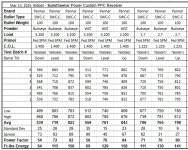
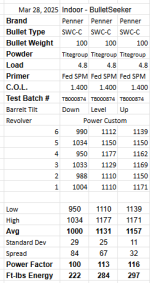
  1. string, prior to each shot, I would tilt the barrel down and then chrono that shot.
  2. string I would level the revolver and give it a shake, then chrono that shot.
  3. string I would tilt the barrel straight up, then chrono that shot.
There was a very large variance between each string, showing that powder positioned at bullet was significantly slower than powder positioned by the primer. I also tried one load that was slightly shorter COL, and used a magnum primer. This helps reduce the variance due to powder position, but still a noticeable variance.

1770959052025.png

1770959191376.png

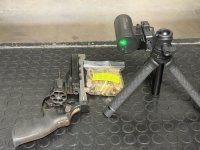
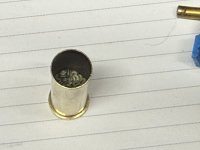
A suggestion was made by another CGN'er that a filler may help with powder position sensitivity. So I made up a batch of practice ammo as I normally do, and added 1.5gr of cotton ball filler for the last 50 rounds so I could run a parallel test.
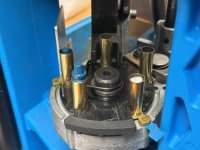
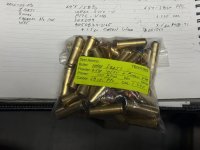
IMG_0911.jpgIMG_0912.jpg

I was concerned about any affect on accuracy of the load, so I did the following testing:
  1. test 24 rounds normal practice ammo - ransom rest @ 17y
  2. test 6 rounds freehand barrel tilted down, leveled, and tilted up prior to each shot using standard practice ammo
  3. test 6 rounds freehand barrel tilted down, leveled, and tilted up prior to each shot using practice ammo made with cotton wad added
  4. test 24 rounds practice ammo with cotton wad added - ransom rest @ 17y
  5. test 24 rounds match ammo - ransom rest @ 17y.
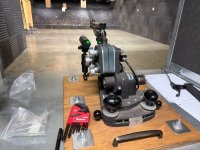
I used an old PPC revolver for all these tests. It's seen a lot of rounds, so I wasn't too concerned about abusing it a little.

The ransom rest testing
IMG_0995.jpg

Testing freehand
IMG_0988.jpg

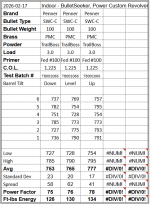
The results of freehand testing. Interesting results, the wadding did indeed reduce the variance due to powder position, but the level and barrel tilt up results were slower with the cotton wad filler. I'm wondering if compressing and expelling the filler consumes some of the energy from the powder charge?
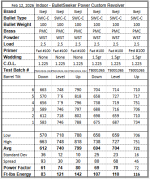
1770959956040.png

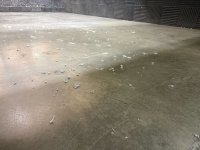
There was a lot of cotton fluff expelled. I noticed one wad of fluff stuck between the cylinder and forcing cone. Not liking that at all, so I kept an eye out for that between each shot.
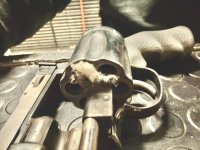
IMG_0991.jpg

Fluff all over the floor :ROFLMAO:
IMG_0998.jpg

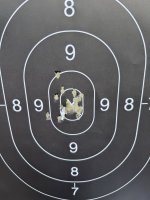
Surprisingly not a significant difference in group size. I knew although this PPC revolver had seen a lot of rounds, that it could do better, so I ran another test of match ammo through (target on the right).
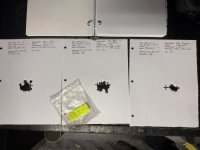
IMG_0999.jpg

Here's a video snippet showing all the cotton fluff blown out each shot
 
good testing. I wonder how a disc of newsprint pushed down over the powder would affect things. snug enough not to move up the case. I did that when I was testing some red dot loads with a .457 round ball in a 45-70
 
good testing. I wonder how a disc of newsprint pushed down over the powder would affect things. snug enough not to move up the case. I did that when I was testing some red dot loads with a .457 round ball in a 45-70
I'm not sure that a disc of newsprint would stay in place? Would the shock from firing one round shake that disc loose for the rest of the rounds in the cylinder?
 
Ideally we shouldn't have to include an extra tilt or shake between shots and just focus on the target out front, so getting that first shot consistent with the post-recoil position of powder in the next five could be a worth something. Your ammo is going to be nose-down in the holster or speedloader and that first round is probably still bunched at the front, while recoil may level it out somewhat while landing most of it up front again.

I miss Trail Boss.
 
VanMan, you definitely are Da Man!:) Great data! Great video! Thanks!

I would have expected most of the cotton to burn, but, obviously, it acts like wadding in a muzzle-loader or even a shotgun. There is not enough time for it to burn. You've proved to my satisfaction that wadding, especially in a revolver, is problematic, to say the least.

The big powder-doughnuts of Trail Boss that take up a lot of brass space seem to be the perfect solution for reduced loads, but............

Thanks again.

Also, great indoor range!
 
Ideally we shouldn't have to include an extra tilt or shake between shots and just focus on the target out front, so getting that first shot consistent with the post-recoil position of powder in the next five could be a worth something. Your ammo is going to be nose-down in the holster or speedloader and that first round is probably still bunched at the front, while recoil may level it out somewhat while landing most of it up front again.

I miss Trail Boss.
I think the light target load I’m using makes powder position more sensitive. I’ve got some 158gr Campro’s I may repeat this test with. Maybe make it a good stiff load and I can give those a good crimp. Could even run a parallel test using factory ammo 🙂
 
VanMan, you definitely are Da Man!:) Great data! Great video! Thanks!

I would have expected most of the cotton to burn, but, obviously, it acts like wadding in a muzzle-loader or even a shotgun. There is not enough time for it to burn. You've proved to my satisfaction that wadding, especially in a revolver, is problematic, to say the least.

The big powder-doughnuts of Trail Boss that take up a lot of brass space seem to be the perfect solution for reduced loads, but............

Thanks again.

Also, great indoor range!
Thanks, managing this indoor range is my retirement gig. Fits in well with my firearms and reloading hobby 🤠

I may have some Trailboss squirrelled away some place …
 
I think the light target load I’m using makes powder position more sensitive. I’ve got some 158gr Campro’s I may repeat this test with. Maybe make it a good stiff load and I can give those a good crimp. Could even run a parallel test using factory ammo 🙂
Exactly. It's doing a really tiny charge behind a light cast bullet in these long skinny 38 Special cases that really highlights the powder position issue, when you're loading for PPC and only have to get through the cardboard, or SASS and its easy power factor. Going up around a factory loading, or ICORE power factor, and there's less of a tiny-fill problem.
 
Thanks, managing this indoor range is my retirement gig. Fits in well with my firearms and reloading hobby 🤠

I may have some Trailboss squirrelled away some place …
The sides of the your revolver's brass run parallel, correct? You can insert the bullet as deeply as you want, right?...... just as you've done in one of your bullets in your photo of your re-loading turret. The blue nose of the bullet barely sticks up above the edge of the case.

This parallel-side situation is ideal for setting the bullet's bottom as close to the power as possible which makes reduced loads really practical. The bullet is ejected from the brass into the barrel's rifling without rotating, but then the rifling does its job and the bullet starts rotating before it exits the muzzle.

For a lot of rifle calibers in which the case sides are not parallel right to the top of the case, the reduced-load option is more difficult because, in the case of 308, there's going to be a lot of empty space below the bottom of the bullet .......... unless one can more or less fill it up with those doughnuts of Trail Boss.
 
The sides of the your revolver's brass run parallel, correct? You can insert the bullet as deeply as you want, right?...... just as you've done in one of your bullets in your photo of your re-loading turret. The blue nose of the bullet barely sticks up above the edge of the case.

This parallel-side situation is ideal for setting the bullet's bottom as close to the power as possible which makes reduced loads really practical. The bullet is ejected from the brass into the barrel's rifling without rotating, but then the rifling does its job and the bullet starts rotating before it exits the muzzle.

For a lot of rifle calibers in which the case sides are not parallel right to the top of the case, the reduced-load option is more difficult because, in the case of 308, there's going to be a lot of empty space below the bottom of the bullet .......... unless one can more or less fill it up with those doughnuts of Trail Boss.

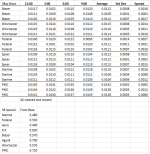
I started reloading for PPC about 3 years ago, and with some great mentoring I've found there are quite a few factors like case volume that can affect the accuracy/consistency of your load. One of the things was the case wall thickness of 38sp brass. At some point the case wall thickens toward the rim end (9mm cases even worse, that's another rabbit hole loading for my 929 lol).

I ended up measuring case wall thickness of various head-stamps, and where they start to thicken. I was finding that seating too deeply and then crimping with the Lee factory crimp die would swage down the bullet, leading to terrible accuracy. The answer from our PPC GM's is Starline brass. We all use that for match ammo. I was looking at using cheaper range brass, so did more investigation.

1771006712545.png

Happens we are running PMC brass on the range right now, so I'm using that brass to reload for my practice rounds and match ammo I give to newbies trying out PPC. From the measurements above, I could tell that the case wall thickened up ~0.72" from the base, so I started at 1.3" COL, all the way down to 1.2" COL in .010 increments. Each round crimped with the LEE FCD, I would then pull each bullet (takes a LOT of wacks with the inertial puller!) and then measure the dia at that base and shoulder of each bullet. At 1.220" there was no swaging affect, so I set the COL at 1.225" just to give a little margin for seating depth tolerance.

For match ammo, it's all Starline brass. For the 50y match ammo, it's new Starline brass, chamfered and blessed with the fresh blood of a chicken :ROFLMAO:
 
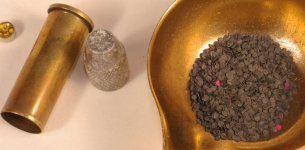
VanMan or anyone else, have you tried Alliant Red Dot? In the photo below, the disk-shaped grains of that "powder" look to my eyes to be fairly similar to unavailable Trail Boss's doughnuts. Might the Red Dot take up much more case-space than Titegroup, meaning that it would be less prone to shifting away from the primer end of the brass when the cartridge is moved into different orientations just prior to being shot?

(I suppose the energy-per-grain-of-weight comparison between Titegroup, Trail Boss and Red Dot would maybe be the all-important factor here. For example, if that number is much higher in the Red Dot than in the Trail Boss, that would mean less Red Dot required and, therefore, it would take up less space in the brass and be more prone to shifting.)

Thanks.
Alliant Red Dot.jpg
 
Red Dot was good powder, but Alliant seems to have taken a prolonged walkabout away from the Canadian market.
 
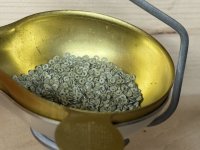
I did up 100 rounds with 3gr of a trail Boss under 100gr Penner coated SWC at 1.225” COL

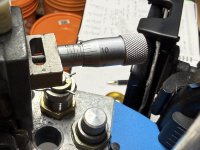
Trailboss is definitely fluffier. I had to go up to 2.35 on the micrometer adjustment on my small powder bar to get 3.0gr of Trailboss. That same setting gives 5.62gr of WST. So Trailboss takes up just under twice the volume as WST.

Will run a test next week for position sensitivity.

IMG_1113.jpegIMG_1116.jpegIMG_1117.jpeg
 
For practical purposes, at 15y, I’m not noticing a huge difference in accuracy caused by powder position sensitivity. This was from yesterday’s 1500 Revolver Optic match 1. 12 shots at 7y (6 reload 6 in 20 seconds) + 12 shots at 15y (6 reload 6 in 20 seconds). The shots pulled to the left is all me, not the ammo lol. I use the 1.4” COL rounds here because of the (relatively) quick reload required here.
 

Attachments

  • IMG_1051.jpeg
    IMG_1051.jpeg
    180.9 KB · Views: 2
  • IMG_1052.jpeg
    IMG_1052.jpeg
    100.1 KB · Views: 2
did the chrono testing of the Trailboss loads. It is definitely less sensitive to powder position! I did notice that my ES and SD were much larger too though. I'm guessing that the large donut shape of the powder does not meter as evenly through my Dillon powder measure. It took me ~50 dumps to settle the powder in the tube before I got a consistent charge weight, whereas with WST or Titegroup, it only takes 10-20 dumps to settle.

1771371006021.png
 
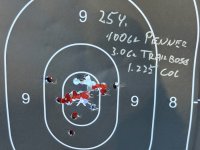
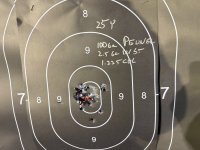
Brought out the Trailboss loads to practice tonight. No difference in accuracy at 25y. First shot barrel tipped down to load by speedloader, as would be normal during a match. All shots 25y right-hand-barricade.

There may be some difference in accuracy at 50y, so I may retest this after my cataract surgery in March.

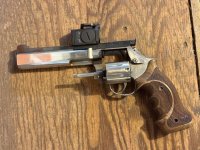
My PPC Revolver Optic
IMG_1150.jpeg


3gr Trailboss load 24 shots
IMG_1144.jpeg

2.5gr WST load 24 shots
IMG_1149.jpeg

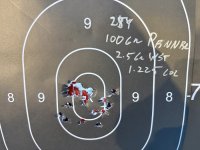
2nd run at 24 shots 2.5gr WST. Light was fading pretty fast, but still happy with this target lol
IMG_1148.jpeg
 
Back
Top Bottom