Powder residue on cases. Go hotter?

Purple shoulder

Regular
Rating - 100%
1   0   0
Location
Winnipeg MB
I'm hand loading for my 6.5x55 m96 and until recently had been using 45 grains of IMR 4350 and a 143 grain ELD-X. Its been working pretty good but I have seen a bit of risidue around the neck and shoulder. Recently I got 8 Lbs of 4350 from Higginson because I plan to shoot this thing a lot. Since I started using this new IMR 4350 I'm getting powder residue all the way back on the case. It seems like it isn't hot enough for a good neck seal so I've gone up a bit to 46.2 gns but im 1.2 gns over Hornady's max already. This is the old 96 action so I want to be careful here. Its still showing no pressure signs that I can see. With the original powder at 45 I was getting 2650fps. I haven't put any of these latest ones over the crony yet. My head says go a bit more but my gut says no. Or maybe it's the other way around.

28ku139.jpg


i5584y.jpg
 
I have had this happen to me not quite a bad as yours. I was using bl-c(2) with a lot of jump from the bullets to lands. It is likely from your chamber having a lot of freebore and your bullets seated at a normal length. You likely have a lot of jump to the lands. I would find out where your lands are and seat 20 jump - 15 jam. You may not be able to do this if feeding from a magazine.
 
Any time I get carbon on the outside of the case like you have it is caused by low chamber pressure and the case not sealing the chamber.

I do not think the carbon on the cases is lying to you about the chamber pressure. Meaning your new batch of powder is not generating the same pressure as the old.

What is strange is the Hogdon's load data tells you that IMR-4831 would give higher velocity at "less" chamber pressure.

You could like stated above and try crimping the cases, "but" if the case necks are work hardened you may be having more brass spring back after sizing and "less" bullet grip.

Bottom line, I have a similar problem with my "older" well used 30-30 cases because I do not anneal my cases.

Hogdon's data list the chamber pressure at 45,100 cup with a Sierra 142 HPBT at 24.8 grains of IMR-4350.

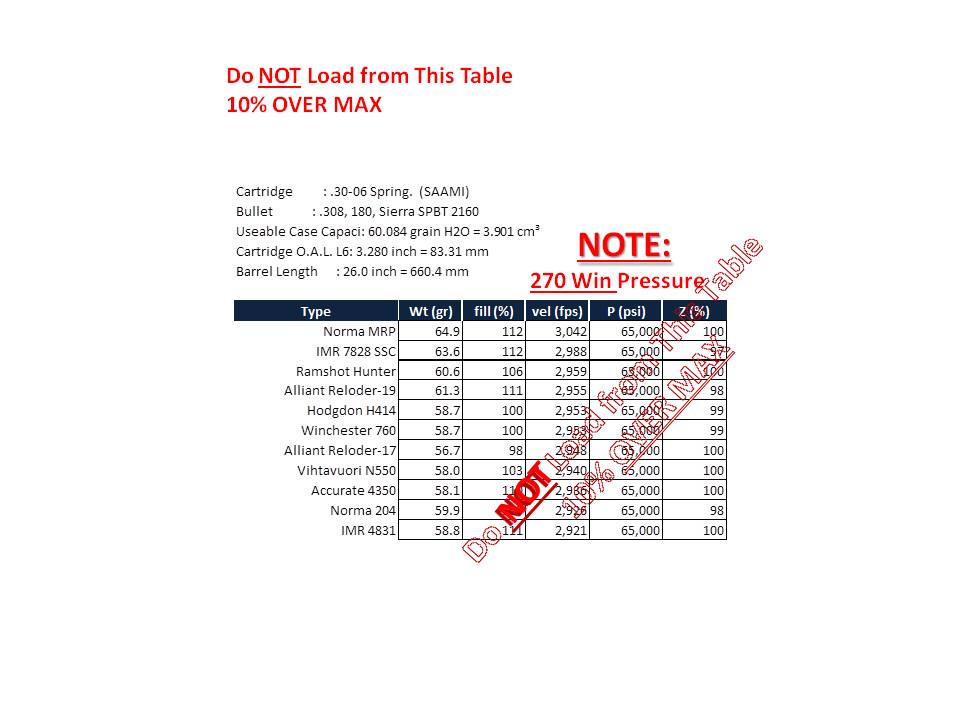
"BUT" SAAMI reloading data is for the weakest action the ammunition will be fired in. Example the 30-06 has a max chamber pressure of of 60,000 psi but the .270 is rated at 65,000 psi. Meaning the older military 30-06 rifles were not designed for the higher pressures but a necked down 30-06 case to .270 in a newer rifle could take higher pressures. The same applies to the .303 British loading data that is loaded for older enfield rifles and cartridge pressure standards.

A Metric Marvel: 6.5×55 Swedish Mauser (the loading data for the 6.5x55 is 51,000 psi or 46,000 cup but read the link below)
http://www.shootingtimes.com/ammo/hunting-ammo/a-metric-marvel-6-5x55-swedish-mauser/

Example below was being discused in another forum and it boiled down to a modern rifle like a Remington 700 30-06 could be loaded to .270 chamber pressures.
EPcuYSG.jpg
 
Try crimping the bullet.
Intresting you should say that as the bullets are seated out fairly far and only about 2 thirds of the way into the neck. I'd like to avoid crimping since its another variable but that might help to understand the issue.

I have had this happen to me not quite a bad as yours. I was using bl-c(2) with a lot of jump from the bullets to lands. It is likely from your chamber having a lot of freebore and your bullets seated at a normal length. You likely have a lot of jump to the lands. I would find out where your lands are and seat 20 jump - 15 jam. You may not be able to do this if feeding from a magazine.
I have about 50 thou jump and thats as far as I can go being a CRF and needing to fit the mag box. I might have to change bullets.

Any time I get carbon on the outside of the case like you have it is caused by low chamber pressure and the case not sealing the chamber.

I do not think the carbon on the cases is lying to you about the chamber pressure. Meaning your new batch of powder is not generating the same pressure as the old.

What is strange is the Hogdon's load data tells you that IMR-4831 would give higher velocity at "less" chamber pressure.

You could like stated above and try crimping the cases, "but" if the case necks are work hardened you may be having more brass spring back after sizing and "less" bullet grip.

Bottom line, I have a similar problem with my "older" well used 30-30 cases because I do not anneal my cases.

Hogdon's data list the chamber pressure at 45,100 cup with a Sierra 142 HPBT at 24.8 grains of IMR-4350.

"BUT" SAAMI reloading data is for the weakest action the ammunition will be fired in. Example the 30-06 has a max chamber pressure of of 60,000 psi but the .270 is rated at 65,000 psi. Meaning the older military 30-06 rifles were not designed for the higher pressures but a necked down 30-06 case to .270 in a newer rifle could take higher pressures. The same applies to the .303 British loading data that is loaded for older enfield rifles and cartridge pressure standards.

A Metric Marvel: 6.5×55 Swedish Mauser (the loading data for the 6.5x55 is 51,000 psi or 46,000 cup but read the link below)
http://www.shootingtimes.com/ammo/hunting-ammo/a-metric-marvel-6-5x55-swedish-mauser/

Example below was being discused in another forum and it boiled down to a modern rifle like a Remington 700 30-06 could be loaded to .270 chamber pressures.
EPcuYSG.jpg
I'm pretty sure the pressure is low. You can see the primers in the pic. They look like misfires. The cases are on load 5 and were annealed once before this. Ive done a fair bit of annealing and I'm sure they are soft enough but not cooked. I'm really thinking about bullet grip now. Maybe I need to seat them in more and get a bit more pressure before the bullet moves. Or crimp as suggested earlier. At any rate I appreciate the time guys. Thank you.
 
I had a couple of Swedish Mausers and saw the same thing with all of them. I tried hotter loads (but still stayed within the bounds of the Hornady reloading data) and it did not make any difference. My cases always came out sooty. Never did track down the problem. Showed my cases to more experienced guys at the range and they suggested that the chambers may be overly generous in their dimensions.

Just a data point, for what it's worth.
 
My old milsurp rifles had long fat chambers and my older Enfield rifles had cordite throat erosion. And the solution was to increase the load or use a faster powder.

A new case is annealed and has soft brass to help seal the case. And a work hardened case reloaded many times will have hard brass in the case neck.

The first time I had cases that looked like the OPs I was fire forming a 7.65 Belgian Mauser and using IMR-4350. The load was too light and the powder was too slow burning and there was snow on the ground and unburnt powder in the bore and in front of the shooting bench.

Just remember reloading manuals are guidelines and each rifle and the reloading components used will change the chamber pressure. Example I'm using Lake City 7.62 cases for my .308 and have to "reduce" the powder charge up to two grain of powder because of the cases reduced capacity.

In the Lyman reloading manual you will see they might have used a universal receiver and a pressure test barrel with a chamber and bore at "minimum" SAAMI dimensions. This gives the highest chamber pressures and a worn milsurp with its larger chamber and worn bore will have lower pressures.
Maximum pressure (SAAMI) 351.6 MPa (51,000 psi)
So again my 30-30 cases at 38,000 cup or 43,000 psi have soot on the case necks and sometimes on the case body using load data and my components.

If you make a workup load starting at the suggested starting load you will have soot on the case neck and body. And as you increase the load the soot gradually decreases until the chamber pressure seals the case neck.

6.5x55
Maximum pressure (C.I.P.) 380.0 MPa (55,110 psi)
Maximum pressure (SAAMI) 351.6 MPa (51,000 psi)

Bottom line if you have soot on your case body you are not anywhere close to max chamber pressure above. And again the loading data is for the weakest action the ammo will be used in and the OP is not loading for a Krag with one bolt lug.

The factory ammo for the .303 British is loaded below 43,000 psi but the No.4 Enfield rifle was later chambered in .308, 7.62 at 62,000 psi or 52,000 cup. So it is the older weaker designs of any cartridge that govern load data pressures. Example you have three different loading pages for the 45-70 rifles depending on design and age.
 
Last edited:
Try not to full length size the cases and use a neck sizer or lee collet. I would say that once formed there should be less issues on the subsequent firings. And be very sure the chamber or brass is clean of any oils before testing. Oil in the chamber could cause a false seal and lead to higher bolt thrust pressures. Elky...
 
Back
Top Bottom