Preserving and Maintaining an Old Revolver

Ve3xti

Regular
Rating - 100%
2   0   0
Location
Kenora
Hello all,

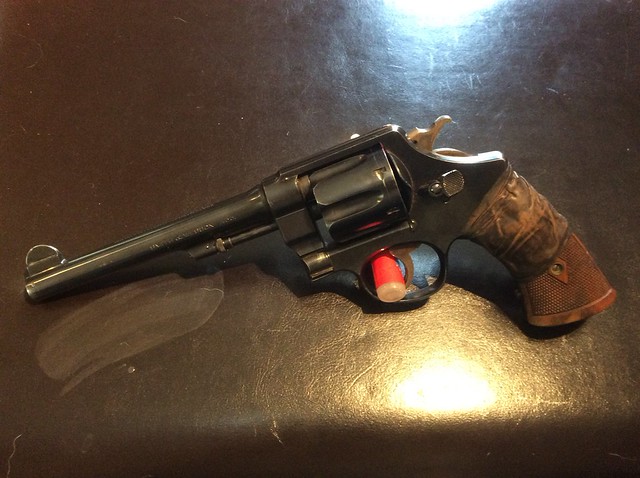
I was lucky enough to inherent a S&W .455 Webley 2nd Model.

S&W 455 by Justin Martin, on Flickr

I have never owned a firearm so I'm quite leery of cleaning and maintaining it. I have removed the tape as I plan to fire it and was happy to find no flaws in the frame or grip. Since the tape has been removed there is the sticky residue left behind by the tape. Any suggestions on how to remove it without damage to the wood or metal? The wood is slightly different colour where the tape used to be due to less handling, is there something I can do to clean the part that wasn't covered by the tape?

Should I strip down the gun and oil it or something?
I'd like to continue to pass this down in as good a condition as possible and am hoping for any suggestions on how to, and what to use to maintain and preserve it.

Thanks in advance!

Justin
 
Go to your local grocery store/hardware store and look for Goo Gone. It'll help remove the left over glue.

As for cleaning, same as with any revolver. The actual cleaner/oil will vary. Everyone here will have different idea's. I use G96. I clean my firearms after every shoot, and they don't get that dirty(Other then my .22's) so G96 is all I need. There are stronger products for firearms that have been left dirty for months/years on end.

If you're REALLY unsure, take it to a local gun smith. They'll clean/inspect it for you.
 
The g96 will get the tape goof off or WD 49, paint thinner, try soap and water on the wood, if the tape has been on for years, they may need a refinish.
if you are not a gun guy , just clean and oil, more guns have been wrecked by over cleaning and home gunsmiths than you can shake a stack at.
I you want to shoot it a bit rubber grips are cheap, lots of used one.
As it 455, I can't see you shooting it much, ammo cost, thou if you set up for hand loading with a small single stage press, price not bad.
I have never loaded 455.
Again , don't overdo the cleaning
When the gun is empty, no ammo, #### the hammer and check that the timing is O.K. cylinder should lock up solid each time you cycle it.
ease the hammer down, don't dry fire it on a empty chamber.
Amy more questions , Just ask, better than asking after something brakes.
Marshall
 
Judging from what I can see, they are the original grips, which should look like this -

SampW%20Hand%20Ejector_zpsls5zhewl.jpg
 
Thanks for all the info guys. It doesn't sound hard at all. Guess I was overthinking things as I didn't want to do anything that would damage it. I think I watch too much pawn stars. :)

They should be the original grips, the gun was my great great uncles and has his name and raved into the bottom of the grips. I also have the original 1935 registration. I'll get it cleaned up and post a few more pics as soon as I can.

Thanks again.
 
...and raved....

Stupid spell checkers, eh? :d

A good way to clean the insides since you're not all that gun savvy is to remove the screw for the wood grips and remove the grip scales. You'll see the mainspring for the hammer and a rather generous size opening into the guts. The trick now is to flush out the old congealed oil, fouling and dirt with a good solvent that will clean and leave behind a light lubrication for protection and operation. A good option is the easy to make up home cleaning mixture called Ed's Red. A quick Google will turn up the recipe. It's a soup of solvents to dissolve and clean with some ATF which will be left behind to protect and lubricate. Best of all when flushed through generously you don't need to disassemble the gun. Just flush, drain, repeat a few times more than drain and allow the solvents to dry away and leave the oil behind. Wipe off the excess on the outside and put the grip scales back on.

It's rather nasty stuff for odor and the solvents used are not good for your skin or internal organs. So do it somewhere with excellent ventilation and wear disposable nitrile gloves. The mix is good to re-use a number of times. So don't toss out the stuff that drains out. Keep it and let it settle out then keep re-using the top liquid for a few more times. When it's done just include it with any waste motor oil you might have. Or take it in an old oil bottle to an oil disposal location. Because you want to use it fairly generously you'll want a bucket to catch the drainings and a squeeze bottle such as a ketchup bottle to suck up and then squirt into all the varioius openings. Work the action a few times while it's soaking to work the mix into and out of all the points.

For the cylinder crane assembly just pour it over the works and operate the ejector and spin the cylinder.

A good trick for cleaning out the chambers in the cylinder is, in your case, a .50Cal brass bore brush on a short cleaning rod extension used in a hand drill to scrub out the chambers. Use a moderate speed so the bristles dig into any crusty fouling more readily.

For the barrel you'll need a cleaning rod, bag of suitable size cloth patches and a .45caliber jag to push through cleaning patches. The little eye loop style jags are only good for putting solvent into the bore. To actually scrub clean you want the round size correct jag so it pushes the cloth patches into the rifling. For extreme cases a few passes with a .45cal bore brush may be needed. But generally only if you notice it's leading up.

For some odd reason .455 ammo IS hard to buy and just as hard to find supplies of suitable stuff for reloading. The good news is that since it's a low pressure round the brass will just about last forever. And since you likely won't shoot it a whole lot paying the elevated price for the cast bullets won't be all that bad. Rusty Wood Trading has them if you can't find them anywhere else. Or possibly one of the .455 gang here can be talked into casting and lubing up some bullets for you from time to time.

For storage be sure you keep it in a cabinet that is located where it is warm and dry. In particular watch out for humidity in cool basements during the summer when we don't use the heating. That can rust a gun quicker than you can turn around. It sounds odd but it's during the summer when you want to run a low power warmer in the gun cabinet such as a Golden Rod in order to lower the humidity inside the cabinet. Or you can run silica packs or similar. But if you rely on the chemical packs be sure to check them often. Moisture leaks in around seams even if they are a close fit. And not many gun cabinets are actually sealed.

I know shooting revolvers is great fun regardless of the guns. And shooting one with such a strong family and historical connection will be just that much more fun. Enjoy it and take it out often.

 
Ed's Red:

1 part Dexron ATF, GM Spec. D-20265 or later.
1 part Kerosene - deodorized, K1 (Ihave found regular old kerosene works fine)
1 part Aliphatic Mineral Spirits (ie "paint thinner")
1 part Acetone

Cheap like borscht, and it works.

As an alternative, you could also soak it in paint thinner (or toluene, which is slightly "hotter", or a 50/50 mix of the two) in a shallow container overnight. Then soak in a 50/50 mix of Simple Green & water for an hour and flush with hot water. (Simple Green, used nearly straight up, can be used on a warm engne to degrease. Very useful stuff.) Then oil lightly inside & out. The grips can be gently cleaned with a soft toothbrush and refinished with Tru Oil or boiled linseed oil or tung oil.

Jethunter here on CGN does good boolits. Brass may be hard to find, but as BC Rider says, lasts forever. Lee Precision has dies for .455 Webley, although the slot in the case holder (which is not specific to .455) is a little wide as the .455 rim is very thin. Works OK, though.


You have a nice piece of history there.
 
I've read you can turn .45 Colt and .45 Auto Rim brass into .455 Webley by shaving the rim thickness. Obviously not from the headspace or you would risk protruding primers.

I don't know how well it works in practice.
 
I've read you can turn .45 Colt and .45 Auto Rim brass into .455 Webley by shaving the rim thickness. Obviously not from the headspace or you would risk protruding primers.

I don't know how well it works in practice.

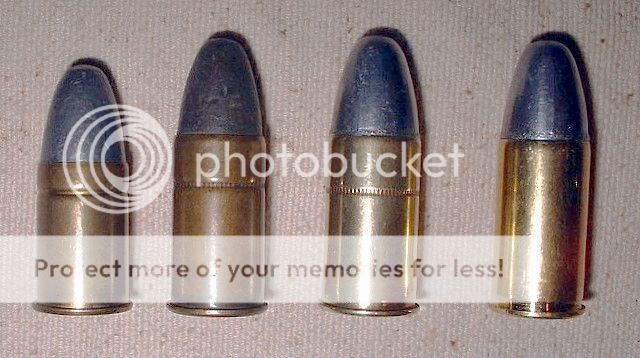
The rounds in this photo are (from left to right): .455 Webley Mk II factory load, .455 Colt factory load (North American commercial designation for the longer .455 Webley Mk I), reload in .455 Colt case, reload in .45 Colt case modified to .455 Webley Mk I specs.

455loads_zpsvgasrhmr.jpg


As indicated, the .45 Colt modification involves thinning the rim from the front (as maxman1 indicates) and shortening the case somewhat. They work just fine, although the rim diameter of the .45 Colt is a bit less than the .455 Webley, so occasionally an extractor can skip past the rim on a tight case ... but that is no problem rally unless you are into speed shooting!

As he also mentioned, .45 Auto Rim cases can also be used, but in my experience those can be fairly hard to locate compared to .45 Colt, and thus tend to be be significantly more expensive.
 
Back
Top Bottom