Pressure Signs

doowroh

Member
EE Expired
Rating - 100%
31   0   0
Location
GTA
Rifle is a Savage 110 Scout (short action) .308 Win. Purchased brand new.
It went in for warranty work because POI at 4~6" higher than POA at 100m (factory Williams iron/peep sights).
The repair order says that the barrel was "untrue" and that they have straightened the barrel.

I'm relatively new to handloading.
I have several boxes of Federal GMM .308 Win (Sierra MatchKing) 168 grain.
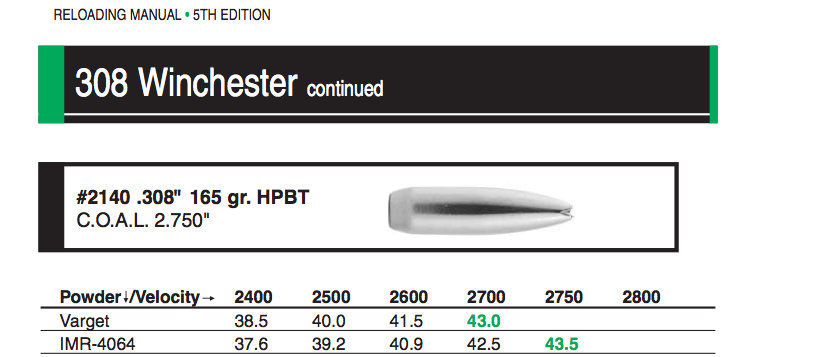
The main purpose of the rifle is for hunting (inside of ~200 yards). I'm trying to develop a load with Sierra GameKing 165 grain HPBT (#2140) with either Varget or IMR-4064 as per this load data.
nCgAtnH.png


Yes, I loaded, AND fired loads higher than published max. I felt somewhat comfortable as the Nosler load data show max. charges much higher than Sierra. Granted, their bullets are different, so the bearing surface, and thus pressures are bound to be different as well.

I loaded up some rounds as follows:
Varget: 42.0 grains -> 45.5 grains (5 rounds each, increasing in 0.5 grain increments)
IMR-4064: 41.0 grains -> 44.0 grains (5 rounds each, increasing in 0.5 grain increments)

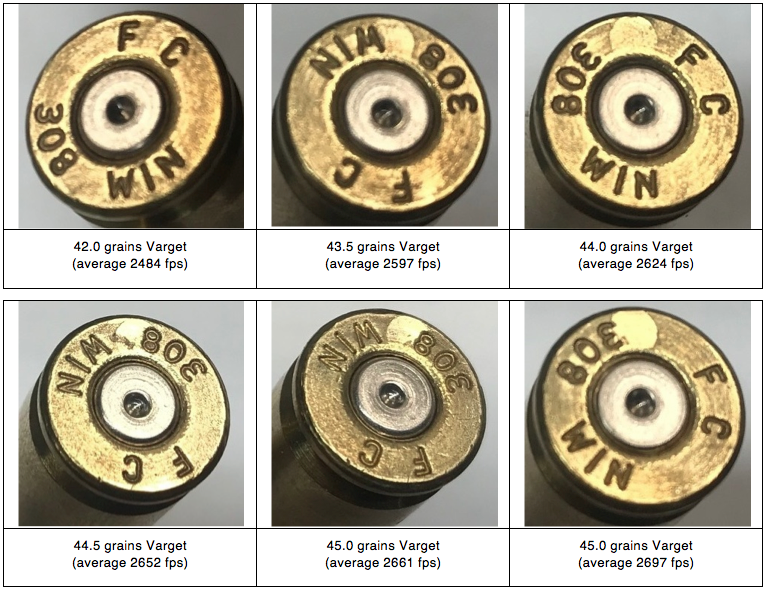
My concern at this point are the pressure signs I'm seeing on the brass. It's Federal brass, so it's known to be soft.

Varget:
Xdg4uD8.png


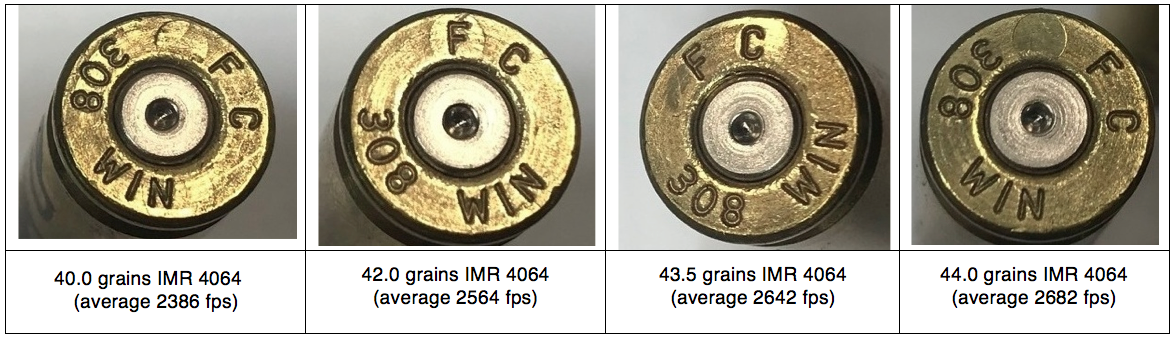
IMR-4064
2gYmS3d.png


So I can understand the ejector marks on the case heads that are above the published Sierra data, but there are also ejector marks on some of the cases that are well below the Sierra max, especially with the IMR-4064. Bolt lift was IMO never really stiff for any of these shots.

I think that I'm going to have to start over, at the very least since my barrel was 'bent'. I can imagine that will change the pressures to some degree. I'm also hoping that I'll be able to get some usable data with the Saterlee load development the next time I'm out. I would use neck-sized brass, at least that seems to be the general internet consensus.

Should I be concerned with these pressure/ejector marks?
Are there any other recommendations for load development?
Should I/can I re-use this brass?
I'm not great at reading primers. How do these primers look?
Full length or neck size only?

Thanks for looking, and thanks for your feedback.
 
Last edited:
if the main purpose of the rifle is for hunting ..... at what range 0-200 yds

if it is 50- 200 yards you do not need to hot rod the 308 ....... the 30-30 with its lower speed/ energy is still good for those distances

with those pressure signs your primer pockets are growing/ and your brass is taking a beating

You need to slow it down and reduce the pressure ..... find a node at a slower speed
 
When you see ejector marks on the head of the case, the pressure is too high for that brass/load.

FC brass IS SOFT, so indications may show sooner with it. All the loads you have shown [except,
possibly one with Varget] are causing brass to flow.

Federal brass will open primer pockets under these conditions. Unless you are very short of brass,
I would turf any that have marks on the head.

As far as primers go, they are a poor indicator of pressures, since they vary considerably from lot to
lot and from manufacturer to manufacturer.

Back down a bit and start over. Dave.
 
Edited the post above. Intended use is white tail deer hunting inside ~200 yards.
Thank you for your feedback.
 
Anytime you have ejector marks it means the brass is flowing into the ejector from high pressure "for that brand of brass" and the brass is stretching beyond its elastic limits.

The load data in any manual is ball park and doesn't apply to all firearms and the components used. In the Lyman manual some of the data comes from pressure test barrels with minimum chamber and bore dimensions. This pressure test barrel will generate the highest pressures, and some of the data comes from the specific firearm listed.

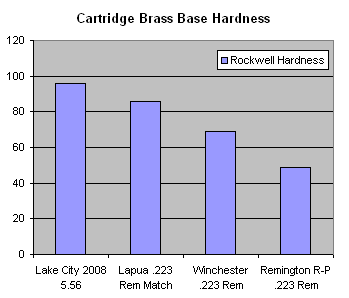
I have a .308 Savage Hog Hunter and used Lake City 7.62 military brass that is harder in the base than commercial .308 cases and have never seen any ejector marks.

That being said you might have defective soft brass, a tight bore or something else causing the problem. I would try some factory loaded ammunition as a base line and then try another brand of brass.

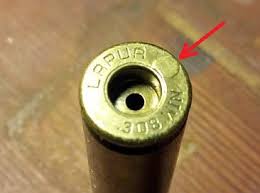
The photo below was posted at accurateshooter.com by a long range competitive shooter. To test the brass he increased the load until he got ejector marks then backed off 1 or 2 grains and then knowing the elastic limits of the brass. Meaning how much pressure the case could take before deforming the brass, and this can vary between brands of cases.


KtO65uH.jpg


Below is why I use Lake City brass in my AR15 and .308 rifles. The Lake City brass and commercial contract ammunition for the military is made of harder brass in the base of the case.

How Hard is Your Brass? 5.56 and .223 Rem Base Hardness Tests
http://bulletin.accurateshooter.com/2014/05/how-hard-is-your-brass-5-56-and-223-rem-base-hardness-tests/

4kXrGuI.png


Again, I would try some factory loaded ammunition as a base line and see if you get ejector marks, and then try another brand of brass.

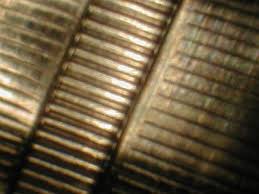
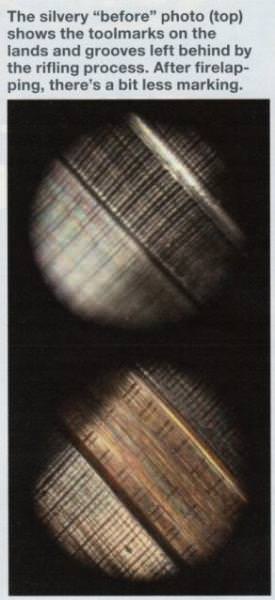
Below is a bore scope photo of a Savage buttoned rifled barrel, and I always wondered if this could raise the pressure.

GpTCke2.jpg


JF55dKK.jpg


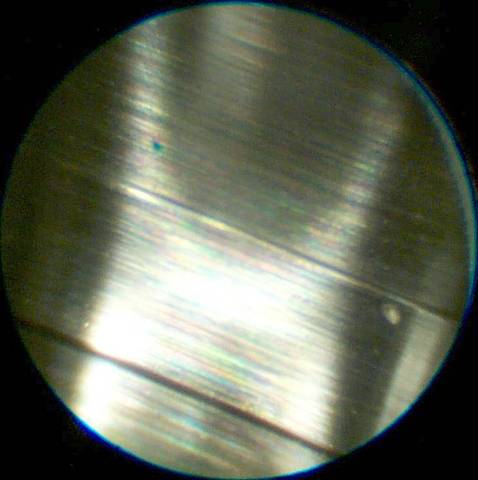
Below is a bore scope photo of a custom hand lapped barrel as a comparison to the 'speed bumps" in the Savage barrel.

S82Lb6S.jpg
 
Last edited:

Ejector marks mean high pressure.

The loading manual data is to tell you what happened in THEIR rifle. It does not mean much about your rifle.

That is why they publish a START load. Start there and work up. I would say that a grain below the load that shows an ejector mark is about Max for YOUR rifle.
 
I also monitor pressures using the C.H.E methods..while doing load development , combined with a cronoy has served me well. Like ganderite said, the manual is a starting point

As stated primers are a poor indicator, due to variances in hardness.
Every rifle reacts differently to different components, and combinations of powder , bullets .
powder can vary lot to lot in burn rate compared to the powder they used in the manual.
I let the rifle tell me what combination of powder charge , brass and bullet it shoots best.

All the uncontrolled variables make handloading interesting,
Have fun , take notes, and pay attention to detail
 
Looks to me like around 43gr of Varget would be a max load for your rifle with the brass and bullets your are using for this test. 42gr looks fine and 43.5gr of Varget is starting to show brass flow so someplace between them.
 
For those of us that have been reloading for a while, we rarely push the limits of a cartridge as you are doing. The reason is simple, there is absolutely no upside, and potentially lots of downside. Case in point, you run out of Federal brass, and pick up some old IVI brass at the range. Load them up with your pet load (eg 44+ grains of Varget) and shoot them. Report is loud, gas escapes from the action, etc...
Give yourself some margin of safety, you'll come to appreciate it.
 
For those of us that have been reloading for a while, we rarely push the limits of a cartridge as you are doing. The reason is simple, there is absolutely no upside, and potentially lots of downside....

Give yourself some margin of safety, you'll come to appreciate it.

cosmic, your advice is well heeded.

Admittedly, I had convinced myself that I needed as much velocity as possible. I was looking for the maximum amount of energy for my hunting load. I am loading to hunt white tail deer - in Ontario bush, so likely inside of 100 yards; 200~300 yards tops. I was also hoping to find a very accurate load during that same process.

Now that I've learned a few things, I'll be starting again, looking for a lower accuracy node, and using ballistics calculators to find my energy.

As it turns out, the Hornady ballistic calculator suggests that I'll still be over 1000 ft. lbs of energy @300 yards (which is a shot that I'm unlikely to take while hunting with this rifle) at speeds around 2300 fps. That's considerably lower (and safer) than the 2500~2600 fps that I was getting at the upper levels of Varget.
 
As cosmic stated above give yourself a bigger margin of safety with your Federal brass because it may be on the soft side and reduce your loads. And even at your lightest loads there are signs of ejector marks and over stressing the brass. And again I would change brands of brass, at

Below is a link from Hodgdon's website where you measure the base expansion just above the extractor groove. This does not tell you the chamber pressure, it simply tells you how hard or strong the brass is in its base. And again I know American Lake City brass 7.62 is harder than commercial .308 brass. And I assume your Canadian made military brass is made the same way.

Simple Trick for Monitoring Pressure of Your Rifle Reloads
http://www.hodgdonreloading.com/reloading-education/tips-and-tricks/simple-trick-monitoring-pressure-your-rifle-reloads

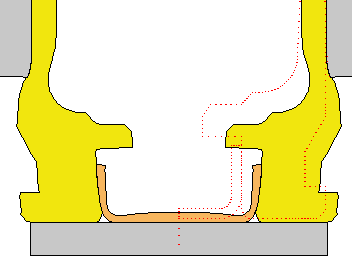
Below are the effects on the unsupported base of the case from over pressure and pushing the brass case beyond its elastic limits. And this is what the link above is telling you to measure after firing the cases.
Bottom line, if you do not have "any' ejector marks and the base of the case is not expanding beyond the hodgdon's link above you are not over stressing "that brand" of brass.

IBJQA9p.gif


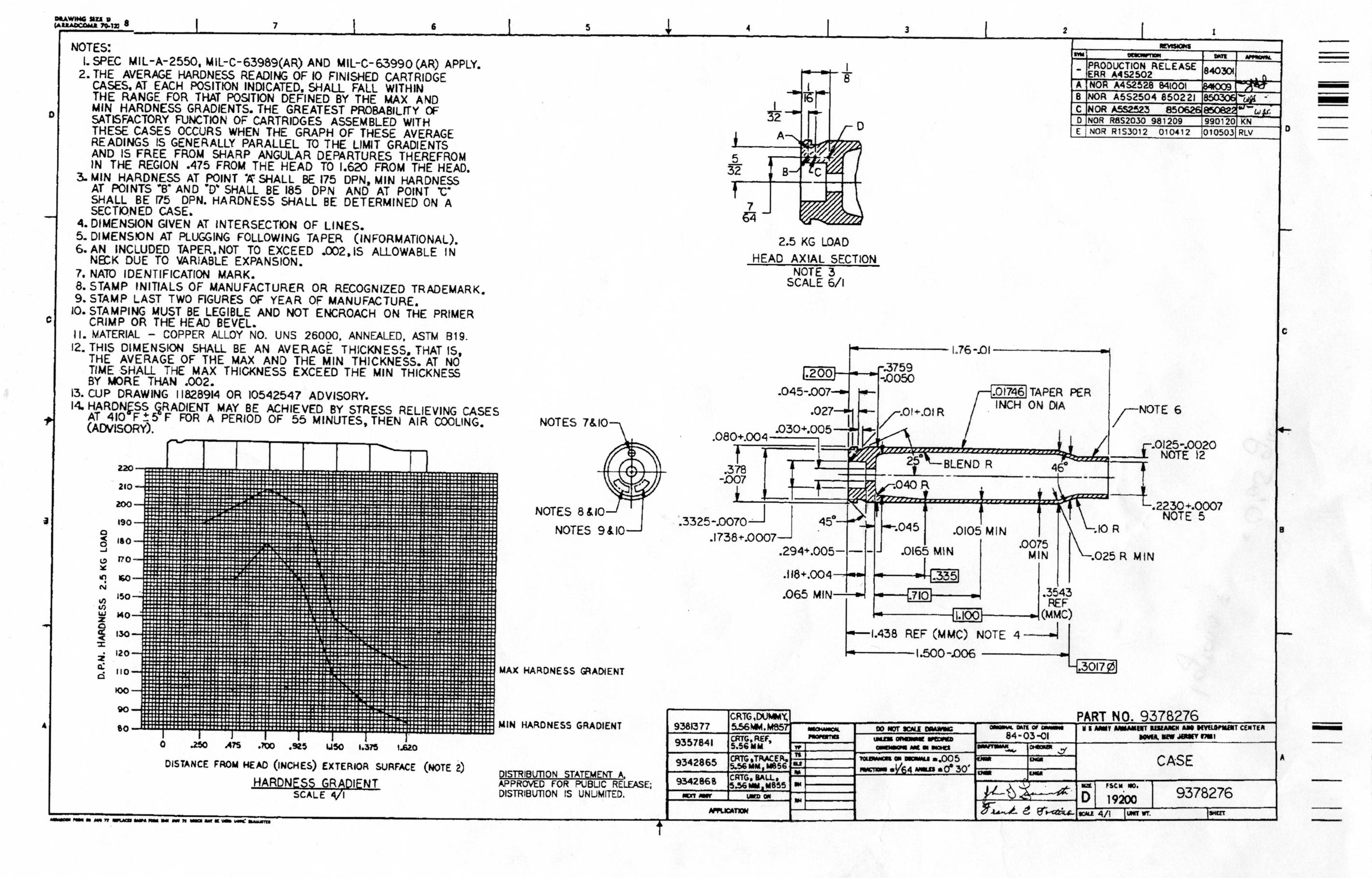
Below is the U.S. Military specifications for 5.56 cases, in the lower left is the hardness gradient for the brass. And I'm posting this is because not all manufactures use the same type and quality of brass in their cases.


JcVlKzc.jpg
 
cosmic, your advice is well heeded.

Admittedly, I had convinced myself that I needed as much velocity as possible. I was looking for the maximum amount of energy for my hunting load. I am loading to hunt white tail deer - in Ontario bush, so likely inside of 100 yards; 200~300 yards tops. I was also hoping to find a very accurate load during that same process.

Now that I've learned a few things, I'll be starting again, looking for a lower accuracy node, and using ballistics calculators to find my energy.

As it turns out, the Hornady ballistic calculator suggests that I'll still be over 1000 ft. lbs of energy @300 yards (which is a shot that I'm unlikely to take while hunting with this rifle) at speeds around 2300 fps. That's considerably lower (and safer) than the 2500~2600 fps that I was getting at the upper levels of Varget.


We'll teach you all the tricks... don't get too caught up in ballistics, especially if you are deer hunting in Ontario. The longest shot taken at our camp over the years was 150 y, most are in the 70 y range. Most deer were taken with the lowly 30-30....
Practice your shooting, particularly off-hand shooting, or shooting off sticks. You will likely find an accuracy node at mid-range power levels. Finally, your rifle will naturally tune to a particular bullet weight - in 308 you have 150, 165, and 180 grain options. Give consideration to trying different bullet weights - you will be surprised by the results. And you will likely find that flat based bullets generally perform better than boat-tails, unless you get the expensive match grade boat-tails. (Game-Kings are not match grade...) I've had very good luck with the plain ol' Hornady spire points.
 
Back
Top Bottom