












































There was a thread recently that brought up the infamous jamming issues of the Ross Mark III rifle in WWI. This comment from that thread caught my eye:
“The Ross probably has better primary extraction that most rifles. The bolt lugs are essentially a large screw, and cycling the bolt causes the lugs to both rotate and move rearward at the same time. It has plenty of primary extraction.”
The comment is true as far as it goes, but doesn’t capture the entire issue. The primary extraction of the Ross Mark III is very typical of similar vintage bolt action rifles, see attached table.
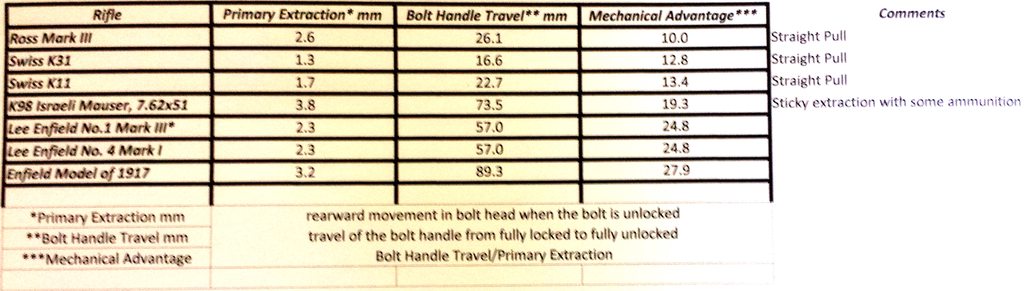
What stands out with the Ross is the low mechanical advantage its bolt system provides when applying that primary extraction. The seven rifles in the table represent a not very random sample of just what happens to be in my gun cabinet. The primary extraction of the sample rifles range from 1.3mm to 3.8mm, with the Ross right in the middle at 2.6mm. Where the Ross stands out is in the mechanical advantage of its bolt system. I calculated mechanical advantage as the distance the bolt handle moved during the unlocking of the lugs divided by the primary extraction. An analogue for this mechanical advantage concept would be the pitch of screw threads. Screws with fine threads are easier to drive against friction than a similar coarse threaded screw. As you can see from the table the Ross rifle is lowest of the group and has less than half the mechanical advantage of some of its contemporaries. The Ross has a value of 10 whereas the Lee Enfield has about 25. I believe this is really an important part of the Ross jamming issue. All of the military rifles of WWI were shallowing some very bad, mass produced ammunition. Some rifle designs were just better at ripping those sticky casings out of their chambers.
A more complete discussion of primary extraction is available from Bloke on the Range at: https://www.youtube.com/watch?v=ZFqOK843IyU
“The Ross probably has better primary extraction that most rifles. The bolt lugs are essentially a large screw, and cycling the bolt causes the lugs to both rotate and move rearward at the same time. It has plenty of primary extraction.”
The comment is true as far as it goes, but doesn’t capture the entire issue. The primary extraction of the Ross Mark III is very typical of similar vintage bolt action rifles, see attached table.
What stands out with the Ross is the low mechanical advantage its bolt system provides when applying that primary extraction. The seven rifles in the table represent a not very random sample of just what happens to be in my gun cabinet. The primary extraction of the sample rifles range from 1.3mm to 3.8mm, with the Ross right in the middle at 2.6mm. Where the Ross stands out is in the mechanical advantage of its bolt system. I calculated mechanical advantage as the distance the bolt handle moved during the unlocking of the lugs divided by the primary extraction. An analogue for this mechanical advantage concept would be the pitch of screw threads. Screws with fine threads are easier to drive against friction than a similar coarse threaded screw. As you can see from the table the Ross rifle is lowest of the group and has less than half the mechanical advantage of some of its contemporaries. The Ross has a value of 10 whereas the Lee Enfield has about 25. I believe this is really an important part of the Ross jamming issue. All of the military rifles of WWI were shallowing some very bad, mass produced ammunition. Some rifle designs were just better at ripping those sticky casings out of their chambers.
A more complete discussion of primary extraction is available from Bloke on the Range at: https://www.youtube.com/watch?v=ZFqOK843IyU






















