Question about maximum book loads

1899

CGN Ultra frequent flyer
Rating - 100%
39   0   0
Location
West
So I have been thinking about this for quite some time now, and I haven't really come up with a reasonable explanation. I therefor turn the issue over to my learned friends.

There are often loads listed, with accompanying pressures, as "maximum" even though the loads are not compressed (i.e. there is more room in the case) and the pressure does not hit SAAMI maximums. Why is this?

Here are a few examples:

.338 Federal
180 AB
50.0gr BL-C(2)
47,500 PSI

compare to
47.0gr Benchmark (compressed)
61,300 PSI


.30-06
180gr Sierra
61gr W760
54,100 PSI


There are many examples like this. Is it to account for temperature sensitivity of the powder? I realize that BL-C(2) and 760 are both ball powders, but there are other examples like with IMR 4895 and 4064 too. Just seems interesting that some maximum loads appear to be so mild.
 
It's possible that they found that after that load in their test rifle, the pressure could spike unexpectedly. That being said, the pressures spike differently in a 20" barrel than a 26" test barrel that the book writers seem to use...
 
There are often loads listed, with accompanying pressures, as "maximum" even though the loads are not compressed (i.e. there is more room in the case) and the pressure does not hit SAAMI maximums. Why is this?

Each rifle is different and two rifles of the same caliber can have different max loads. The reloading components vary, different make bullets may vary in hardness, case capacity, etc.

In the Lyman manual you will see load information from a universal receiver and a test barrel with minimum chamber and bore dimensions and using a copper crusher or pressure transducer. Many manuals will list a specific firearm used and with these the pressure readings come from a strain gauge glued to the barrel. So again you have "MANY" variables and why you are told to work up a load from the suggested starting load looking for excessive pressure signs.

And what you are referring to is called loading density and compressed loads.

Nosler FAQ, What is load density and how is it possible to have more than 100% load density i.e. compressed load?

Load density is a calculation of case capacity versus powder bulk density. Case capacity is measured by taking a piece of firedbrass, filling it up with water and then loading a bullet into the case neck at the tested OACL listed in Nosler’s Reloading Guide #7. The weight of water left in the brass after the bullet has been seated is the case capacity. Powder bulk density is how many grams of a particular powder fit into one liter.


Example:

In Nosler’s Reloading Guide #7, a 270 WSM case holds 73 grains of water (case capacity) loaded with our 130 grain bullets. It also states that the maximum charge of MAGPRO is 72 grains in this cartridge. Incidentally, MAGPRO has a powder bulk density of .970 grams per cubic centimeter so the load density calculation looks like this:

Powder Charge (72 grains) ÷ [Case Capacity (73 grains) x Powder Bulk Density (.970)] = 102% Load Density.
 
So the suggestion is that the .338 Fed load with maximum BL-C(2) at 47,500 PSI could somehow exceed the 62,000 PSI SAAMI spec in a different rifle? I would assume that IMR, which is where I got those loads from, would use the same test rifle for the same chambering.

So put a different way, even though load density is under 100%, and even though the pressure is tested at 47,500 PSI when the SAAMI max is 62,000 PSI, we are saying this is the maximum load because...

Purely an academic question as I have worked up loads for many years now, sometimes stopping below book and sometimes going over.
 
One word, Liability. They also have to take into consideration that not all guns are in top shape, and that steel has come a long way in the last 100 yrs. with regards to strength, but that there are a lot of older guns out there where the steel may not be up to todays level
 
One word, Liability. They also have to take into consideration that not all guns are in top shape, and that steel has come a long way in the last 100 yrs. with regards to strength, but that there are a lot of older guns out there where the steel may not be up to todays level

Yes, but we are talking the same manufacturer - in this case IMR - and the same bullets, in what I assume is the same test firearm, where the maximum loads vary from 47,500 PSI to 61,300 PSI. If it was about liability then why suggest one load that is 13,800 PSI higher than another? And it's not like the low pressure load is a fast burning powder where pressure ramps up really quickly, or a small change in charge may equal a large change in pressure.

Maybe Andy is right - that's the highest they tested.
 
I remember Ganderite explaining this. I believe he said they test a string of rounds and measure the pressure. Some powders produce a more consistent max pressure while others tend to spike. Max pressure listed is the average and loads should not spike above max SAAMI pressure. Comparing IMR4895 to H4895 for same bullet weights shows the Hodgdon at noticeably lower max pressure. I would surmise that H4895 tends to spike more in that loading than IMR4895.
 
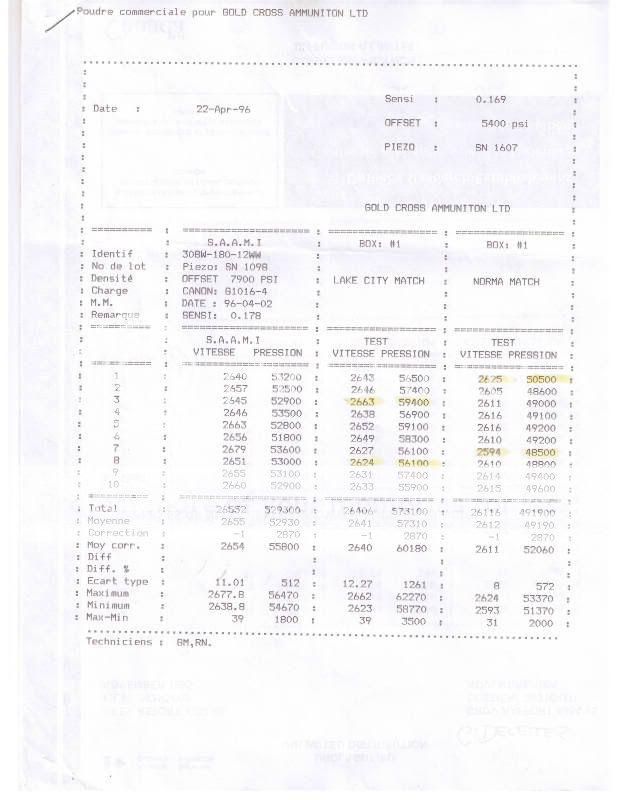
I have worked in the lab, testing ammo, and helping to create load data.

A typical batch of test ammo is 20 rounds. Each is fired for pressure and velocity.

The averages are calculated.

There are maximum limits to average pressure.

BUT, the limit might be expressed at max average 63,000 psi and no single round over 65,000 psi.

When you see max load with an average well under the max, it means the pressures were erratic.

Look for a load with a max test pressure close to the SAAMI max pressure. That means the pressure build up was more linear.

You have to start low and work up. I guarantee your rifle is nothing like the very high quality SAAMI test barrel the lab used on a popular caliber like 308, ot the avergae rifle they used for less popular calibers. Each rifle is different.

testdatasheet.jpg
 
Interesting. So the powder/chambering combo that shows low pressure for "maximum" loads are ones where the pressures were erratic.
 
I have worked in the lab, testing ammo, and helping to create load data.

A typical batch of test ammo is 20 rounds. Each is fired for pressure and velocity.

The averages are calculated.

There are maximum limits to average pressure.

BUT, the limit might be expressed at max average 63,000 psi and no single round over 65,000 psi.

When you see max load with an average well under the max, it means the pressures were erratic.

Look for a load with a max test pressure close to the SAAMI max pressure. That means the pressure build up was more linear.

You have to start low and work up. I guarantee your rifle is nothing like the very high quality SAAMI test barrel the lab used on a popular caliber like 308, ot the avergae rifle they used for less popular calibers. Each rifle is different.

testdatasheet.jpg

Are there problems with secondary explosions in barrels from unburnt powder that exceed max?? Could that be a reason that some are below max pressure??

What sorts of temperatures are loading book loads tested at??
 
Some companies like Hornady also provide data to a set velocity rather than to maximum pressure. It is conceivable that there will be cases where a given load will not make the next "step" without drifting outside their acceptable limits.
 
Back
Top Bottom