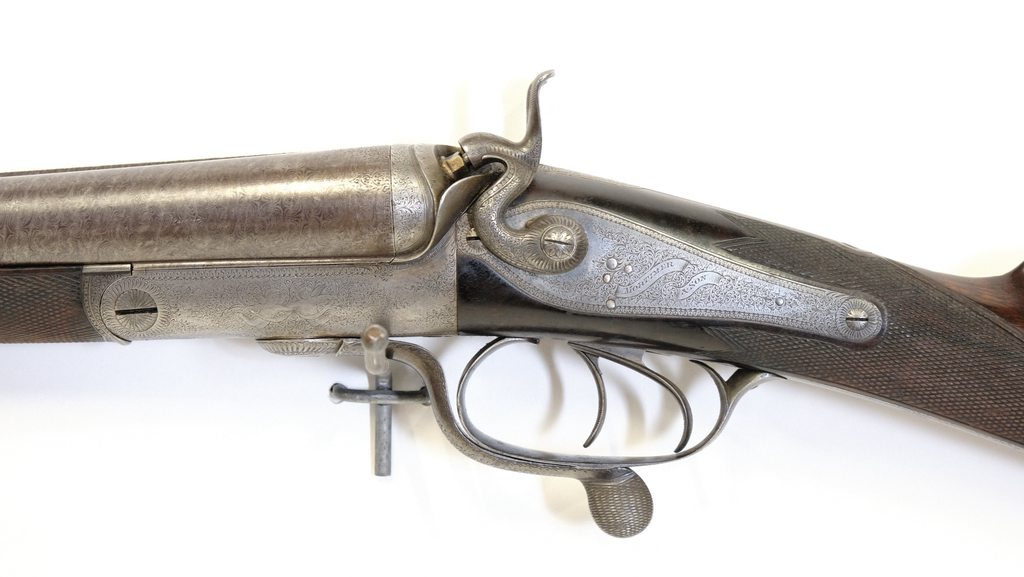
Questions re choke vs barrel length

ParksPipes

CGN Regular
Rating - 100%
2   0   0
Location
Ontario
Some questions came up while shooting the other day and I thought I’d ask the forum, maybe some of you know the science and/or have done some actual comparison on paper?

So, in regards to choke vs barrel length:

1. Will a shorter barrelled gun pattern the same as a longer barrelled gun with all other things being equal?
So, say both 12 gauges, Cylinder chokes, one with 25” barrels and the other 32” barrels, both firing the same oz’s of lead, 1, 1 1/8, or 1 1/4, at a standard patterning distance of 40yds?

2. Will different bore size guns (as measured 9” from the breech face) of the same nominal ‘gauge’, all with the same choke, say Cylinder, shooting the same load, pattern the same at the same distance, i.e in 12 gauge comparing a 13 (.710”), 13/1 (.719”), 12 (.729”) and 12/1 (.740”)?
Because even though all four are ‘12 gauges’ the actual bore/muzzle diameters are different for each, does the constriction variance from a 13 to a 12/1 make any difference to the pattern density?

3. Does the comparative difference between choke patterns increase exponentially as the distance increases, meaning is there relatively less difference between a Cylinder and Full choke at 10yds vs 40yds, in a gun with all else equal?

4. And last, in terms of actual pellet count if I was shooting a 10 bore Cylinder gun what would that compare to wrt choke in a 12bore using different loads, so 10 bore at 1 1/4 oz to 1 1/2oz vs 12 bore at 1oz?
Meaning, even though the 10 is technically a Cylinder gun could it actually be compared to an X choked 12 with such-and-such a load?

Hunting season is coming up so it’s time to get this important stuff sorted out!!
 
Maybe a misunderstanding of what is "choke" in a shotgun? It is not a device - it is not a standardized dimension - it is often a restriction from a measured bore size to a muzzle size - not the same one brand to another, because the bore sizes are also different - it is calculated from the shot count percentage of a given barrel into a standardized test area - I believe old school standard used to be into a 30" diameter circle at 40 yards - 70% of the shot fired into that test area was "full choke", etc. - so "choke" was a performance standard - a result - not a device. You can have "blown patterns" - the distribution of the shot hits are not evenly spread on that test area - holes or gaps in the pattern that no pellets would hit the target under consideration - maybe shot size too large for the target (game bird or clay pigeon)? Maybe shot quality not good - too many shot pellets not round and fly off in odd directions, rather than where aimed? If your desire is to deliver X pellets into a target that is Y diameter at Z range, then you are probably going to want to play with choke, shot size, etc.
 
Barrel length doesn't really effect patterns. Choke does. Forcing cone length and angle does. Bore size does.
No 2 barrels will ever shoot identically.
As distance extends the choke plays a much more important role.
A longer cylinder barrel just gets you those few extra inches closer to the target.
A bigger bore will pattern more evenly and a bigger bore such as a 10ga will pattern heavier loads of bigger shot better
The best thing to do is get a bunch of cardboard or paper squares at about 2'x2' min and have fun shooting them with various loads and chokes and see what works for you
 
Maybe a misunderstanding of what is "choke" in a shotgun? It is not a device - it is not a standardized dimension - it is often a restriction from a measured bore size to a muzzle size - not the same one brand to another, because the bore sizes are also different - it is calculated from the shot count percentage of a given barrel into a standardized test area - I believe old school standard used to be into a 30" diameter circle at 40 yards - 70% of the shot fired into that test area was "full choke", etc. - so "choke" was a performance standard - a result - not a device. You can have "blown patterns" - the distribution of the shot hits are not evenly spread on that test area - holes or gaps in the pattern that no pellets would hit the target under consideration - maybe shot size too large for the target (game bird or clay pigeon)? Maybe shot quality not good - too many shot pellets not round and fly off in odd directions, rather than where aimed? If your desire is to deliver X pellets into a target that is Y diameter at Z range, then you are probably going to want to play with choke, shot size, etc.
I like that, performance standard/result and not a device
 
Barrel length doesn't really effect patterns. Choke does. Forcing cone length and angle does. Bore size does.
No 2 barrels will ever shoot identically.
As distance extends the choke plays a much more important role.
A longer cylinder barrel just gets you those few extra inches closer to the target.
A bigger bore will pattern more evenly and a bigger bore such as a 10ga will pattern heavier loads of bigger shot better
The best thing to do is get a bunch of cardboard or paper squares at about 2'x2' min and have fun shooting them with various loads and chokes and see what works for you
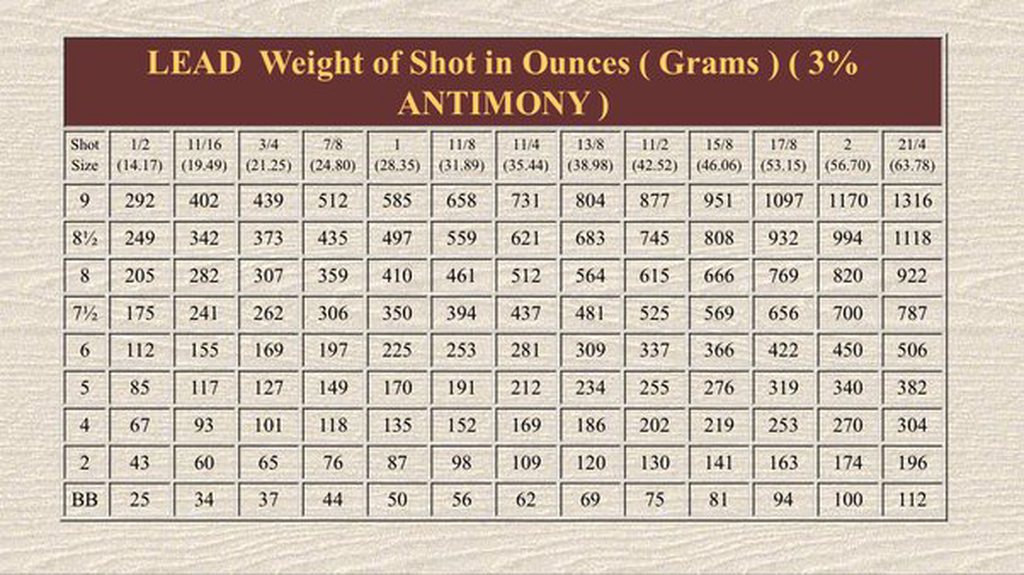
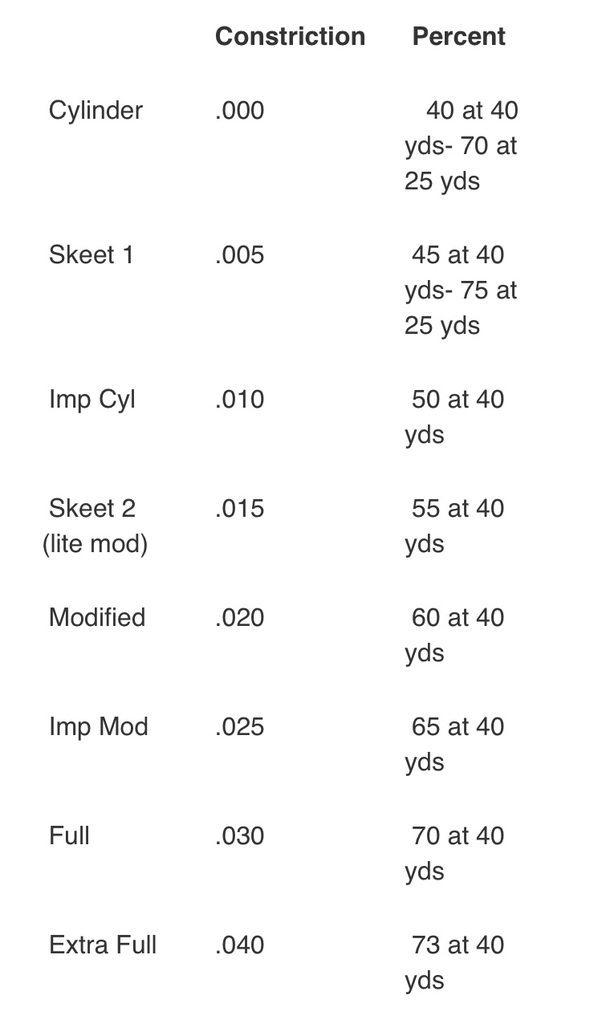
Using pellet counts per oz of shot and choke pattern percentages from the tables below I figure that a 10 bore gun shooting 1 1/2oz of #8 shot (615 pellets) at true cylinder, 40% in a 30" circle at 40yds = 246 pellets.
Comparing that number of pellets within the 30" circle at 40yds to 1oz, 1 1/8oz and 1 1/4 oz loads, like those from a 12 bore, give comparable 'choking' of 60% for the 1oz, or modified, 53% for 1 1/8oz, about improved cylinder, and 48% for the 1 1/4oz load, and so still about IC.
What I'm thinking about is just how effective a vintage open choked 10 bore may or may not be.
So, maybe a straight stocked gun and if not too heavy, might make a great open country bird gun and throw patterns equal to common 12 bore chokes?
Actually there'd be extra pellets too surrounding the core pattern, so even that more effective.
Heavier payload is better.
Just thinking out loud.
Gotta get a 10 bore I guess!

And Yes Bryon I remember you mentioning that about the 10 bore throwing nicer patterns of heavy pellets.

What both you guys said about each gun barrel shooting uniquely I've heard before, although not done very much actual testing myself.
Usually just pass by the pattern area and go shoot clays...

zb9RDAuh.jpg

RfP49AVh.jpg
 
Your numerical analysis would be valid, but it presumes that the pellet distribution across the 30" test area is evenly spread - I do not think that can be calculated - have to shoot and see pellet holes/marks to know if your shot size, your load, your barrel is producing "blown patterns" or not. "Choke" designations are describing pellet hits into a 30" diameter circle - you might be wanting to hit a golf ball size head with one pellet / you might be wanting to hit a clay pigeon, on edge, with two pellets - "choke" does not tell you if you will or not.
 
Barrel length certainly affects handling, swing, etc. That affects performance. Ever see a trap gun with a short barrel?
 
Since your tossing around the idea of using the vintage ten I’m assuming you’ll be shooting bismuth which I found to pattern better than lead most times. Lots of great advice but shooting on paper will be the proof in the pudding. Best of luck
 
I think that the notion that barrel length affects the shot pattern has been debunked through testing, everything else being equal a short barrel should pattern the same as a long barrel. There's lots of other factors that do affect the pattern though such as bore diameter, choke diameter, choke length, choke design, forcing cone length and of course the ammo used.
 
There is a lot to unpack in the OP but a few things to consider than might shed light on some of the queries. When referring to “pattern”, everything I will post refers to the overall SIZE of a given pattern, NOT the quality ( IE even distribution). I would like to preface this post with “ none of what I am about to post is scientific evidence or claims of absolute fact. Rather, this is my belief based on experience and critical thinking regarding the concept of “ chokes”. So, having shot Muzzleloading shotguns (which by nature are all cylinder bored), I can say that, in my experience, from 20Ga up to 8GA, ALL throw the same SIZE of pattern. In other words, a 20GA cylinder bore will throw a 40” pattern at a given range and an 8GA will also throw a 40” pattern at the same range. Of course, the 8GA will throw a more dense pattern since it is throwing a LOT more shot in the same size circle. “CHOKE”, IMO is a function of redirection NOT just making the exit smaller. When the shot passes through the choke, the outer pellets are redirected toward the centre on the pattern so they exit the muzzle in a converging direction. This is what, IMO provides the tighter pattern (less dispersion). The tighter the choke, the steeper the angle of the exiting shot and tighter the pattern. I do not believe that the barrel length would have any affect.
 
I think that the notion that barrel length affects the shot pattern has been debunked through testing, everything else being equal a short barrel should pattern the same as a long barrel. There's lots of other factors that do affect the pattern though such as bore diameter, choke diameter, choke length, choke design, forcing cone length and of course the ammo used.


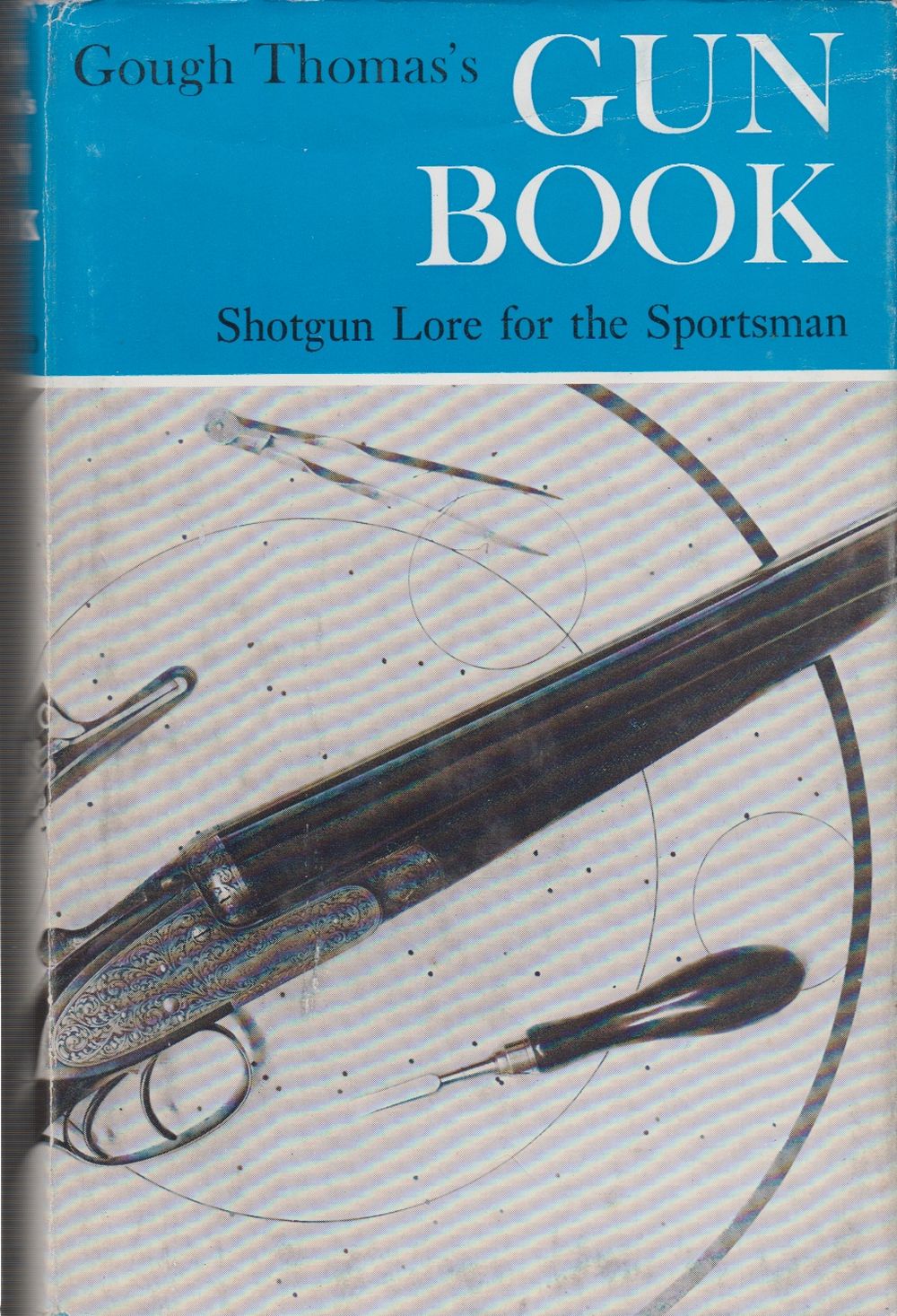
Currently reading this (from the 1960's)
- Gough Thomas gun book; shotgun lore for the sportsman (which is a collection of some of his writing for the UK based magazine Shooting Times)
A fun read thus far!

Anyway, he's talks at length about chokes/barrel length and performance. The highlights
- If the barrels are identical (same bore diameter) and the restrictions are the same = the pattern ought to be the same
- The difference in velocity between a 25" barrel vs a 30" barrel is a moot point when talking about a hunting shotgun

One thing interesting bit that I want to research a bit further, he talks about a test done (by Shooter's year book, choke VS cylinder, 47 I.M.I.)) comparing the pattern between cylinder and a full choke, at 40 yards.

P-47

choke versus cylinder—permissible aiming errors

There is no doubt at all that in recent years there has been a sharp revival of interest in the question of gun borings, and the relative merits of the different degrees of choke for various classes of shooting. One can point to several good reasons for this. The large new entry of shooters are generally of a more enquiring turn of mind on technical points than their fathers were. Then again, the increased popularity of pigeon shooting and wildfowling has focused attention on the merits
of choke, and the same could be said for clay pigeon shooting and D.T.L. On the other hand, skeet has done much to restore the reputation of true cylinder boring in its proper sphere, being helped in this by the crimp-closed cartridge. Last come the many instances of shooters who have abandoned old, open-bored guns, with which they shot well, for new, heavily choked Continental ones, with which they have shot badly. Some of these, who have acted on my advice to
have most of the choke removed from their right barrels, have come back to me with a much-heightened perception of the harm choke can
do to the game tally when misapplied.

In these circumstances, a question that was recently put to me is probably one that has occurred to many readers. ‘Why,’ I was asked, ‘do you always say, when you are speaking about choke, that the open borings give the shooter a better chance, particularly at the shorter ranges at which most game is shot. What has range got to do with it? I should have thought that everything maintained a certain proportion, and that the open boring would stand in the same relation to the choke at 40 yds. as it does at 20.’ This is a good question: it reveals that the man who asked it imagined the shot from a gun as spreading from the muzzle in a true cone—a sharp cone in the case of a choke barrel, and a broader one with a cylinder. If this were so, range would indeed have nothing to do with the question: the openbored barrel would permit the same angular aiming error, in excess of that permissible with a choke, at all ranges. In fact, however, shot charges do not behave quite in this orderly, geometrical manner.

Trumpets, not cones

If the bulk of the charge from a gun could be contrived to leave a visible envelope in the air, just large enough to contain it, we should see, on regarding the envelope from the flank, that it was not a cone, but slightly flared, like a trumpet. Further, the choke-trumpet would not only be smaller in diameter at the mouth than the cylinder trumpet, it would also have more curvature, so that at the mid-region the relative disparity would be even more pronounced, as shown in my diagram.

It will be seen that the choke makes more demand on aiming accuracy at the shorter ranges than it does farther out. For those who prefer to think in terms of figures, the matter may be put another way. The spread of the bulk of the charge (which, incidentally, is the same for all calibres) ts given in The Shooter’s Year Book, published by I.M.I. For improved cylinder and full choke, the figures are as follows.

Percentage of shot within a 30" circle @ 40y
Range — 10 15 20 25 30 35 40 yds.

Imp. cyl. - 15 20 26 32 38 44 51 in.
Full choke - 9 12 16 21 27 33 40 in.

Because of this spread of shot, every gun permits of a certain aiming error, measurable as an angle. If we take as a basis the aiming error
permitted by a full choke, we can very quickly work out from the above data what increase in this error would be permitted by an improved cylinder. Thus—

Range (yds.) Permissible increase in aiming error
10y 66 %
20y 62 "%
30y 41 %
40y 28 %
These figures bring out the essential point admirably. At 25 yds. or so—a common game-shooting range—a man armed with an improved cylinder may commit far greater aiming errors than his companion using a full choke, without falling below the latter’s standard of performance, as measured in terms of game bagged for equal chances. They also show the full-choke man the need for allowing his birds plenty of law, whereby he may show to less disadvantage.


Further into the book, he goes on about the density of pattern of a tighter choke, and how the pellets in that 30" circle at 40yards are usually better distributed within said circle.

22829270751.jpg
 
I think that the notion that barrel length affects the shot pattern has been debunked through testing, everything else being equal a short barrel should pattern the same as a long barrel. There's lots of other factors that do affect the pattern though such as bore diameter, choke diameter, choke length, choke design, forcing cone length and of course the ammo used.
It's fascinating that up to 7" of barrel length doesn't really affect pattern that much (I thought that I had heard/read this before), but a decrease of .010" bore diameter over a short length within the barrel at muzzle does....
 
Currently reading this (from the 1960's)
- Gough Thomas gun book; shotgun lore for the sportsman (which is a collection of some of his writing for the UK based magazine Shooting Times)
A fun read thus far!

Trumpets, not cones

22829270751.jpg
That's neat stuff.
Lots of factors to consider.
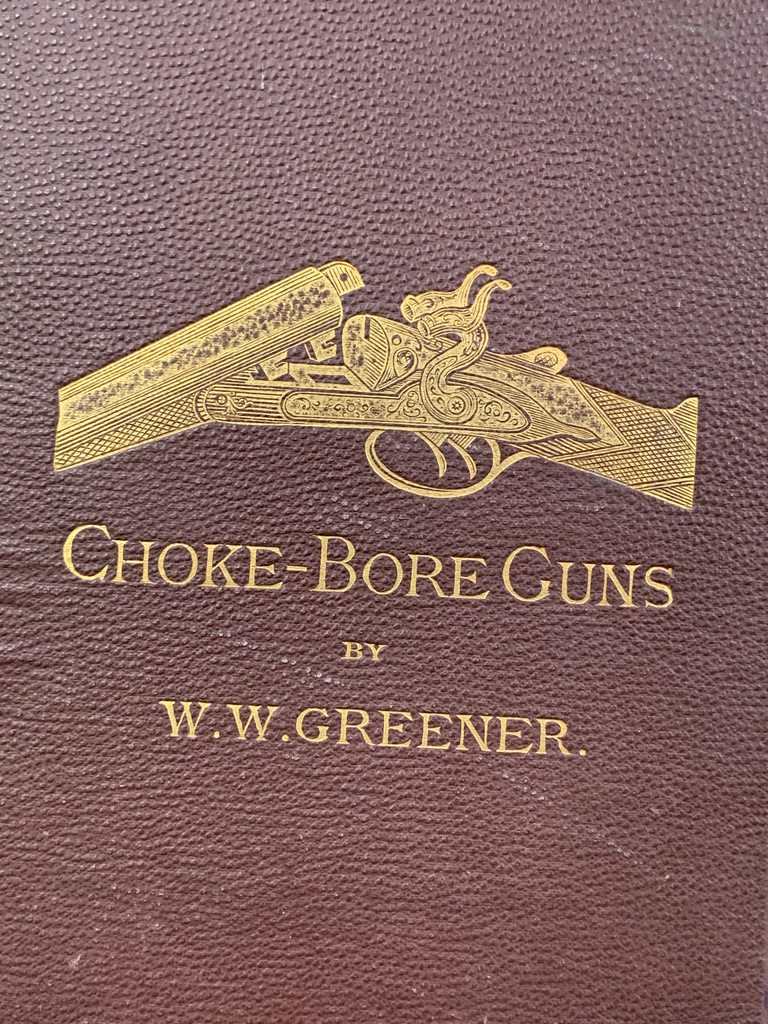
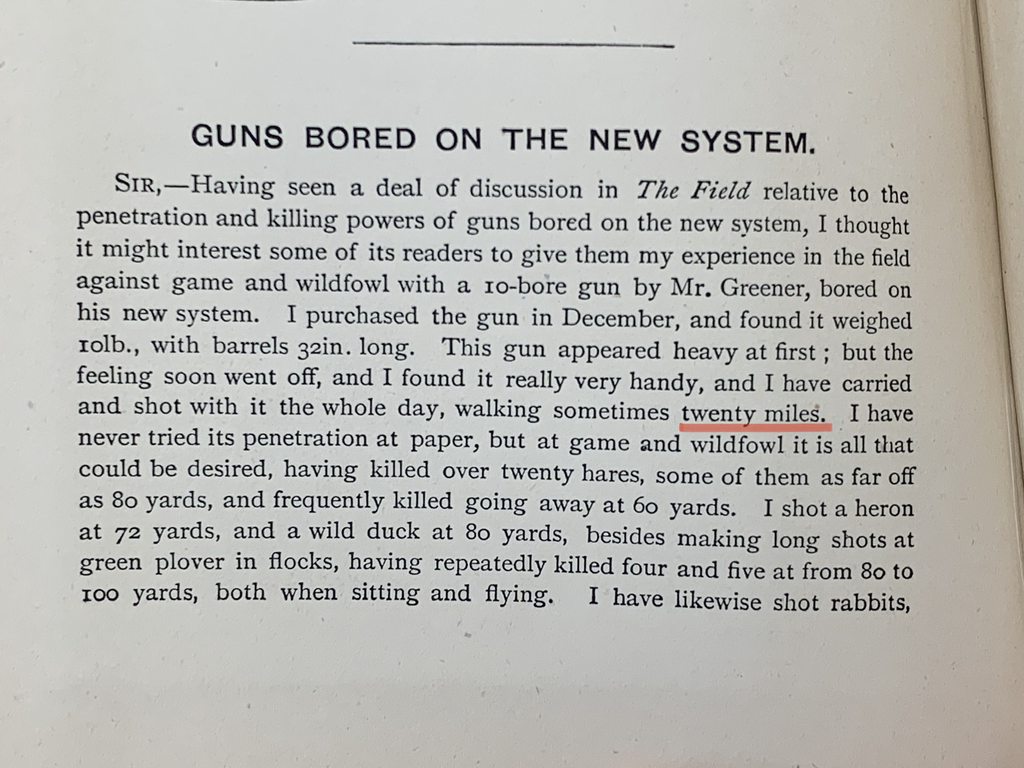
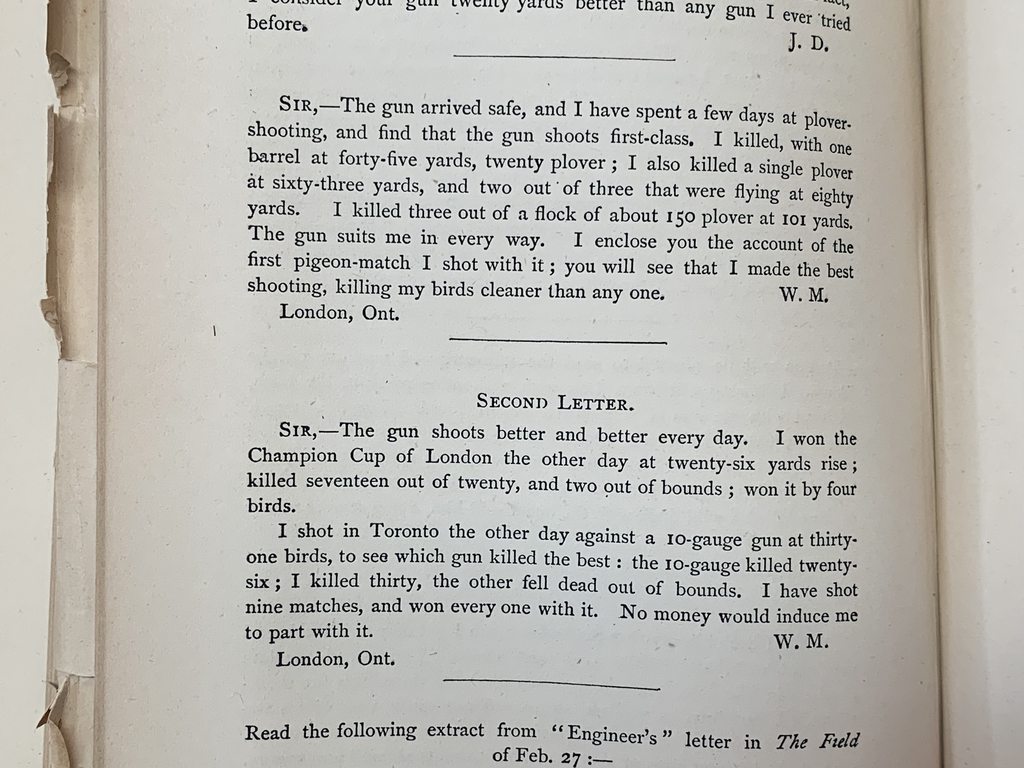
In Greener's book on ChokeBore it is written that to compensate for the tighter pattern at closer distances created by the choke-boring that shotshells could be loaded with greater charges of powder and less weight of shot... to intentionally 'blow' the patterns and essentially make spreader loads.
 
Hey, this is all just for good conversation......!

More from that book, Choke Bore Guns (1875):
sW48e6ih.jpg

4RfYRerh.jpg


When Men Were Men:
beIpatnh.jpg

Some proud new owners' feedback:
ybY8OzPh.jpg

So there's no denying that choke is effective, but it also has it's limitations, AND there are many factors that contribute.
'Horses for courses' when choosing a gun.


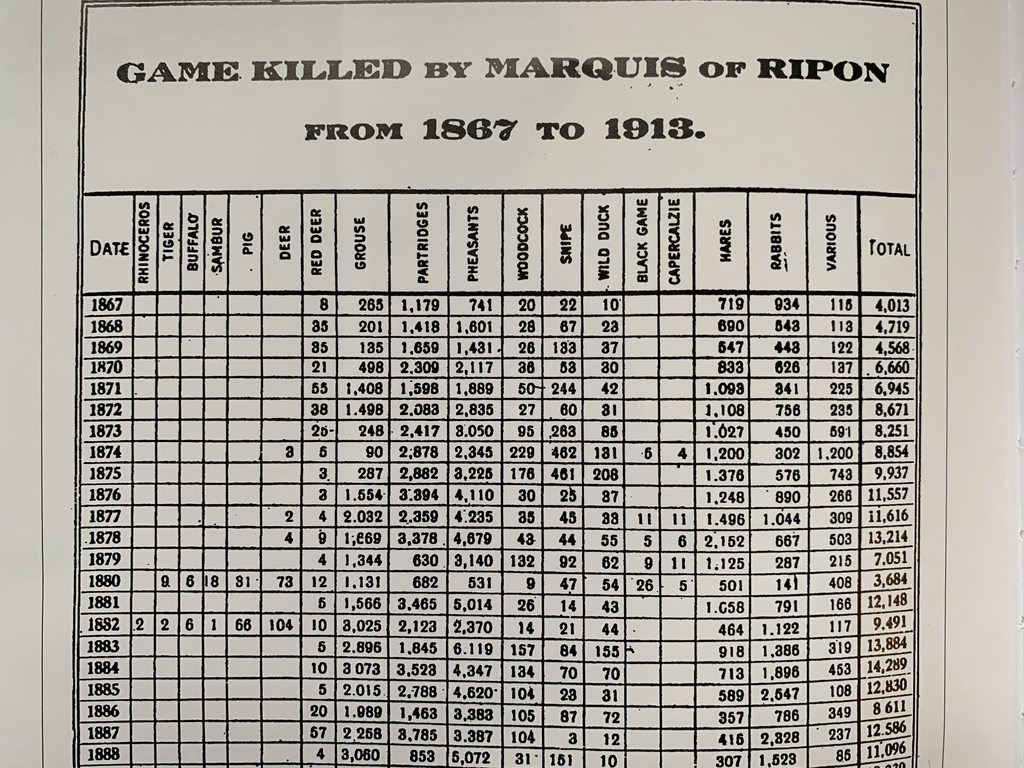
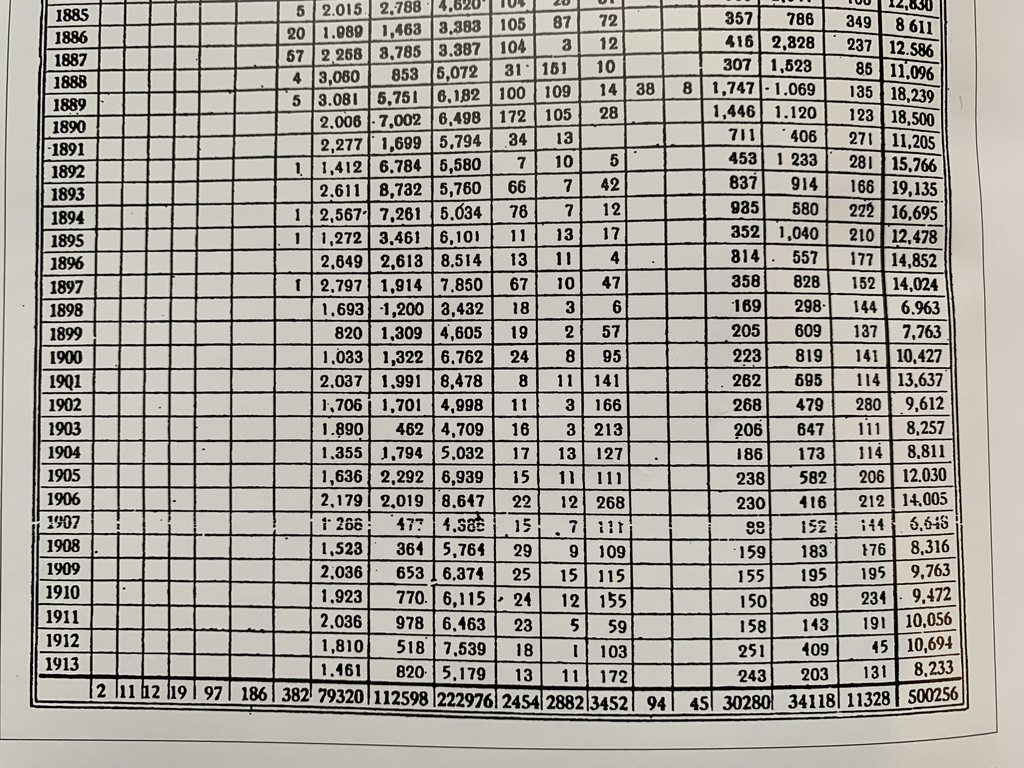
Lord Ripon was able to take game pre 1875 without choke boring.....
I know this table has been posted before and is staggering, but considered within context of a different time, when shooting was popular sport championed by royalty and game scores were published in the newspapers, the toll makes more sense.
d6j0q3sh.jpg

jOXzXenh.jpg


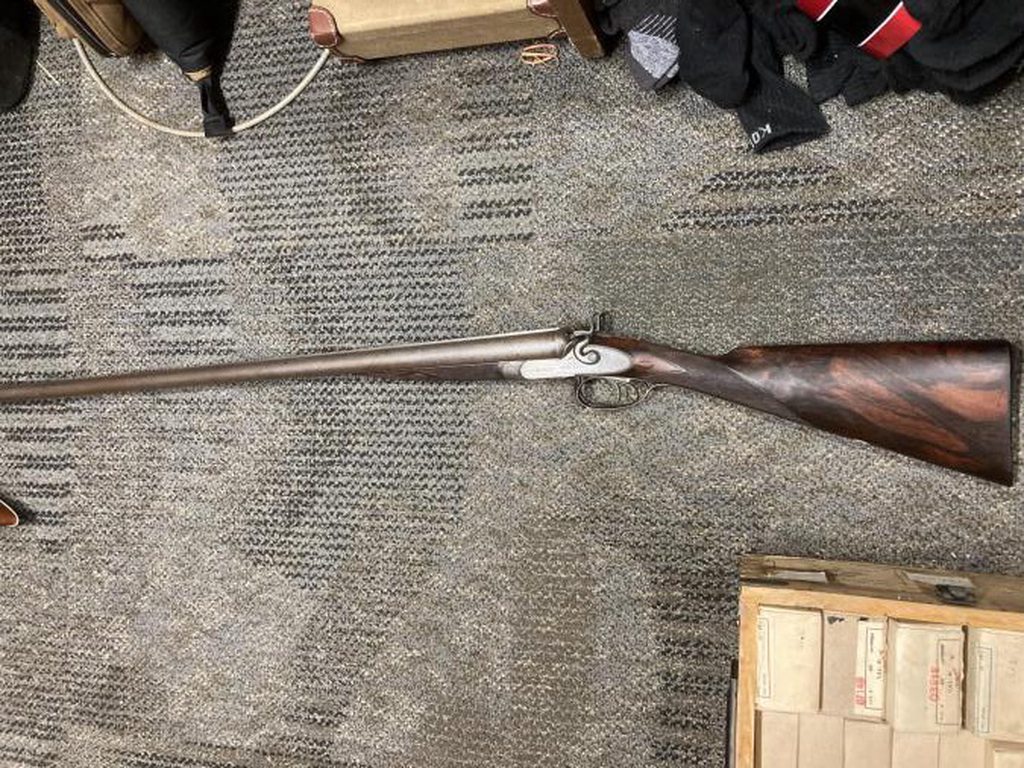
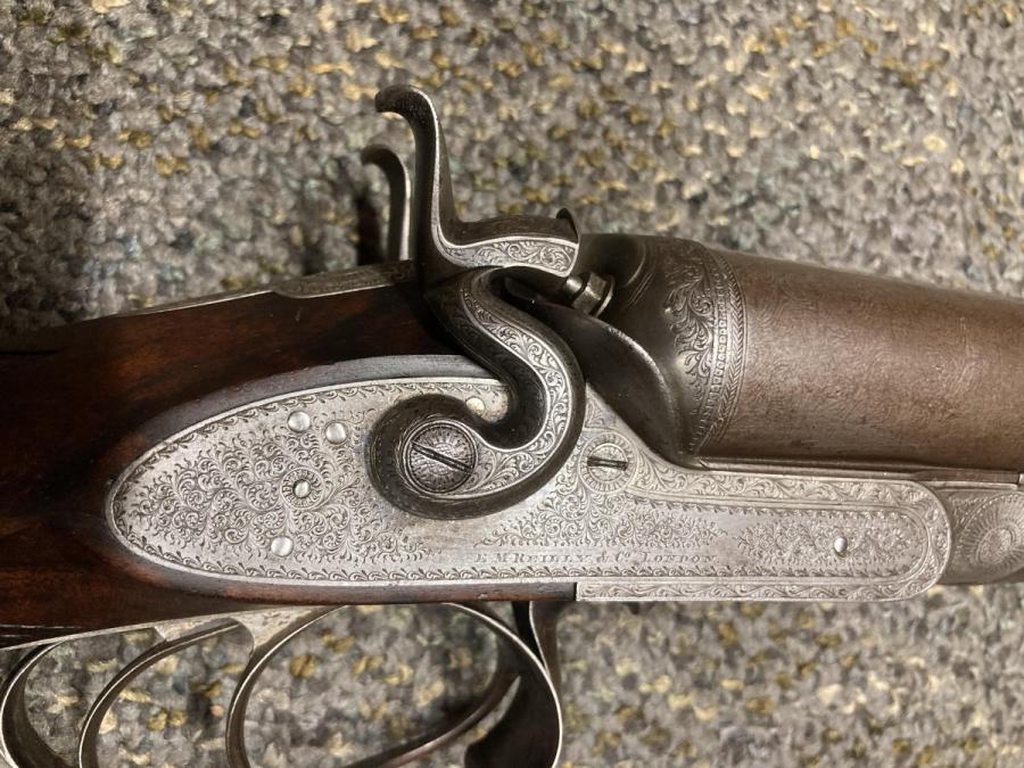
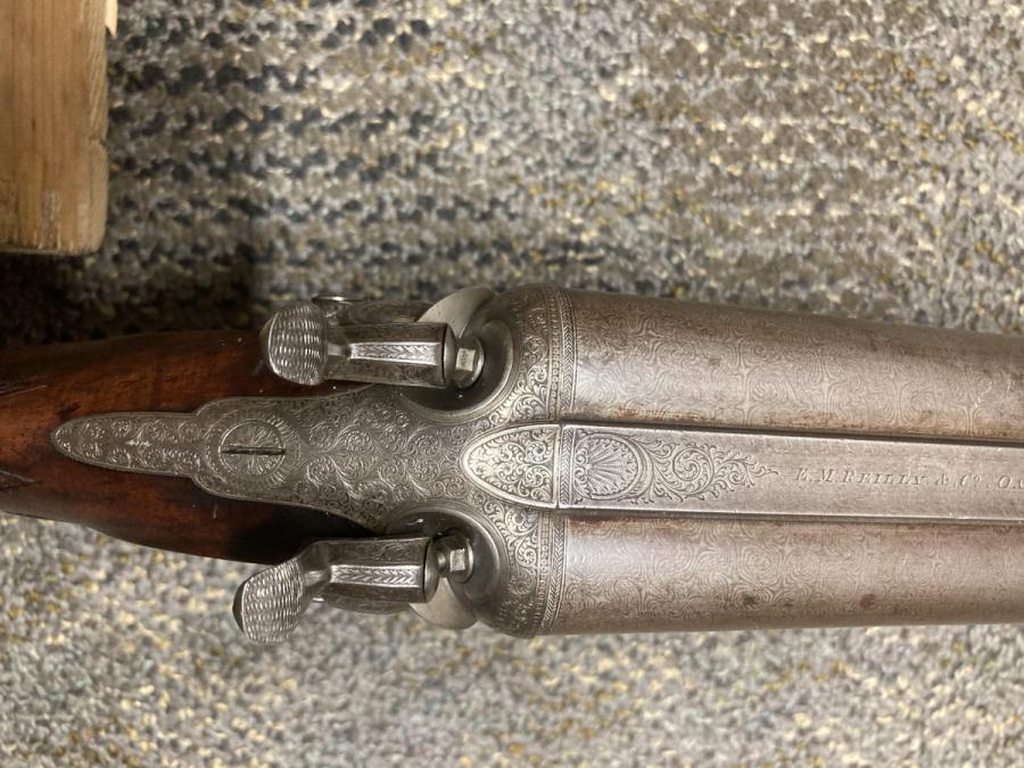
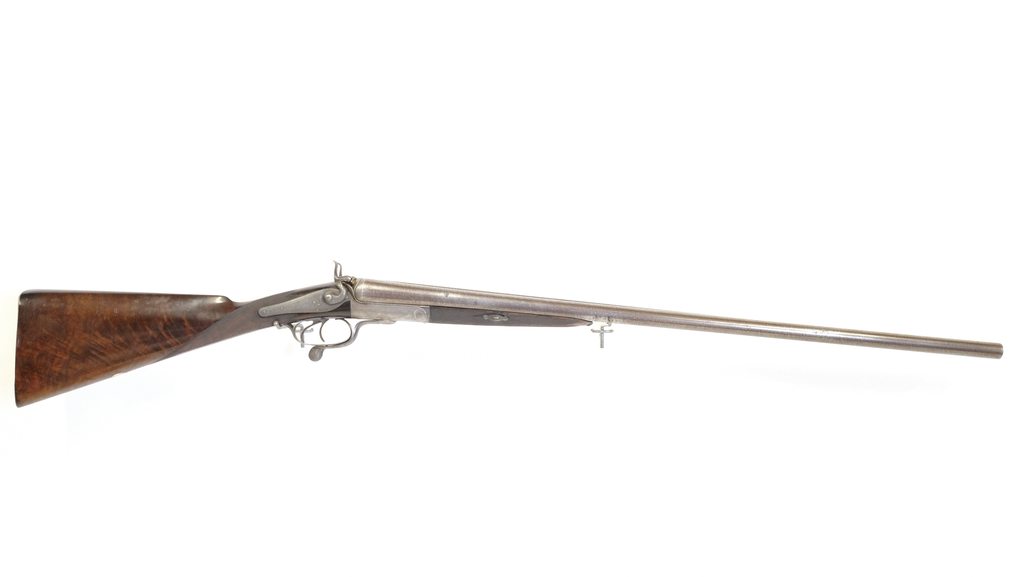
What started all this was a beautiful 10 bore 32" barreled with cylinder bores for sale last year on #######.
An EM Reilly, and for the record someone bought it, not me...though I am really starting to wish that I did, what a beautiful gun!
What struck me was that although it was likely intended a 'fowler' that with the straight stock and possibly reasonable weight that it might make a good open country bird gun.
Some of these 10's weren't 10lbs+, but I don't know what this one weighed.
So I've been wondering what a gun like this would be best suited for in your opinions??
kb2rvv8h.jpg

ABn2ehmh.jpg

C5NbVoMh.jpg


Here's a 10bore Mortimer available at Intersurplus right now with straight stock, 32" barrels, likely Cylinder, and weighing 7.9lbs, and 2 3/4" chambers. It sounds almost like a 12 gauge.
Another beautiful gun and provided everything checked out, barrels and stock, I wonder what it would work best for as a shooter?
By the way, I'm not hot-to-trot to buy this, just adding to the conversation.
oOoTctth.jpg

ADcfCUmh.jpg
 
The best experimental analysis of shotgun choke is published in Dr. A. C. Jones - Sporting Shotgun Performance.
It's all about the constriction in bore diameter.
The idea about "blown patterns" is largely flawed.
Shotgun patterns are "self healing" to some extent.
Because of the randomness of pellet distribution within patterns it's necessary to do statistically valid numbers of patterns.
Eyeball analysis of single patterns will only lead you astray.
The variation within a sample size of 10 patterns is substantial.
I highly recommend Dr. Jones book. It is a substantial amount of information to digest, but worth the effort.
 
Answers:

1. Yes
2a. Yes
2b. No
3. Yes
4. Pellet count will always be greater with more ounces of same sized shot.
For hunting , you will do better with a 12 gauge with some choke than you will with a cylinder bored 10 gauge
 
With that level of sculpting around the fences and decorative scroll, I’m thinking live-pigeon guns, rather than waterfowlers. 10-gauge was popular in that sport.
 
Barrel length certainly affects handling, swing, etc. That affects performance. Ever see a trap gun with a short barrel?
Trap guns have long barrels mostly for the longer sight radius... they can be pointed more accurately.
 
Back
Top Bottom