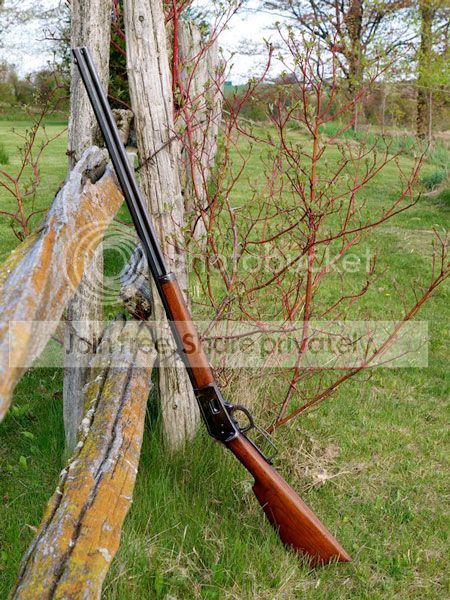
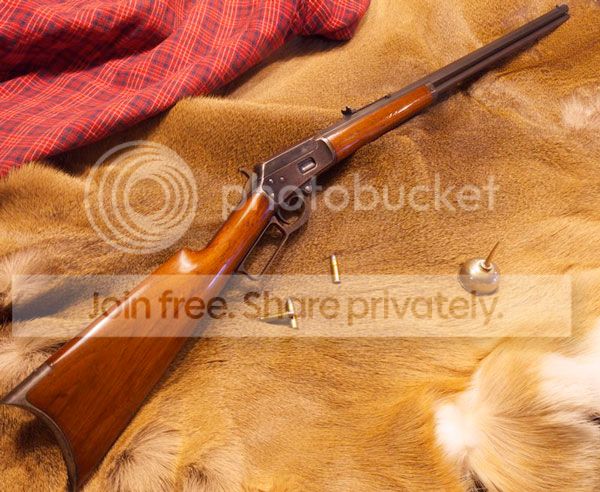
Road King was kind enough to let me try out his beautiful Marlin 1889 32-20 with the special order barrel. The rifle is in gorgeous shape and the bore is beautiful. I am always very nervous handling a high condition classic Marlin like this so a great deal of care was taken throughout this process, as I know some of you collectors would be very concerned about shooting a beautiful old rifle like this. Here are a couple photos I took of it ....
The factory information:
SN 95679
Caliber: 32
Barrel: Octagon
Length: 28"
Shipped: February 13, 1894
I first tried some Black Hills ammunition. I wasn't sure about the bullet weight, but I think they were 115 grain cast. I set up a target at 50 yards and fired five rounds. I got a 5-shot group at 50 yards of 4 & 1/2" and all the holes had crescent grey smudges on one side, an indication that the bullets were wobbling. Whatever the groove diameter of the bore, it was larger than the bullet diameter of this Black Hills ammo. Next up, I tried some 115 grain cast bullets that a friend sent me, cast from a Magma mold. These gave me a 5-shot group at 50 yards of 3 & 3/4". These holes also had grey crescents on one edge, so these to were wobbling. The bullet diameter of these bullets was .312. I found that there was some resulting leading just forward of the chamber from the undersized bullets, so I cleaned the bore and then moved on to the next test. The next and last cast bullet I tried were some 90 grain RCBS bullets sized to .314". I was so confident these would shoot better than I dispensed with the 50 yard target and set one up at 100 yards. I got a 4-shot group at 100 yards of 4" and there were no grey crescents. Still, I was certain that this Marlin could shoot much better than that. Either I was loosing my touch or these .314" bullets were still a bit undersized. I cleaned the bore again and still found some leading just forward of the chamber. This told me that even the .314" bullets were a tad undersize. Finally, I tried some Horandy 85 grain XTP bullets. These were only .312" diameter, but I knew that the jacketed bullet would be more forgiving than a cast bullet if it was a bit undersized. My first test was at 50 yards and I got a 5-shot group at 50 yards of 1 & 1/16" with three shots going into a tight 3/16". That was more like it! I then set up a target at 100 yards, and very carefully squeezed off three shots. The result was a 3-shot group at 100 yards of 1 & 1/8". They say that 3 shots tell you how good the gun is, 5 shots tell you how good the shooter is. With my 56 year-old eyes making the rear sight good and blurry, I wasn't interested in how good the shooter was, so I quit at three shots for this target. With the right bullets this classic old '89 is a tack driver. Here's a photo of that 3-shot Hornady group at 100 yards ....

Some of you might be wondering why I did not slug the bore. As I mentioned at the outset, I'm nervous enough as it is just handling and shooting this high condition gun. There was no way I was going to slug it, especially given it was not my rifle. If I were to take a guess, I'd say that a cast bullet sized to .316 should be very accurate, given how much improvement I saw between moving from .312 and .314. Of course, a jacketed bullet is a lazer, as we saw.
The factory information:
SN 95679
Caliber: 32
Barrel: Octagon
Length: 28"
Shipped: February 13, 1894
I first tried some Black Hills ammunition. I wasn't sure about the bullet weight, but I think they were 115 grain cast. I set up a target at 50 yards and fired five rounds. I got a 5-shot group at 50 yards of 4 & 1/2" and all the holes had crescent grey smudges on one side, an indication that the bullets were wobbling. Whatever the groove diameter of the bore, it was larger than the bullet diameter of this Black Hills ammo. Next up, I tried some 115 grain cast bullets that a friend sent me, cast from a Magma mold. These gave me a 5-shot group at 50 yards of 3 & 3/4". These holes also had grey crescents on one edge, so these to were wobbling. The bullet diameter of these bullets was .312. I found that there was some resulting leading just forward of the chamber from the undersized bullets, so I cleaned the bore and then moved on to the next test. The next and last cast bullet I tried were some 90 grain RCBS bullets sized to .314". I was so confident these would shoot better than I dispensed with the 50 yard target and set one up at 100 yards. I got a 4-shot group at 100 yards of 4" and there were no grey crescents. Still, I was certain that this Marlin could shoot much better than that. Either I was loosing my touch or these .314" bullets were still a bit undersized. I cleaned the bore again and still found some leading just forward of the chamber. This told me that even the .314" bullets were a tad undersize. Finally, I tried some Horandy 85 grain XTP bullets. These were only .312" diameter, but I knew that the jacketed bullet would be more forgiving than a cast bullet if it was a bit undersized. My first test was at 50 yards and I got a 5-shot group at 50 yards of 1 & 1/16" with three shots going into a tight 3/16". That was more like it! I then set up a target at 100 yards, and very carefully squeezed off three shots. The result was a 3-shot group at 100 yards of 1 & 1/8". They say that 3 shots tell you how good the gun is, 5 shots tell you how good the shooter is. With my 56 year-old eyes making the rear sight good and blurry, I wasn't interested in how good the shooter was, so I quit at three shots for this target. With the right bullets this classic old '89 is a tack driver. Here's a photo of that 3-shot Hornady group at 100 yards ....
Some of you might be wondering why I did not slug the bore. As I mentioned at the outset, I'm nervous enough as it is just handling and shooting this high condition gun. There was no way I was going to slug it, especially given it was not my rifle. If I were to take a guess, I'd say that a cast bullet sized to .316 should be very accurate, given how much improvement I saw between moving from .312 and .314. Of course, a jacketed bullet is a lazer, as we saw.