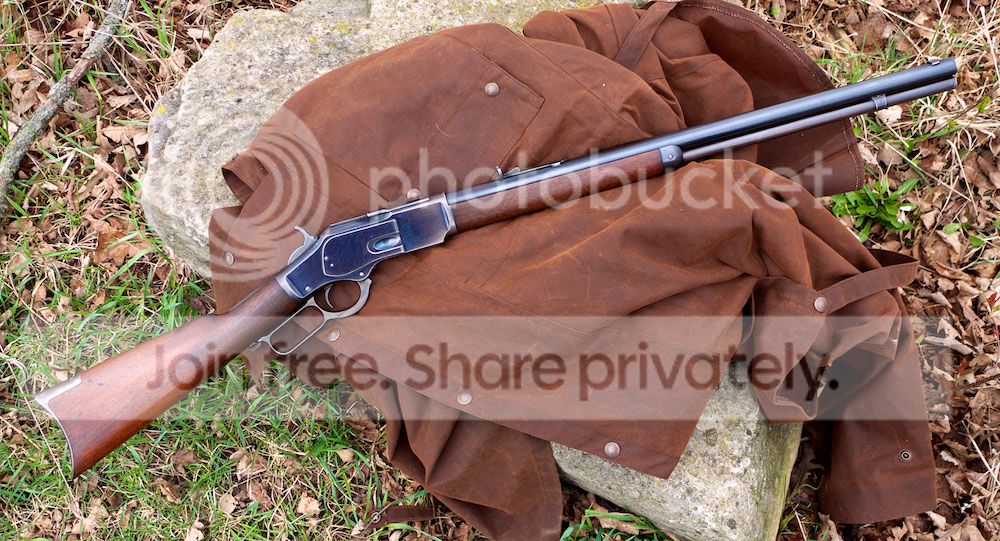
Rifle: Original Winchester 1873 44 W.C.F. (44-40) shipped September 18th, 1889
This old rifle is in beautiful condition, with just enough wear at the carry point to allow me to feel fine about shooting and hunting with it (but very carefully, of course).
Bore groove diameter: .431"
Bullet Mould: The one mould I had did not drop a bullet large enough to size to .431, so I decided to order a gas check design. I ordered a three-cavity brass mould from Accurate Molds and specified that I wanted to get a .431" diameter bullet from pure wheel weights after sizing. They want the finished sizing diameter and the alloy and they figure out how big to make the mold. The mold dropped the bullets at around .432. Just perfect. This is my second brass mold from Accurate and I am impressed with both. The bullet, with gas check, weighs 205 grains. Here are a few photos of the mould and bullet.


I seated the bullet so I could use a Lee Factory Crimp die, crimping the case around the forward driving band, and staying within the O.A.L. specs so it would feed through a '73 no problem. My load was 18.5 grains of 5744 for a velocity of around 1,273 fps. Here is a photo of a finished cartridge ....

Range Results:
I loaded up 10 rounds and shot two five-shot groups at 100 yards. The rear sight notch is tiny, and I mean tiny. It made it very difficult to shoot accurately when combined with my 56 year-old eyes.
The first group was 2 & 5/8" and the second one 3 & 1/2", both at 100 yards, resting the rifle across my shooting bag. The two groups I got are probably at least an inch or more larger than what the rifle can actually shoot. Superimposing the two targets, I got a 10 shot group of 3 & 5/8" at 100 yards. Like I said, I can't sight worth diddly right now with that tiny notch. I will improve that in the future. The gun shoots a lot better than I could today. Here are some photos ....
Target 1:

Target 2:

Clean up: Call me a stick-in-the-mud if you like, but I like Hoppes #9 solvent and that is pretty much all I use. I put one patch down to soak the bore, waited about 15 minutes and put another patch down to clean it up. It was pretty much clean with just one patch. There was little or no leading at all in this smooth, shiny bore. I put another patch down, soaked with 3-in-1 oil and then a dry patch to wipe out the excess oil and leave a very thin film of oil in the bore. I sure do like a smooth, shiny bore that cleans up that fast.
Next: I have a small, triangular file. I want to widen that tiny rear v-notch very slightly so I can see better where that front blade is. That should reduce my five shot groups to a consistent 2" at 100 yards, given what I saw today. I'm planning to load up another 20 rounds and start practicing with this classic old Winchester 44 (as Louis L'Amour sometimes referred to them in his novels).
This old rifle is in beautiful condition, with just enough wear at the carry point to allow me to feel fine about shooting and hunting with it (but very carefully, of course).
Bore groove diameter: .431"
Bullet Mould: The one mould I had did not drop a bullet large enough to size to .431, so I decided to order a gas check design. I ordered a three-cavity brass mould from Accurate Molds and specified that I wanted to get a .431" diameter bullet from pure wheel weights after sizing. They want the finished sizing diameter and the alloy and they figure out how big to make the mold. The mold dropped the bullets at around .432. Just perfect. This is my second brass mold from Accurate and I am impressed with both. The bullet, with gas check, weighs 205 grains. Here are a few photos of the mould and bullet.
I seated the bullet so I could use a Lee Factory Crimp die, crimping the case around the forward driving band, and staying within the O.A.L. specs so it would feed through a '73 no problem. My load was 18.5 grains of 5744 for a velocity of around 1,273 fps. Here is a photo of a finished cartridge ....
Range Results:
I loaded up 10 rounds and shot two five-shot groups at 100 yards. The rear sight notch is tiny, and I mean tiny. It made it very difficult to shoot accurately when combined with my 56 year-old eyes.
The first group was 2 & 5/8" and the second one 3 & 1/2", both at 100 yards, resting the rifle across my shooting bag. The two groups I got are probably at least an inch or more larger than what the rifle can actually shoot. Superimposing the two targets, I got a 10 shot group of 3 & 5/8" at 100 yards. Like I said, I can't sight worth diddly right now with that tiny notch. I will improve that in the future. The gun shoots a lot better than I could today. Here are some photos ....
Target 1:
Target 2:
Clean up: Call me a stick-in-the-mud if you like, but I like Hoppes #9 solvent and that is pretty much all I use. I put one patch down to soak the bore, waited about 15 minutes and put another patch down to clean it up. It was pretty much clean with just one patch. There was little or no leading at all in this smooth, shiny bore. I put another patch down, soaked with 3-in-1 oil and then a dry patch to wipe out the excess oil and leave a very thin film of oil in the bore. I sure do like a smooth, shiny bore that cleans up that fast.
Next: I have a small, triangular file. I want to widen that tiny rear v-notch very slightly so I can see better where that front blade is. That should reduce my five shot groups to a consistent 2" at 100 yards, given what I saw today. I'm planning to load up another 20 rounds and start practicing with this classic old Winchester 44 (as Louis L'Amour sometimes referred to them in his novels).