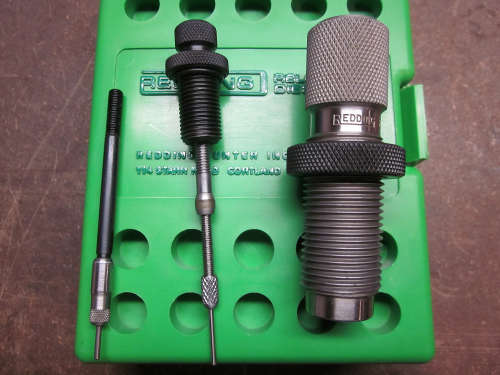
Redding Type 's' full length doe, neck bushing Q

Kosmic

Regular
Rating - 100%
11   0   0
Location
YUL
Hi guys, I have a question.

Q1 Resizing .308 Federal brass 1F (not initially fired by me). Why do I measure 0.331"-0.332" of neck dimension when I'm using a 335 titanium nitride neck sizing bushing???

I'm lost....I though that by using a 335 bushing it would maybe spring back to 0.336" or close to that but now I'm at 0.331"-0.332" after resizing.

Info: Redding Type 'S' FL bushing die w/ 335 TiN bushing, Federal brass 1F, starting neck dimension 0.345", wall thickness ~0.015"-----> end-up at 0.331" - 0.332" neck dimension.

I know that I don't have the right size bushing for a 0.001" neck tension on 0.015" wall thickness w/ .308 bullets......I'm just experimenting before using my Lapua brass.

Q2 Lapua brass .308 are ~0.015" wall thickness. So if 0.308" + 0.030" (wall thickness x2) = 0.338" - 0.001" (neck tension) = 337 <----- I should buy that bushing?

Thanks for you help. Learning a lot here.
 
Response from Redding support....for reference.

Kosmic,

Looking through the numbers you have provided. If your brass is .0155", that would indicate a loaded round would measure .339" (I do believe that is what you also stated). In this instance I would suggest a .337" bushing.


It also appears a fired case OD is .345". We have found that reducing the neck down .008" or more will often result in a case coming out of the bushing smaller than what is stamped. This is caused by the chamfer found on the inside of the bushing. The case tends to enter the chamfer and continue and eventually over shoot the hole. The original design of the bushing was for tight neck chambers that only expanded .003-.004" upon firing. try sizing a fired case down .003-.004" at a time. This tends to eliminate the problem.


I have pasted below a link from our web page talking about the same thing.

http://redding-reloading.com/tech-line-a-tips-faqs/136-bush-size-quest


Let me know should you have any further questions.


Thank you for using Redding Reloading Equipment.


Have a nice day,

Scott Lawrence

Customer Service Supervisor
 
I have two bushing dies, a .223 Forster bushing bump neck sizing die and a .243 Redding full length bushing die. Both dies produce cases with more neck runout than a standard Forster non-bushing full length die.

At the Whidden custom die website they tell you they get the most concentric cases with non-bushing full length dies. And Whidden also sells expander kits with five expanders from bullet diameter to .004 under bullet diameter.

I have several Lee collet neck sizing dies, "BUT" I'm not a fan of neck sizing and prefer to full length resize. On the opposite end of my opinion many, many reloaders like the Lee collet die. And I think this is because the Lee collet die produces less neck runout than a bushing die with a standard off the shelf factory made rifle with a SAAMI chamber.

Bushing dies work best with custom rifles with tight neck chambers, meaning chambers that require less than .004 neck diameter reduction when sizing. When you reduce the neck diameter .004 or more with a bushing die it will induce neck runout. The bushing floats inside the die and can move side to side and even tilt when reducing the neck diameter .004 or more.

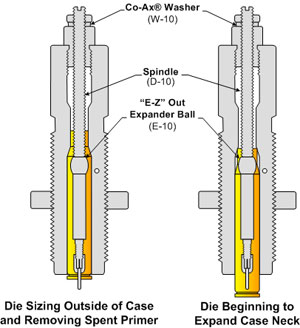
Redding bushing dies come with a expander for people who "do not" neck turn their brass. Meaning there is no sense in pushing any neck thickness variations to the of the case neck. So you size and expand unturned case necks to make the inside of the case neck uniform.

If you take a non-bushing full length sizing die and remove the expander the sized case will be very concentric and with little to no neck runout. But when you replace the expander if it is not perfectly centered in the die the expander will induce neck runout. On top of this you can send your Forster die back to them and they hone the neck of the die to your desired diameter.

The Forster full length benchrest dies with the high mounted "floating" expander always have a perfectly centered expander. With the Forster die the neck of the case is held and centered in the neck of the die when the floating expander enters the case neck. Meaning the Forster full length die can not pull your necks off center and induce neck runout.

Y7Iyv8o.jpg


Bottom line, too much of what benchrest shooters do filters down to the average reloader and is not needed. I do not use any of my bushing dies because they produce sized cases with more neck runout than a standard full length die. If you are a neck sizing fan you can size like Jerry recommends at Mystic Precision with a Lee collet die and a Redding body die.

Or you can be hard headed like me and full length resize using Forster full length benchrest dies. And if needed have Forster hone the dies neck to the desired diameter.

Just remember with your off the shelf factory rifles you have no control how much the case neck will expand when fired. But even with a standard full length die you can control how much the neck diameter is reduced and expanded when sized with a little work.

FL Bushing Dies vs. Honed FL Dies
http://www.accurateshooter.com/technical-articles/reloading/fl-bushing-dies-vs-honed-fl-dies/

Are Your Sizing Dies Overworking Your Rifle Brass?
http://www.massreloading.com/dies_overworking_brass.html

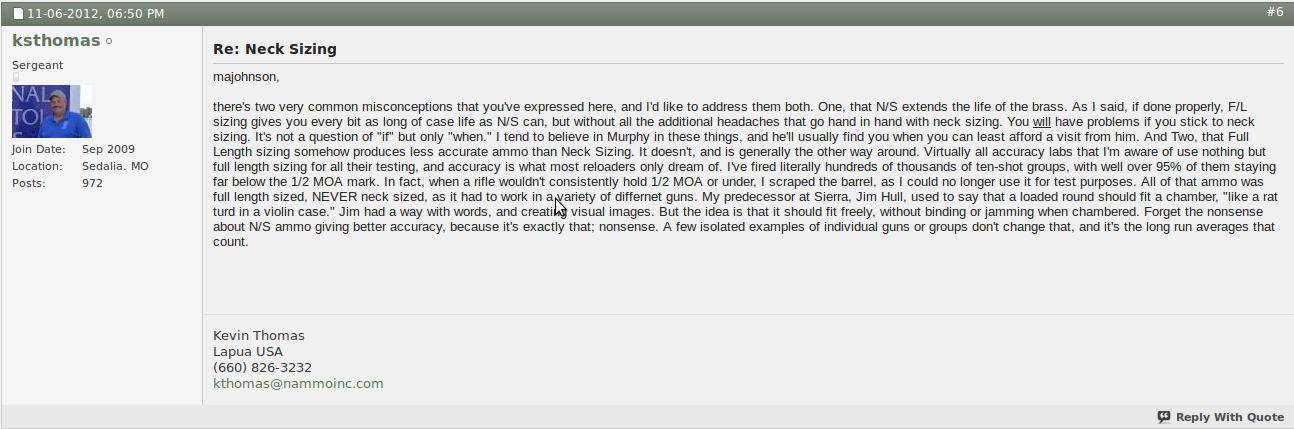
And below advice from Kevin Thomas who worked in the Sierra ballistic test lab and now shoots for Team Lapua USA.
And Kevin Thomas is also a fan of full length resizing and that the case should fit the chamber like "Rat turd in the violin case". :stirthepot2:

Y3IiYL5.jpg
 
Last edited:
Thanks bigedp51 for the explanations.

I shot some Federal GMM 175gr SMK today and the neck with a bullet seated was at 0.339" so 0.0155" wall. Then measured 0.343" once fired. Diff of 0.004"

Does this equal to a tight chamber? info: Broughton barrel.

That's what I want to do, full length all the time but with a bushing to 0.001" - 0.002" neck grip. info: using Lapua brass
 
Kosmic

As long as you do not have excessive neck runout sizing at .004 you should be OK. You can also try sizing the neck down .002 in two separate operations like Redding said in their email.

Have fun buying more bushings, I have 3 bushings with my .223 Forster bushing bump die and 5 bushings with my .243 Redding full length bushing die.

Below a Redding full length non-bushing die with a modified Forster expander and spindle installed that has less runout than my Redding .243 bushing die.

kWbieba.jpg


"Only you can prevent neck runout" :evil:
Attila the Hun
 
Kosmic:

One other thing to check is that your calipers are zeroed. Calipers that come out of zero provide for some very frustrating and perplexing results.

A second thing that can happen is that the necks are smaller than your neck sizing die to start with. I don't believe this is the case here since you are utilizing fired cases, but have found necks one some new brass are too small to be sized with a .335 neck bushing and resolve it by running them over an expander mandrel first.

I also use Lapua brass in a number of different .308s. Most of the necks on my brass measures 0.0143"-0.0147", averaging 0.0145". This leads to a loaded outside neck diameter of 2 x 0.0145" +0.308" = 0.337". I have had good luck and continue to use the .335 TiN bushing in both the Redding Type S FL die and the Redding Competition neck die.

Good luck.
 
Thanks Bulaman. My caliper was zeroed. As per Redding, I tried to reseize too much in one go.

My Lapua brass with bullet seated (dummy round) measures 0.339" - 0.308" = 0.031" for 0.0155" wall.....that of course is my Lapua brass lot and with my caliper.

I ordered a Redding 337 TiN bushing.
 
Back
Top Bottom