Refreshing existing checkering

Not the best pic, but here's one of my early attempts at restoring some worn out flat checkering with just a 60° straight cutter.
I tried to follow the lines that were visible without making too many new ones. Lots of the lines I couldn't make out at all.
Not perfect by any means, but I'm okay with that.

jwgs3Eq.jpg

Beautiful work, any chance for a picture of the cutter? I have to show local stores pictures, the kids are highschool aged haha
 
An old book recommended a three-corner file, heated and bent at the tip - then trimmed on the grinder so the teeth come right to the end - this makes a beautiful little tool to follow grooves and freshen them up - or even deepen them to points. I've even changed a pressed-checkered Savage into a cut-pointed stock. It will cut right to the border-line and follows grooves far better than a factory checkering tool. It cuts on the forward stroke, and follows the groove well on the return stroke. Careful work with a wire brush can really clean up old grimy checkering too - try it.
 
I have that book by Monty Kennedy - says copywrite both 1952 and 1962. Page 58 - "English Flat Checkering":

"The flat checkering consists of nearly straight-sided grooves spaced usually 20 to 22 per inch, and about .025" depth. A well executed job shows no evidence of any vertical taper or draft to the grooves, which are clear cut and fuzz free. The tops of the diamonds are the original surface of the stock and little evidence on the checkering is noticeable to the hand. I can not quite savvy the object of flat checkering, though one point in it's favour I must concede, namely that the stock may be lightly sanded for re-finishing without damaging the checkering. On the other hand, it affords no better grip than a smooth stock and it is worse than the common type to fill with oil and dirt." He shows a picture of a home made tool to cut such grooves, and it is clearly not resulting in any sort of "points" to the diamonds that it has.

So, as per above, apparently do not use a "v" tool for that stuff - "no vertical taper or draft to the grooves". I suspect is like the picture in Post #6, but Kennedy does not show a real clear example of it. Either that, or what Parker Hale did was to just scratch lines in the wood for decoration?
 
Thanks guys!! I will try the modified file trick… but I have a old gunsmith friend that surely have checkering tools that he doesn’t use anymore and I was thinking I could buy them from him!! We’ll see!
Keep the tips coming!
 
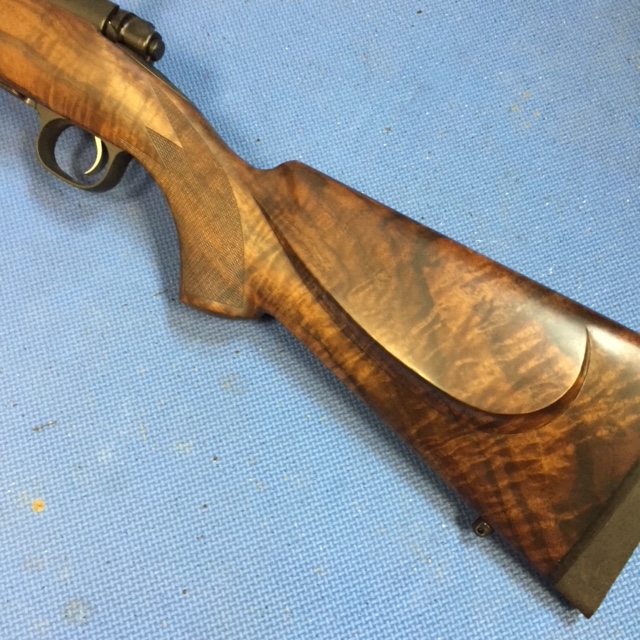
We might be using different words - as mentioned, I know next to nothing about doing this. I think your checkering in your picture might once have had "pointy" tops to it. The picture below is what I am referring to - is on a Parker Hale rifle, like 1950 or so - action is a military 98 with thumb cut-out - receiver is stamped "Safari De Luxe". I do not think these were ever "pointy" tops, even when new??

View attachment 566213

I kind of think that that checkering was recut in the distant past, as it is not even, or it was poorly done at the factory. different depth on some lines, and a couple lines miss cut, down by the cap.
It is quite worn, so think it was pointy, not flat top, thou I have seen new checkering that did not come to a point, easy enough to do, just a light sanding to level, but don't see the point of no points.
 
I have always preferred the 90 degree cutter, you don't need to go as deep to 'point up' and the points are a bit stronger.
Don't mind the screw ups I know they are there...

Picture-010-small1.jpg
 
I have always preferred the 90 degree cutter, you don't need to go as deep to 'point up' and the points are a bit stronger.
Don't mind the screw ups I know they are there...

Picture-010-small1.jpg


Yeah I’d like to screw up the way you do…. Damn nice work!!
 
Don't use a 3 square file .Trust me .I have checkered more than a few rifle stocks.You can grind the curf off of a piece of fine hacksaw blade and carefully clean out the grooves as your existing checkering still looks good now that you have cleaned it.If you start to use a 60/90 degree cutter you will have to recut all of the checkering lines.
Dennis the flaws in that checking are few and only the trained eye will pick them up.Funny how hard you get on your self when your cutting the checkering. Yet only you know where things went off a bit.
Here is a borderless job .that was painful.No border to hide the over runs
DGfs5uW.jpg
 
Last edited:
That is very good, when you really have to look for a problem, darn good , I just see one little spot, and really not a problem.

BTW, anyone remember a parts dealer in Winnipeg, kind of semi retired and he and his wife sold from home.
He is passed on now, had good supplies of these cutters, I think about 2.00 each.
His name is not coming to me. bought lots from him, had a good stock of cooey bolts as well.
He would send stuff out as soon as you phoned , even before payment , and just send a chque when invoice came with the parts. Good people.

P.S. Looking at your checkering that reminds me of the comment I made in that other post about fellow wanting to start,
about not trying to touch up a problem that is not there, or you end up redoing the whole thing, again.

P.P.S. GE Flach, That looks great, 28 or 32 lpI ? I have never done a boarderless. I can see a lot of slow work there.
 
Last edited:
Don't use a 3 square file .Trust me .I have checkered more than a few rifle stocks.You can grind the curf off of a piece of fine hacksaw blade and carefully clean out the grooves as your existing checkering still looks good now that you have cleaned it.If you start to use a 60/90 degree cutter you will have to recut all of the checkering lines.
Dennis the flaws in that checking are few and only the trained eye will pick them up.Funny how hard you get on your self when your cutting the checkering. Yet only you know where things went off a bit.
Here is a borderless job .that was painful.No border to hide the over runs
DGfs5uW.jpg

Thank you for taking the time to look at the pictures!! Fine work right there sir!! Barry Jensen had good things to say about your craftsmanship today when I talked to him on the phone!!
Cheers
 
”BTW, anyone remember a parts dealer in Winnipeg, kind of semi retired and he and his wife sold from home.”

Maybe Gene Dunning?
 
Years before he shut down the store-front & worked from gun-shows, he had a shop off Portage Avenue in Winnipeg's West End. I want to say on Lipton or Toronto Streets.

That's where I got introduced to Rifle & Handloader magazines which he sold long before they were available in any other LGS.

Ever square inch of the place was crammed with gunsmithing & casting supplies.
 
Don't use a 3 square file .Trust me .I have checkered more than a few rifle stocks.You can grind the curf off of a piece of fine hacksaw blade and carefully clean out the grooves as your existing checkering still looks good now that you have cleaned it.If you start to use a 60/90 degree cutter you will have to recut all of the checkering lines.
Dennis the flaws in that checking are few and only the trained eye will pick them up.Funny how hard you get on your self when your cutting the checkering. Yet only you know where things went off a bit.
Here is a borderless job .that was painful.No border to hide the over runs
DGfs5uW.jpg

Yes, grind the kerf off a broken hacksaw blade: 20 or 22 teeth per inch to clean out and sharpen up your grooves sometimes it is easier to pull the cutter toward yourself for control but a bit of practice will tell all.
 
Back
Top Bottom