Relading for Semi-Auto rifles

Paul_1982

CGN Ultra frequent flyer
Rating - 100%
140   0   1
Location
Orangeville
Im sure Ive missed the answer somewhere on here, but Id also like to see peoples set ups on reloading for semi-auto rifles- .223 rem specifically.

Ive used the Lee handloading tools to reload my .303, .243 and .308 bolt rifles for the last few years... but just ordered a Hornady Lock n Load Progreasive from Budget Shooter Supplies. Im looking to start reloading all my calibres from 9mm to .223 rem for my AR.

Ive read about the differences with semi autos and the need to trim the cases to ensure no FTF issues. I found lots of online info on the progressive presses and loading the already prepared brass... but little on fast and efficient ways to prepare the brass for semis- trimming specifically. Maybe Im off the mark on my research?

In any case, what method/equipmemt/order do you guys load for your AR's and semis? Ive seen the Dillon 1200 die trimmer and other seperate devices... which arent cheap, so I want to only buy once cry once lol

Im looking for the fastest most efficient way more or less.

Thanks in advance!
 
small base dies for semi

I have a different take on this. Avoid RCBS dies for .223, as they seem to be the only ones whose regular dies give problems, thus making you buy small base (I have heard that Redding may also, but I don't know). Lee and Hornady do not generally give problems when using their regular full length resizing dies.

For trimming, I set a caliper to the max case length, and quickly try to pass each case through it as part of inspection. If it passes, it goes into the pail to be lubed and loaded. If it fails it goes into the bucket to be trimmed. When the time comes to trim my old reliable is a Lee cutter-and-stud type trim tool, with the cutter mounted in a drill. I've been tempted to try the Little Crow WFT but haven't yet.
 
I just prepped 1200 military 223 brass for reloading. My most efficient way was as follows.

After cleaning in a Lyman 1200 tumbler with 50/50 corncob and princess auto walnut mix

1. deprime with a lee universal deprimer (buy extra pins)
2. swage primer pockets with RCBS pocket swager (not required for non military crimped primer brass)
3. trim a little extra short with a drill driven Lee Deluxe Quick Trim (350-400 per hour) this is a quick rate for the QT system and leaves some of a lip on the brass that is dealt with easily by the Lee Carbide FCD.
4. Dillon case lube prior to running them through my Dillon 550B loaded with Lee .223 Deluxe die set.

Once this is done I use a Caldwell brass catcher on my AR and reuse many times until I see cracking in the necks.

This is certainly not MATCH grade preparation but totally works for my application of shooting at 25 yds for quick times. I use D4198 for powder and Campro bullets. It's cheap and reliable.
 
Last edited:
If you're looking for the fastest most efficient way, then a camdex machine is pretty much on the line between "I'm an individual reloading for my own needs" and "I'm a commercial reloader who wants to sell product", so that's the fastest most efficient way for an individual. It'll cost you though.

Realisticly, you're gonna look also at cost of equipment, so it all depends on how much brass you're gonna prep per year. Most methods to prep bras is either long and tedious or quite expensive. If you add that up with 223-plinkers being the worst ammos of all regarding savings per round, it quickly becomes an unsolvable problem. Either you spend hundreds on equipment or you spend hours on the most boring task of all in reloading. All of that to save a few pennies per reload (actually, when federal went on sale before christmas, the pack of 1000 ended up about the same price as components to reload 1000 rounds).

If you reload little (my limit would be about 200 rounds/year), then you can go with the cheapo stuff that cost less than 50$ (but choose one that work with a drill, not by hand). Lee, Lymans, etc...

Then you have the slightly more expensive but still annoying stuff, like the WFT (which is like the Lee or Lymans, but high-quality) or the frankford arsenal at about 350$. Those are more expensive but still not automated in any way, and the job is long and tedious because you either have to manually do multiple operations (trim, chamfer and deburr) and/or it's long to go from one case to the other (unscrew something, remove case, re-screw).

For a semi-auto, all of them can do the job in the end, just know that you'll be bored out of your mind if you have a sizeable amount of cases to prep.

Then there's the giraud trimmer. Fast, reliable, and you can use it for your .303, .243 and .308 too. But it's 600-700$, so if you intend to mostly use it for your 223-semi, then you'll need to prep a LOT of cases to get your money back. It's still not fully automated but it's fast and accurate.

A camdex will cost a few grand and will do the job.

The other option is to sell your brass on the EE for a few pennies, then buy already prepped cases, either in small lot from retailers like FOC, or in larger lot directly from black sheep brass. It seems like he has pulled his ad for 223 (I think he sometimes run out of some calibre when he has large commercial contracts), but you can contact him here: https://www.canadiangunnutz.com/forum/member.php/177032-BlackSheepBrass

Personally, I'll probably be doing that. For 1000-2000 pieces per year, I don't see myself spending hours on ####ty equipment or spending 600$+ on a giraud trimmer. I'm right in the spot between the 2 options, so selling my 1Fired and buying pre-prepped is probably the route I'll choose when I'm done with my current stack of 223/556.
 
I just prepped 1200 military 223 brass for reloading. My most efficient way was as follows.

After cleaning in a Lyman 1200 tumbler with 50/50 corncob and princess auto walnut mix

1. deprime with a lee universal deprimer (buy extra pins)
2. swage primer pockets with RCBS pocket swager (not required for non military crimped primer brass)
3. trim with Lee Deluxe Quick Trim (350-400 per hour) this is a quick rate for the QT system and leaves some of a lip on the brass that is dealt with easily by the Lee Carbide FCD.
4. Dillon case lube prior to running them through my Dillon 550B loaded with Lee .223 Deluxe die set.

Once this is done I use a Caldwell brass catcher on my AR and reuse many times until I see cracking in the necks.

This is certainly not MATCH grade preparation but totally works for my application of shooting at 25 yds for quick times. I use D4198 for powder and Campro bullets. It's cheap and reliable.

Roughly how long did it take to prep your 1200 pieces? Let's suppose we forget the tumbling time and count only case prep time (your steps 1, 2 and 3)?
 
If you're looking for the fastest most efficient way, then a camdex machine is pretty much on the line between "I'm an individual reloading for my own needs" and "I'm a commercial reloader who wants to sell product", so that's the fastest most efficient way for an individual. It'll cost you though.

Realisticly, you're gonna look also at cost of equipment, so it all depends on how much brass you're gonna prep per year. Most methods to prep bras is either long and tedious or quite expensive. If you add that up with 223-plinkers being the worst ammos of all regarding savings per round, it quickly becomes an unsolvable problem. Either you spend hundreds on equipment or you spend hours on the most boring task of all in reloading. All of that to save a few pennies per reload (actually, when federal went on sale before christmas, the pack of 1000 ended up about the same price as components to reload 1000 rounds).

If you reload little (my limit would be about 200 rounds/year), then you can go with the cheapo stuff that cost less than 50$ (but choose one that work with a drill, not by hand). Lee, Lymans, etc...

Then you have the slightly more expensive but still annoying stuff, like the WFT (which is like the Lee or Lymans, but high-quality) or the frankford arsenal at about 350$. Those are more expensive but still not automated in any way, and the job is long and tedious because you either have to manually do multiple operations (trim, chamfer and deburr) and/or it's long to go from one case to the other (unscrew something, remove case, re-screw).

For a semi-auto, all of them can do the job in the end, just know that you'll be bored out of your mind if you have a sizeable amount of cases to prep.

Then there's the giraud trimmer. Fast, reliable, and you can use it for your .303, .243 and .308 too. But it's 600-700$, so if you intend to mostly use it for your 223-semi, then you'll need to prep a LOT of cases to get your money back. It's still not fully automated but it's fast and accurate.

A camdex will cost a few grand and will do the job.

The other option is to sell your brass on the EE for a few pennies, then buy already prepped cases, either in small lot from retailers like FOC, or in larger lot directly from black sheep brass. It seems like he has pulled his ad for 223 (I think he sometimes run out of some calibre when he has large commercial contracts), but you can contact him here: https://www.canadiangunnutz.com/forum/member.php/177032-BlackSheepBrass

Personally, I'll probably be doing that. For 1000-2000 pieces per year, I don't see myself spending hours on ####ty equipment or spending 600$+ on a giraud trimmer. I'm right in the spot between the 2 options, so selling my 1Fired and buying pre-prepped is probably the route I'll choose when I'm done with my current stack of 223/556.

Hmmm. Good to know. Im around the same number as you... maybe 1500-2500 a year. I did not buy a small base die... got the Hornady full length. Is that something I should switch out for a small base for my AR?

Maybe selling my once fired to buy prepped brass will be my best option.

That said I would like to hear from Dillon 1200 users... I think if I were to get a trimmer it might be that one.
 
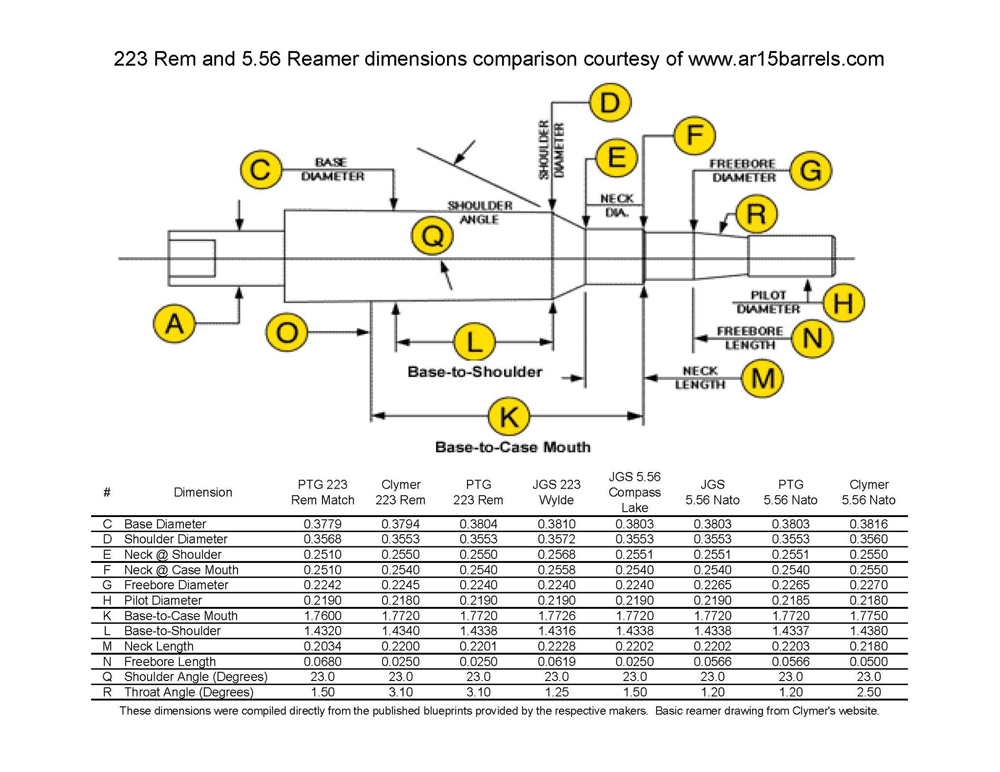
Chambers and dies vary in size meaning in diameter and length to shoulder location.

A small base die will size the case body .002 to .003 in diameter, and also push the chase shoulder back .002 to .003 more than a standard sizing die.

In a semi-auto the case needs to be reduced in diameter .003 to .005 smaller than its fired diameter. This insures the case will spring back from the chamber walls and extract reliably.

Most semi-autos and pump actions have larger diameter chambers than most rifles. Meaning as long as the case is fired in your rifle a standard die should work.

I buy bulk once fired military Lake City cases fired in a multitude of different chambers. The first time I resize these cases I use a small base die to reduce the cases to minimum SAAMI dimensions. Thereafter I size the cases in a standard full length die and have never had a problem. "BUT" chambers and dies vary in size so nothing is written in stone. Meaning start with a standard die and "IF" you have problems then try a small base die.Is it the same for all manufacturers of dies?


NOTE. i have a standard Lee .223/5.56 die that will reduce the case diameter more than my RCBS small base die. And this same Lee die will push the case shoulder back further than my small base die will.

Below variations in .223/5.56 chambers.

wjAOlWq.jpg


Below look at the variations in resizing dies and .223/5.56 neck diameters. Note that the RCBS small base die reduced the case neck diameter .004 "LESS" than a standard RCBS die.

Are Your Sizing Dies Overworking Your Rifle Brass?
http://www.massreloading.com/dies_overworking_brass.html

Table 2 - Inside Diameter Measurements for 5 different sizing dies
overworked_table2.jpg
 
I use RCBS full length dies, no issues .
A Frankfort arsenal costs $250 all in. I have one , but now wish I had a bought the Geraud. I find the Frankfurt to slow.
And as others have said, not much savings in cheap FMJ bullits.
But where you do save ,is the more quality ammo.

I load Hornady Vmax and Nosler Varmageddon for 50 cents a round.
 
I use RCBS full length dies, no issues .
A Frankfort arsenal costs $250 all in. I have one , but now wish I had a bought the Geraud. I find the Frankfurt to slow.
And as others have said, not much savings in cheap FMJ bullits.
But where you do save ,is the more quality ammo.

I load Hornady Vmax and Nosler Varmageddon for 50 cents a round.

Ok so I was JUST looking at the Frankford and found it on Amazon for $239 CAD. The Giraud will be $500 U.S. all in... is it that much better? Im not opposed to spending coin if its worth it...
 
Ok so I was JUST looking at the Frankford and found it on Amazon for $239 CAD. The Giraud will be $500 U.S. all in... is it that much better? Im not opposed to spending coin if its worth it...

I’ve read that it’s faster and easier to use.
It does the chamfer and deburring in one go around,so one less step.

When useing the FA for large amounts of .223 , it gets painful on the fingers, while chamfering and deburring, you have to grip them tight,and there so small....:)

To me ,it’s worth it, if it makes the process faster and easier,I’m all for it.
 
I’ve read that it’s faster and easier to use.
It does the chamfer and deburring in one go around,so one less step.

When useing the FA for large amounts of .223 , it gets painful on the fingers, while chamfering and deburring, you have to grip them tight,and there so small....:)

Good to know I will take that into consideration! Cheers!
 
I used my FA for about 100-120 cases. Bought an RT1200 and never looked back. Here' my process:

1. Collect dirty range brass
2. Wash in SS tumbler without the pins, just Blue Dawn and dry in the open for a few days
3. Lube with Lyman aerosol Quick Slick
4. Through the 650 with the Lee Universal Decapper in #1, SwageIt & Dillon .223 sizing die in #2, RT1200 in #4
5. Wash in SS tumbler with pins, Blue Dawn & Lemishine and dry in dryer (old food dehydrator)
6. Load it in the 650 with Lyman M die in #1, primer & powder in #2, powder check in #3, seating die in #4 and crimp in #5.

It's fast and efficient, but not cheap. I love to reload, but doing 223 any other way for me is too tedious.
 
Roughly how long did it take to prep your 1200 pieces? Let's suppose we forget the tumbling time and count only case prep time (your steps 1, 2 and 3)?

It’s hard to say because I did it all in small pieces. The bulk of the time was spent actually cutting which took 3 1/2 hrs. The decapping and swaging are only a quick throw of the press each so they go quick. If I had to guess I’d think 1 1/2 hrs to do them. Maybe less...
 
Last edited:
Considering you'll save about 10¢ per round by reloading, that's about 7000 rounds to pay for the trimmer. And at some point you'll need to change the blade on the giraud, which isn't free.

You better love prepping cases.

I hate prepping cases - but it is a vital operation, and if you hope to load good quality ammo or even accurate ammo whether it goes in an auto or a bolt gun, you need that operation to be repeatable. That’s why I bought the Giraud trimmer. Expensive but worth it.
The cutter head last nearly forever so the machine will eventually pay for itself. Sooner the more rounds you fire, and depending on your load, you could be potentially saving more than 10 cents per round.

Should I be using a 5.56 (harder) primer or can I get away with just normal, Winchester small rifle primers in my AR? Don’t want a slam fire to happen, or out of battery detonation.

I use a variety of primers including all of the known brand match primers including 205m (which are about the softest out there) without a problem.


Spend the money now on good quality kit, and exceptional if you can afford it, including dies.
I’ve spent years loading with regular RCBS, Redding and Hornady dies. I use Lee factory crimp dies too.

Some years ago I switched all of my AR loading to match dies from Redding as that is what I use to load my match .308 too.
Way nicer dies, far better quality, adjustability, easier cleaning of the die, and finished round run out is all but eliminated. Even if you are loading budget plinker loads, it is a good feeling knowing your ammo is of the quality made by excellent quality dies.

I recently picked up a .243 win. Chambered rifle and decided to get a set of dies, but thought of doing it on a budget, so I bought a set of Lee ‘delux’ dies. They were around $80 and I’ll tell you, pulling them apart to clean the packing oil from them and finding metal bits and machining marks in them - they are absolute crap. The only exception being the crimp die.
So I ordered a set of match dies through Brownell’s, which I know will be top notch for marginally more.

And this is the whole point. The die set cost ( or any other tool you use) spaced over the course of your use is negligible at best whether that tool is $200 or $1000. If you decide to discontinue use or get out of it, quality tools hold their value.
If you are spending your time handloading, you can just as easily make top quality ammo for the same time you spend on budget loads.
 
Back
Top Bottom