I'd take a randomly selected handload over a randomly selected factory load if I had to bet. For starters, a randomly selected handload doesn't have to be entirely random. Pick the bullet by what's suitable for purpose with consideration for what will reach the lands and still fit in the mag. Powder can be easy, if a .308 doesn't shoot with 4895 or Varget there's probably something wrong with it. Powder charge can be easy because my first trip to the range will involve all of them from bottom to top. Chances are, some of it is going to shoot. Initial COL can be determined by what reaches the lands in my rifle; I don't have the constraints of having to work in all of them, or being safe in any other than my own.
Not surprisingly, when good bullets go down good barrels with appropriate powders and sane COLs good times routinely happen.
This is a quick and dirty workup with a 308. Top row is one bullet and 3 charges , 2nd and 3rd rows are a different bullet and 4 different charges.
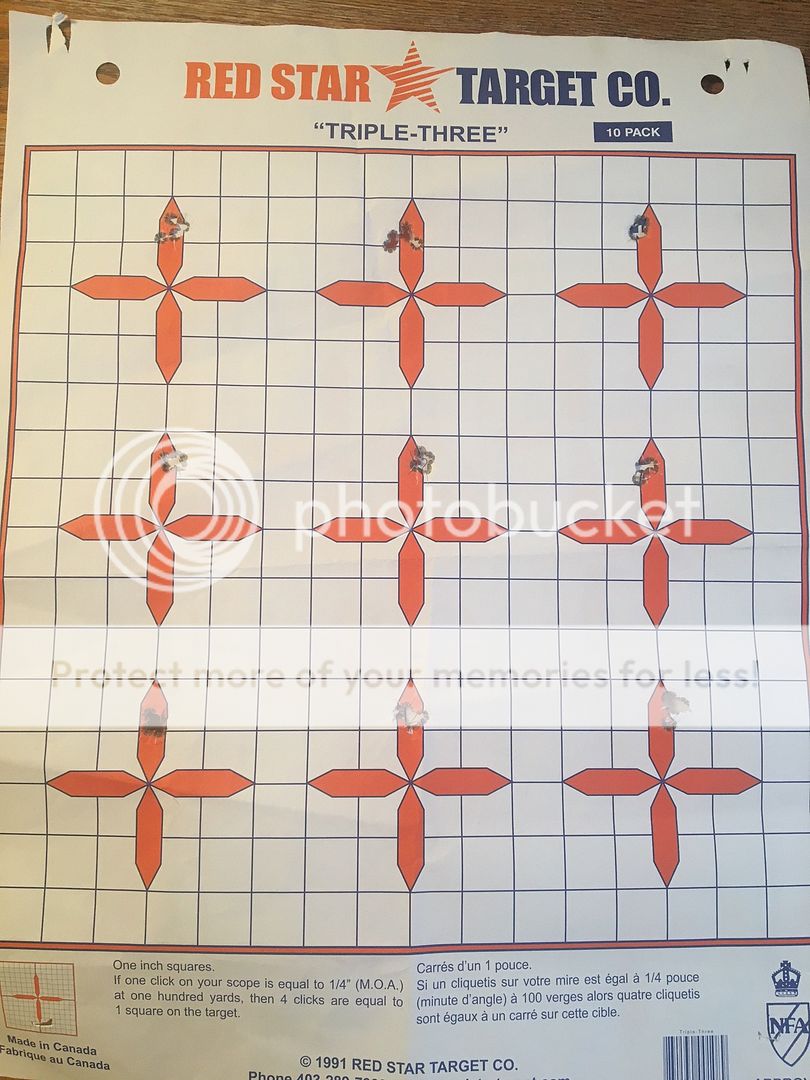
What barrel are you using for those groups, those look too tight to be a factory barrel, especially with full grain jumps in powder charge.
Looks like you need to back out to 200 or 300 yards to really see which load is the best load.
You've found a load getting the accuracy you're happy with, but are you getting the performance velocity-wise you think you're getting. A friend of mine was shooting a M70 carbine in 30-06 and had a load that was decently accurate at 100 yards, but seemed too low at 200 yards. So he used my chronograph and found out he was only getting .30-30 type velocities! Needless to say he made some changes to his pet formula. He had been reloading for decades, but never saw the need for a chronograph. He just went with the velocities in the reloading manuals. In my opinion you can't really do load development properly without chronograph because without it you really don't know what you're doing.
So, next step is to use a chronograph to see if you're happy with the velocities. If you're happy with the accuracy, and happy with the velocity, then after that just make a bunch of those loads and practice at all different distances and shooting positions. Then you're deadly.
Sorry, I don't completely agree with this.
I do think that a chronograph is a useful tool for load development but if you're using current reloading manuals and you start low and work your way up to book max noting where the accuracy nodes are you only need a chrony to verify velocity for drop charts. I'm not saying it shouldn't be used or that I myself don't use it throughout testing but it really isn't needed in order to make very accurate and repeatable ammo that runs close to the maximum velocity the rifle is capable of safely shooting.
I start low and work my loads all the way up to book max or until I see signs of pressure then drop back to the last tight grouping. After that I try a 0.1gr and 0.2gr charge change higher and lower to see if it tightens up, once I have the best powder charge I start refining seating depth to see if improvements can be made.
By working all the way up to max for your rifle without stopping at the first decent group you will find the higher accuracy node and end up in the same spot as the guy using the chrony.
Lately I've only been loading up 3 rounds at a time to test, while testing I run them over the chrony to help get me quickly to my ballpark velocity that I want to play in (also paying attention to what they're doing on paper and the ES) without wasting barrel life shooting 5-10 rounds of every possible powder charge. Once I'm close to having a powder charge I start making more so I can test repeatability and get a more accurate velocity spread (of course looking for a small ES).
Once I'm done that it's all about testing at different distances to see what it does out to whatever the maximum range I plan to shoot that rifle.
The chronograph is a valuable tool but too many people end up simply chasing more velocity rather than using it to help get to the most accurate load possible.
OP, document everything you do. EVERYTHING!!!
Bullet, powder, powder charge, seating depth, case trim length, primer used, ambient temperature during testing, distance rounds were tested at, name your rifle and put it at the top of the page. I go back through my older logs and don't even know what rifle the loads were developed for because I've bought and sold so many over the years I can't keep track any more. I usually just tear those pages out and throw them away.
Also, be sure to wait a couple minutes between every shot if you really want to see what your rifle can do. Unless you have a high end aftermarket barrel (properly stress relieved) you will have point of impact stringing as the barrel warms up. Factory barrels do this no matter what contour they are.




































































