Reloading… on a budget

Bigbadbear

New member
Rating - 100%
1   0   0
Hey Gents. New to Gun Nutz and newish to reloading. I just acquired a browning x bolt stainless stalker in 7mm rem mag. 26” barrel with 1: 9.5” twist and I would like to load up some rounds purely for hunting. I’ve done my share of research and have decided on 150gr Barnes TTSX. I’ll be using a combination of Lee and RCBS reloading equipment loaned to me from my father.

I cant justify buying 3 different powders to experiment with so my plan is to choose 1 powder, and play with charge quantity and seating depth until I land on the best result.
My theory is that with this I can get the same but probably better results than factory ammo.

As for powder I’m thinking Hodgdon H1000. I have mainly chosen this powder as a couple of my friends with comparable 7mm rem mags have done powder experimenting and both landed on h1000.

As for brass, Im still on the fence. Some guys swear by Nosler, Hornady, Federal… but from what I read it’s really more important to use one brand for consistency then for accuracy.

Keeping in mind that this is strictly for hunting deer and elk, out to 400yds NOT match shooting and wanting sub .5 MOA accuracy. Let me know what you think. Thanks a lot!
 
A "recipe" will include the brand of brass used and the type of primer - also how much of what type powder and type/weight of bullet. If it is of any help, Nosler #9 book shows N160 as "most accurate powder" in 7mm Rem Mag for their 150 grain bullets, but they used 24" Wiseman barrel with 1-9" twist, Fed 215 primers and Nosler cases. IMR 4350 gave several hundred feet per second more speed. So, your mileage might vary from that. They list 9 powders, but do not list H1000 for that bullet weight in 7mm Rem Mag. I do not have a Barnes Manual - I do not know what they recommend, nor do I know Barnes' recommended bullet 'jump".
 
Good luck with the 150 ttsx and your 1-9.5" twist rate. You are right at the verge of it should be a bit faster twist rate to stabilize better. It should still stabilize it, it might just take a bit longer downrange to fully stabilize(go to sleep) and give you the accuracy you are looking for.

Don't get discouraged if your groups are a bit larger than expected, and shoot it at 200 yards and 300 yards and you might be surprised. A tiny bit of bullet yaw at closer ranges before the bullet fully stabilizes does happen.

But it might fully stabilize perfectly for you and your rifle. Just as long as you know you are right in the edge of where it should almost be a 1-9" twist rate.

I am of no help with load data for 7mm Remington Magnum. Best of luck, let us know how it turns out. But your pick of H1000 is a perfect powder to start with.
 
Welcome.
You can pick one powder/bullet and it will probably do what you need it to.
I've always found that the faster you can push a Barnes bullet the better the accuracy.
Good luck!
 
If I was to only choose 1 powder for the 7MM REM MAG , it would be IMR7828 ; I think H1000 is too slow for the 7Mag JMHO. I use many different powders in my 7RMag, with many different bullets . No 2 rifles will be exactly the same for loading recipes, again JMHO
Your 1: 9.5 won't be optimal to stabilize the 150 TTSX but it should work, Good Luck
 
Last edited:
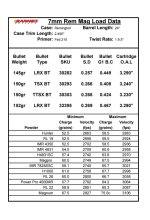
Barnes lists h1000 and a 9.5 twist in their data. My gut says H1000 sounds a bit slow for a bullet that light, but otherwise looks like you're on the right track.

1000029013.jpg
 
Good luck with the 150 ttsx and your 1-9.5" twist rate. You are right at the verge of it should be a bit faster twist rate to stabilize better. It should still stabilize it, it might just take a bit longer downrange to fully stabilize(go to sleep) and give you the accuracy you are looking for.

Don't get discouraged if your groups are a bit larger than expected, and shoot it at 200 yards and 300 yards and you might be surprised. A tiny bit of bullet yaw at closer ranges before the bullet fully stabilizes does happen.

But it might fully stabilize perfectly for you and your rifle. Just as long as you know you are right in the edge of where it should almost be a 1-9" twist rate.

I am of no help with load data for 7mm Remington Magnum. Best of luck, let us know how it turns out. But your pick of H1000 is a perfect powder to start with.
that’s interesting, I didn’t realize that could happen but it makes sense. Thanks for the info.
 
I always had really good luck with h4831sc in 7mm rm. Never messed with h1000 but it seems more popular with 168gr ish bullet weights.
H4831 is my second choice, only because, like I said before a couple of my buddies landed on h1000 after some experimentation. I guess the results will dictate if I have to get a pound of 4831 or if I’m happy with the results from h1000.
I haven’t purchased any powder yet, as I’m learning it’s hard to find!
Also I am still on the fence between the two powders.
Thanks for the info
 
H4831SC, IMR 7828, RL 22 were always great powders for me in the 7RM.

Your logic of picking a powder and sticking it it makes sense unless you have disastrous results which is unlikely. I don't think you would go wrong with H1000 either. Sometimes it comes down to what is actually available.
 
realistically, how much shooting are you going to use the 7mag for? OE rounds are very good quality these days, Barnes loads can be had for ~$85/20 or $5 a piece and you wind up with once-fired brass, plus $ for dies and equipment.
Then compare, add up your prices for brass, bullets and powder and you might save a $buck per bang
checks and balances, ymmv
 
realistically, how much shooting are you going to use the 7mag for? OE rounds are very good quality these days, Barnes loads can be had for ~$85/20 or $5 a piece and you wind up with once-fired brass, plus $ for dies and equipment.
Then compare, add up your prices for brass, bullets and powder and you might save a $buck per bang
checks and balances, ymmv
You’re right, I went back and forth for weeks before deciding to hand load. I am getting brass from friends and family, and the reloading equipment is on loan from my father. So costs will be minimal. But I am interested to see the results and that will determine if it was all worth it or not.
 
H4831SC, IMR 7828, RL 22 were always great powders for me in the 7RM.

Your logic of picking a powder and sticking it it makes sense unless you have disastrous results which is unlikely. I don't think you would go wrong with H1000 either. Sometimes it comes down to what is actually available.
Those are all good powders in 7rm.
 
You’re right, I went back and forth for weeks before deciding to hand load. I am getting brass from friends and family, and the reloading equipment is on loan from my father. So costs will be minimal. But I am interested to see the results and that will determine if it was all worth it or not.

Absolutely don't be dissuaded from learning to handload. It gives you a new perspective on firearms, ammunition and ballistics. It also offers you the ability to create practice ammunition using a less expensive bullet and save you some money there. Shooting practice is so often neglected by the average hunter.

You've already got the gear so getting yourself set up isn't going to cost much. You can make 100+ rounds of 7RM with one pound of powder. Even with component prices these days you are going to be looking at under $3 per round for your TTSX loads. Get some less expensive bullets for shooting at the range and they will be more like $2 a round.
 
You’re right, I went back and forth for weeks before deciding to hand load. I am getting brass from friends and family, and the reloading equipment is on loan from my father. So costs will be minimal. But I am interested to see the results and that will determine if it was all worth it or not.
It is a rare factory round that has left the barrels of my hunting rifles since about... forever. "Helped" Dad reload the 30-06 rounds on his Black Bair press for my P17 surplus rifle I shot my first deer with when I was eight years old... that was over 60 years ago. It's been nothing but reloads after experimentation ever since.

With that in mind, there's some rational to the suggestion you start out with factory ammunition, even if family is going to supply you with their empty brass.

First, if you're like most hunters who aren't also recreational centerfire shooters with their hunting rifles, you're only going to fire a few rounds each hunting season.

These days, unless you're a dedicated hunter willing to spend the money to send dozens of bullets downrange in the quest for the best grouping performance possible, it is very unlikely that as a novice wanting to keep reloading as inexpensive as possible, you will be able to equal the performance of factory hunting ammunition straight off the store shelf with only minimal investment in bullets, powder, etc for experimentation.

In other words, it's probable that factory ammo, whether from Barnes or any other bullet manufacturer like Nosler, Hornady, etc, will be as good or better than what you reload as a novice and spend little time experimenting with.

Second, having decided you want to use the Barnes 150 gr. TTSX, buying a box of that factory ammunition allows you to do two things:
1. Fire the ammunition for group at 300 yards to provide you with a baseline of performance for comparison to your reloads.
2. Provide you with empty brass fire formed in your rifle, if you properly resize the brass after firing. That brass is a better starting point in comparison to brass fired from several other peoples' rifles.

There's a learning curve to getting the best performance available from your hunting rifle by reloading, versus simply producing ammunition that reliably goes "bang" every time you pull the trigger. And that learning curve and experimentation to determine the best reload for a bullet out of your rifle has a cost associated with it that you may not want to open your wallet to pay for.

If you want to do it at minimal cost by borrowing reloading equipment and fired brass given to you by family and friends, you will probably get better results at lower cost by simply purchasing commercial ammunition loaded with your chosen round. $40 a year for Barnes commercial ammunition loaded with your chosen bullet should cover your sighting confirmation and game shooting each year. (Unless you're a terrible shot or have the opportunity to shoot many game animals each year). You'll probably spend more on gas each day you head out hunting each year.

Not trying to discourage you, but I enjoy the load development process, even with what the costs for primers, powder, bullets has risen to now. If that's not for you, including the associated cost of experimentation, that is why I suggest you might consider sticking with factory ammunition instead.
 
Back in 1982, I like you, started off reloading with bare-bones reloading equipment and components. One bullet, powder, primer and case. I used IMR-4831, made one load for the 30-06, which lasted me until 1990. After, I slowly played around with development.

Today, with the cost of factory ammunition, it's prudent to reload, to save cost manufacturing a custom cartridge. All things equal, all prices increased over the decades, neither is inexpensive. Case-in-point, every commodity is most expensive and it will never decrease in price, no thanks to government and human greed.
 
Last edited:
As alluded to above, and perhaps OP's point in titling this thread - I still get "neighbours" come over who think I can reload a box of shells for them for $5 - I used to be able to, but that was decades ago. I have no clue where OP lives, but when it comes to buying consumables for reloading, versus store bought ammo - is some homework required on the reloader's part. Hodgdon powders (H1000, H4831SC) are usually sold minimum one pound - that is 7000 grains. So, if your load is circa 60 grains, then that is about 116 rounds, if you don't spill or waste any. Bullets tend to come in packages of 50 or 100 - I can not buy 6 or 22 bullets at a store (that I know of). Primers come in trays of 100 - often purchased in cartons of 1000, but that is 10 x trays of 100 - some stores sell as trays of 100 only. Assuming that you have a supply of brass and reloading tooling - you are still looking at buying powder, bullets and primers. Chances are good that you will have to buy enough stuff to make 5 boxes of factory ammo (100 rounds). Some of us now buy primers by the multiple thousand, now buy bullets by 500 and now buy 8 or more pounds of powder at a time. Without counting stuff on hand - easily enough things here to make a hundred boxes of 20 rounds ammo - probably several hundreds boxes. And I have the tools - some of it like 50 or more years old, but still seems to be working fine. OP - do not forget the "knowledge" needed - there are multiple typos on-line and in many books - you will want to compare one to the other, if you care. Easily 10 different reloading manuals on my reloading desk - that is not counting the complete sets of "old" manuals that I normally do not refer to - unless I am using "old" stuff.

I am not a "target shooter" - mostly I have been firing at game - of course, for me, that means considerable rounds were sent down range at paper targets to compare loads, to set in a scope, etc. I suspect much is written about "reloading", that makes good sense if you have a hand made custom rifle. If you have a store bought, factory, mass produced rifle, or an ex-military "sporter" - be very pleased with yourself and it, if you can get MOA 5 shot groups - even 3" 5 shoot groups at 100 yards are not bad. It will not be your gear's issue if you do not get your deer or elk with a 3 MOA rifle. You will not be set up for 0.25 MOA groupings, or less (all bullet holes touching each other) - but some folks are.
 
It is a rare factory round that has left the barrels of my hunting rifles since about... forever. "Helped" Dad reload the 30-06 rounds on his Black Bair press for my P17 surplus rifle I shot my first deer with when I was eight years old... that was over 60 years ago. It's been nothing but reloads after experimentation ever since.

With that in mind, there's some rational to the suggestion you start out with factory ammunition, even if family is going to supply you with their empty brass.

First, if you're like most hunters who aren't also recreational centerfire shooters with their hunting rifles, you're only going to fire a few rounds each hunting season.

These days, unless you're a dedicated hunter willing to spend the money to send dozens of bullets downrange in the quest for the best grouping performance possible, it is very unlikely that as a novice wanting to keep reloading as inexpensive as possible, you will be able to equal the performance of factory hunting ammunition straight off the store shelf with only minimal investment in bullets, powder, etc for experimentation.

In other words, it's probable that factory ammo, whether from Barnes or any other bullet manufacturer like Nosler, Hornady, etc, will be as good or better than what you reload as a novice and spend little time experimenting with.

Second, having decided you want to use the Barnes 150 gr. TTSX, buying a box of that factory ammunition allows you to do two things:
1. Fire the ammunition for group at 300 yards to provide you with a baseline of performance for comparison to your reloads.
2. Provide you with empty brass fire formed in your rifle, if you properly resize the brass after firing. That brass is a better starting point in comparison to brass fired from several other peoples' rifles.

There's a learning curve to getting the best performance available from your hunting rifle by reloading, versus simply producing ammunition that reliably goes "bang" every time you pull the trigger. And that learning curve and experimentation to determine the best reload for a bullet out of your rifle has a cost associated with it that you may not want to open your wallet to pay for.

If you want to do it at minimal cost by borrowing reloading equipment and fired brass given to you by family and friends, you will probably get better results at lower cost by simply purchasing commercial ammunition loaded with your chosen round. $40 a year for Barnes commercial ammunition loaded with your chosen bullet should cover your sighting confirmation and game shooting each year. (Unless you're a terrible shot or have the opportunity to shoot many game animals each year). You'll probably spend more on gas each day you head out hunting each year.

Not trying to discourage you, but I enjoy the load development process, even with what the costs for primers, powder, bullets has risen to now. If that's not for you, including the associated cost of experimentation, that is why I suggest you might consider sticking with factory ammunition instead.
That’s a good point. I’m going to dabble alittle bit and see if it’s something I want to get into. But you’re right, practically speaking factory ammo is more suited to the average hunter. Including myself.
Thanks for the insight
 
One brand of brass bullets primers and powder. I admit shooting to on a budget with some of mine, with work you will get it figured out as to what works best. I load for various calibers, different bullet weights, rifles, handguns, smokeless and black powder. I admit its not cheap loading for some, my 338 LM is a prime example. DIY it's getting up to 4 $ a pop, store bought is 10+ a pop. Generally I buy 1 box of factory and use it as a bench mark. Doing incremental loading to find what works is the pricey part, but once its set the price point drops! Good luck!
 
Back
Top Bottom