












































I posted this article on another forum. There were some errors and typo's and this is a revised version of that post. I was reading a post on this site, the general sentiment being that the poster was dissatisfied with a die that seemed to require excessive force to resize a case. The only way to determine if there is "a problem" is to measure the resized case. This write-up details this measuring process.
Reloading 102
Beyond the Basics, Measuring the case
Most times we reload, follow the “101 of reloading” and life is good. Then one day we reload for a new rifle, in a new caliber and our straw house falls down around our chins. The problem is not visually apparent; we need to move beyond the basics.
Reloading is a hobby, a pretty good one, almost therapeutic. However, it can become a frustrating science when “Something goes bump in the night”. If you reload long enough, for more than one caliber, for a safe full of rifles, you may run across that “What the heck is going on here” situation. These can include bad groups from a rifle that shoots factory rounds nicely, rounds that are hard to chamber, casings that head separate after several firings, necks that split, having to jump on the handle to resize a shell and other puzzlers.
I’m not an expert, or a scientist, or a famous bench rest shooter or an engineer. There are no letters behind my name. This will be a basic tutorial outlining sleuthing tips which may help you find your problem or to confirm all is right. I may suggest “fixes” that have worked for me; you will have to determine if they are an appropriate solution for your situation. There is no intent here to bash any one manufacturer or brand of tool or product, nor is it an attempt to promote any product. Most reloading problems are not manufacturing errors; they are just the result of tolerance stack up or specific industry standards. I hope that takes care of the lawyer issues, now on to the good stuff.
Cartridge Case Neck
Sometimes things don’t seem right. You hear squeaking and need to lean on the handle of the press to get the case out of the sizing die. You try all the obvious, you polish the expander, clean the inside of the case neck, lube it with magic powder and super slip, it seems to work but after several reloads the necks split. So you try annealing and perhaps contemplate buying new dies, a different press, a new rifle or even going to church more often. You are frustrated, you are shooting a 30-06 and you are having problems. Why me? What’s happening?
In order to find a remedy, you will first need to find the cause. When considering the neck of a reloaded cartridge the most important consideration is that the die and expander have left the neck with sufficient tension to hold the bullet in place until it is fired. Under heavy recoil situations a crimp may be required to help hold the bullet in place. If you measure a bullets diameter and the diameter of the expander button of a die you’ll discover that app. 0.002” tension seems to be what is required.
I own a digital vernier caliper and use it fairly often; it would be on my list of tools to buy for reloading. Our first measurement will be the outside diameter of the neck of a case that has been fired in the rifle we are loading for. I chose 30-06 cases for demonstration purposes, because I just happened to have some available. The same basic measurements apply to any cartridge case.
Figure 1.
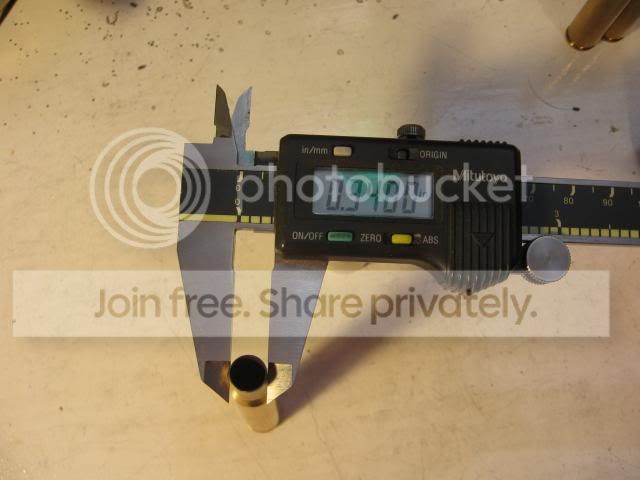
The picture above shows that the outside neck diameter of this fired case is 0.3400”
Figure 2
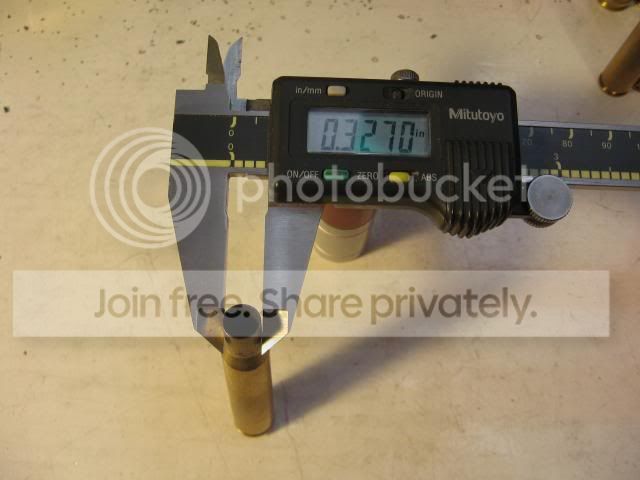
After being sized in a die with the expander/decapper removed the outside diameter of the neck is 0.327”.
Figure 3.
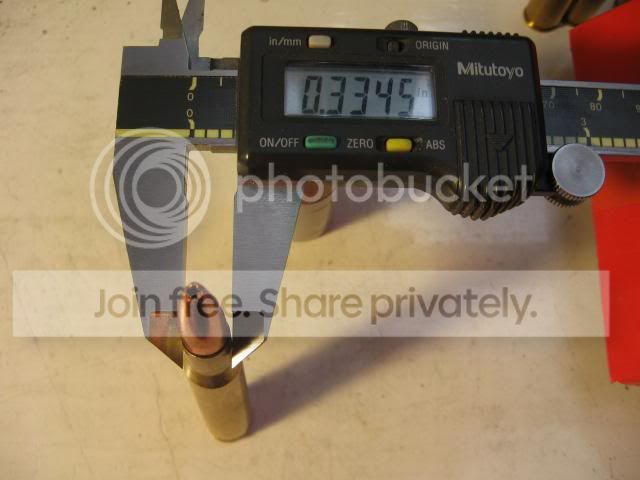
This measurement, 0.3345”, is of the outside diameter of the neck with the bullet seated
deep enough so that all of the case neck supports the shank of the bullet.
These measurements are fairly typical of what you would expect from a production rifle and using commonly available reloading dies. The neck is being worked 0.340 – 0.327 = 0.013” in the sizing operation. The expanding and bullet seating work the brass in the opposite direction 0.327 – 0.3345 = 0.0075” and when we fire the round the case neck expands to seal the chamber, preventing the hot pressurized gasses from leaking past the case, and then its grip on the chamber neck relaxes slightly and ends up at 0.340” for an additional 0.0055” of work.
Interestingly, the 0.3400” measurement is very close to the 0.3405” that SAAMI lists as the neck diameter for chamber minimum. The diameters of a maximum chamber are 0.002” larger. If you factor in the elastic modulus of brass the neck of my rifles chamber would surely fall between min and max.
The 0.3345” measurement is 0.0052” less than the SAAMI spec for the neck diameter of cartridge maximum. SAAMI allows -0.008” on diameter for cartridge minimum. The minimum neck diameter for a loaded 30-06 would be 0.3395” – 0.008” = 0.3305”. When I consider that the die I used reduces the neck to 0.327” or only 0.0035” less than cartridge minimum, I have to admire the tolerances that it was built to. If I were to size a cartridge minimum case the neck would be reduced to a size that the button would only have to expand the neck by less than 0.002” and the bullet would expand the neck another 0.002”.
Figure 4.
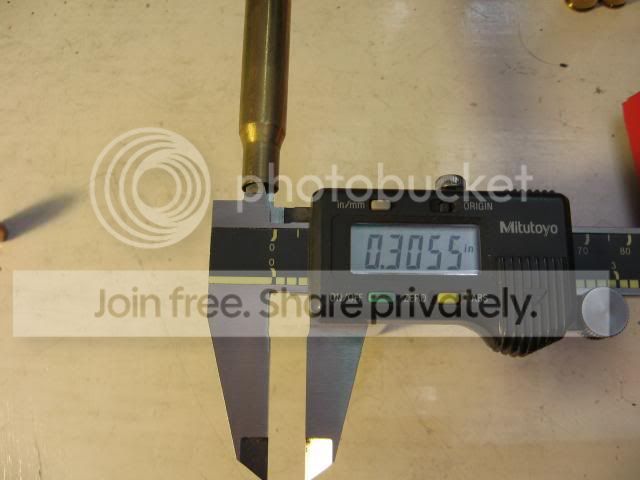
While I had the calipers out I measured the inside of a resized case, 0.3055” is under
bullet diameter which ensures enough tension or grip on the bullet.
Measuring the inside with the vernier illustrates the versatility of the vernier. To confirm adequate tension on the bullet I pulled the bullet on that case and the neck returned to 0.3330”. That would indicate 0.0015” of actual neck tension. When the bullet is seated, it expands the case by the amount that it is larger than the inside of the neck. Cartridge brass has a limited amount of “spring”, the case neck has about 0.001” of “spring”. A work hardened case neck will loose its “spring” and annealing is the only method of restoring that property.
The Cartridge Body
The same measuring techniques can be used to check the amount of sizing of any of the diameters of the cartridge body. The most that a fired case should have expanded would be so it was just slightly smaller than the SAAMI chamber maximum specification. A sized case should not be any smaller than the cartridge minimum specifications and ideally I would expect that you would need a small base die to achieve cartridge minimum.
Let’s take a few measurements to serve as an example. I’ll continue to use the 30-06 as an example cartridge.
Figure 5.
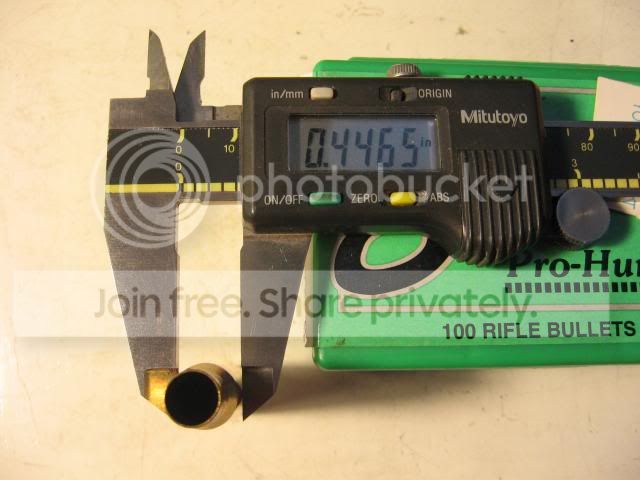
On a fired case, at a point near the top of the case the diameter is 0.4465”.
Figure 6.
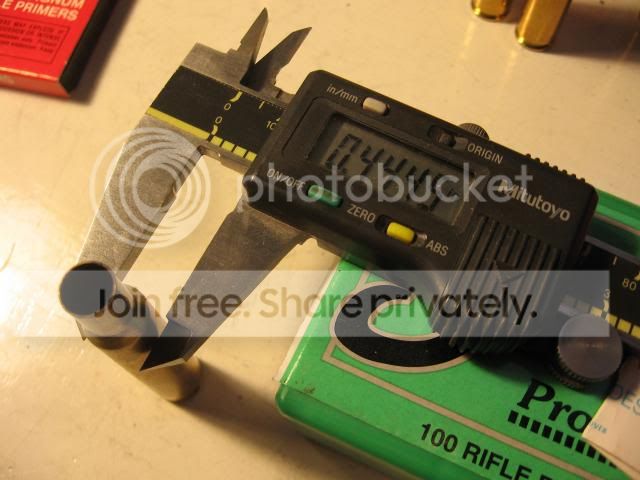
When I used Full Length sizing die “A” the sized diameter was 0.4445”.
Figure 7.
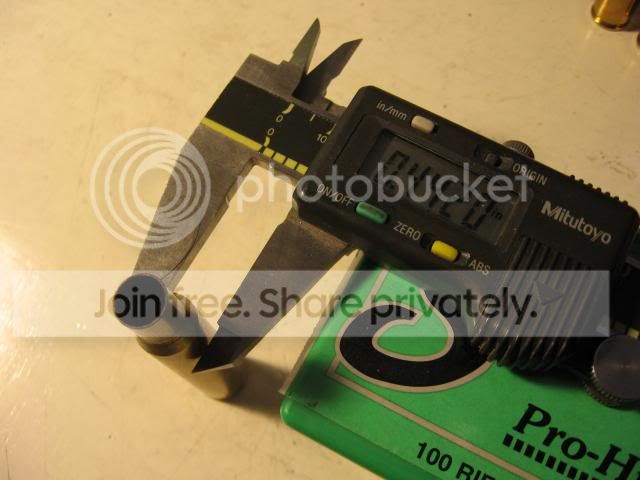
When I used Full Length sizing die “B” the sized diameter was 0.4420”.
Figure 8.
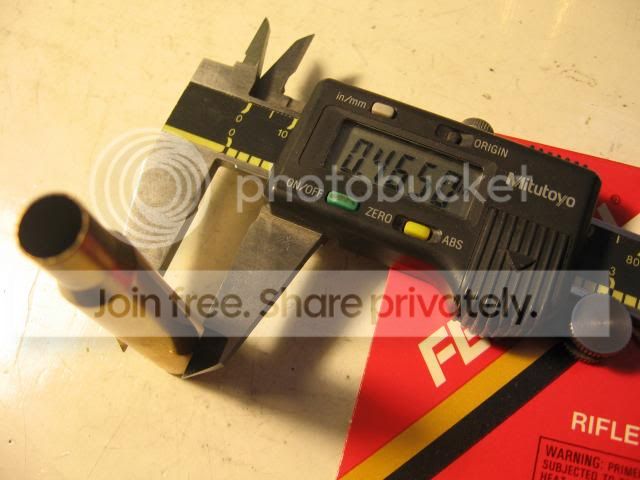
On a fired case, at a point near the bottom of the case the diameter is 0.4650”.
Figure 9.
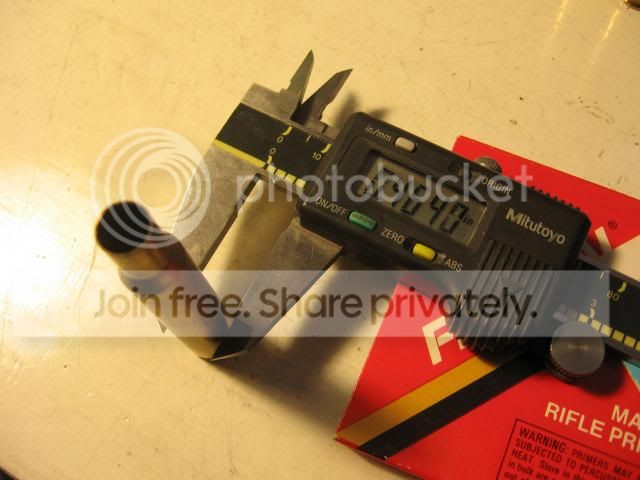
When I used Full Length sizing die “A” the sized diameter was 0.4640”.
Figure 10.
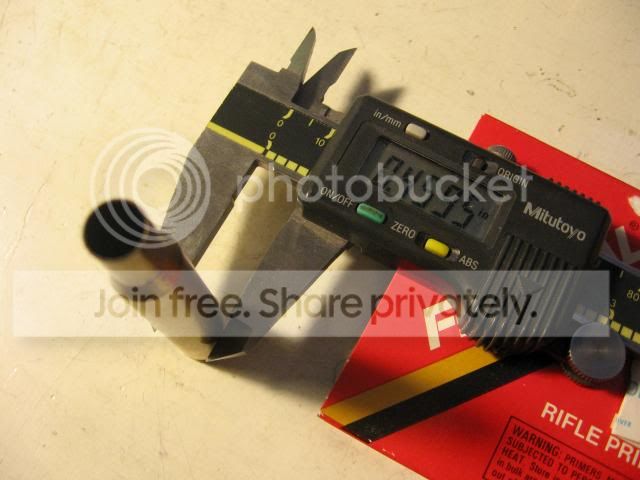
When I used Full Length sizing die “B” the sized diameter was 0.4595”.
What do these measurements mean? I measured the same dimensions on a new unprimed case. Sizing die “B” reduced the size of a fired case to almost exactly the same dimensions as a new case while die “A” sized a fired case minimally, probably why it is the die I use most often and it requires very little effort to resize a case. In order to compare dimensions to the SAAMI specifications you need to measure at specific points on the case. For expediency I measured case diameters that were easy to photograph.
Cartridge Headspace (or shoulder setback)
That leaves us with one critical measurement, and that is the cartridge length from the headspace datum diameter to the case head. I use a tool that attaches to my caliper. It comes with several sleeves and as SAAMI uses 0.375” as their datum diameter for measuring cartridge headspace from, for the 30-06, that is the sleeve I attached to the caliper.
Figure 11.
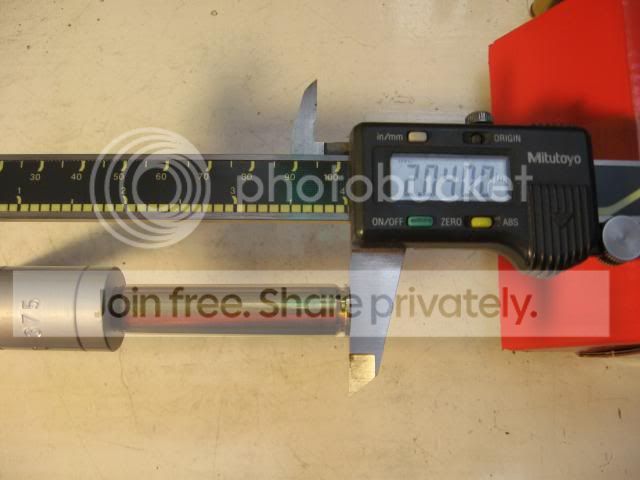
I didn’t want the spent primer to skew my measurements, so I removed the primer with a decapping die, leaving the case un-sized.
The headspace dimension for a fired case was 2.0400”.
When I use sizing die “A”, this dimension does not change, 2.0400” before and after. With this die/shell holder combination the shoulder was not set back at all. When I sized a fired case with sizing die “B”, the measured cartridge headspace was 2.0335”. Die “B” is setting the shoulder back 0.0065”.
I adjust my sizing dies as per RCBS instructions:
Generally dies will set the shoulder back on a fired case; the resized case will be a bit shorter than the fired case. If a die sets the shoulder back more that desired, and you adjust your dies according to instructions, how do you reduce the amount of shoulder setback?
All the major brands of shell holders are manufactured to a standard depth. For a “standard” shell holder, the distance from the surface that contacts the die, to the surface that supports the base of the case, "X" is 1/8 of an inch, 0.125”. Shell holders are built to fairly tight tolerances, they are usually right on but they can vary +/- a thousandth of an inch.
Figure 12
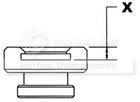
Redding sells competition shell holder sets for increasing the resized cartridge length or reducing the amount of shoulder setback. Each set contains 5 shell holders, deeper than a standard shell holder, in 0.002” increments. They are marked +.002, +.004, +.006, +.008 and +.010. Instructions are included, explaining how to use the set to tailor ammunition for your rifle.
You may encounter a die that won’t set the shoulder back enough, a resized case will be longer than a fired case and the case may take some effort to chamber. I’ve encountered this twice, once I shortened a shell holder by a few thousandths and store it with that particular die. With the other caliber, I just lapped the bottom surface of the die until it set the shoulder back the desired amount.
I intentionally titled this article “Reloading 102”, as it goes beyond the basics or the 101 of reloading. My intention was not to compete with all the fine basic instructions available, online and in loading manuals. I wanted to show how to measure a case, to determine exactly what happens to it when it is sized, in real numbers. It also shows how useful a measuring tool the digital vernier caliper is. There are other instruments specifically designed for measuring inside dimensions just as there are precision instruments for measuring outside dimensions. A digital vernier measures from 0.0000” to 6.0000”, to within 0.0005”, inside and outside, gives absolute readings at the push of a button, instantly converts to metric and photographs well. They aren’t very expensive either, which is nice.
Addendum A: Desired amount of case shoulder setback.
In the instructions that come with the Hornady headspace gauge it states; “Typically, when full length resizing, the die should be adjusted to set the shoulder back 0.001” to 0.002”. This will provide a proper (minimal) clearance with the firearms chamber. A proper headspace will minimize case stretching, reduce work hardening, extend case life, improve accuracy, and increase safety.”
There are other opinions on optimum shoulder setback. One recommendation is that the shoulder setback should be “size on size” or 0.000” setback for Bolt action rifles and 0.001” for semi-auto rifles. Another recommendation is that the "desired" amount of shoulder setback should be in the order of 0.003" to 0.004".
The 0.003” to 0.004” recommendation has this explanation, “If the case shoulder is contacting the chamber, the bolt will be harder to close. It can also cause other problems, but all are avoided by setting back the case shoulder the amount recommended and even a little more does not compromise accuracy."
In our family we have 4 different bolt action 270 Winchester rifles, and naturally there are chamber differences. I load one load for all; in the tightest headspace chamber this ammunition has 0.001” of shoulder setback and in the longest headspace chamber shoulder setback is around 0.003”. I use a Lee FL die and the #2 shell holder that comes with the die. Accuracy is good, no worse than if I tailor the shoulder setback to each individual rifle.
I also reload for 350 Remington Magnum, and although a belted magnum “headspaces” on the belt, SAAMI lists a cartridge headspace dimension using a 0.440” datum diameter to measure from. The set of sleeves that comes with my headspace gauge does not include a 0.440” sleeve; I used the 0.420” sleeve to take relative measurements. A fired case was 0.006” longer than a FL resized case. I consider this to be a bit more than ideal but still OK for good case life, reliable ammunition. The 350 Remington Magnum headspaces off the belt, shoulder setback is mainly a consideration for case life and ammunition reliability.
I have another 350 FL die, and it sets the shoulder back an additional 0.019”. That would give me a 0.025” shoulder headspace gap, and that would be a problem. I contacted Redding and have ordered a +0.022” shell holder to use with that die. This sort of dimensional discrepancy doesn’t happen often, but it does happen with belted magnum calibers, confirmed by the fact that Redding had +0.019”, +0.022” and +0.025”, #6 shell holders in stock.
When I load for our bolt action 223 Remington’s, the setback is 0.002”.
Reloading 102
Beyond the Basics, Measuring the case
Most times we reload, follow the “101 of reloading” and life is good. Then one day we reload for a new rifle, in a new caliber and our straw house falls down around our chins. The problem is not visually apparent; we need to move beyond the basics.
Reloading is a hobby, a pretty good one, almost therapeutic. However, it can become a frustrating science when “Something goes bump in the night”. If you reload long enough, for more than one caliber, for a safe full of rifles, you may run across that “What the heck is going on here” situation. These can include bad groups from a rifle that shoots factory rounds nicely, rounds that are hard to chamber, casings that head separate after several firings, necks that split, having to jump on the handle to resize a shell and other puzzlers.
I’m not an expert, or a scientist, or a famous bench rest shooter or an engineer. There are no letters behind my name. This will be a basic tutorial outlining sleuthing tips which may help you find your problem or to confirm all is right. I may suggest “fixes” that have worked for me; you will have to determine if they are an appropriate solution for your situation. There is no intent here to bash any one manufacturer or brand of tool or product, nor is it an attempt to promote any product. Most reloading problems are not manufacturing errors; they are just the result of tolerance stack up or specific industry standards. I hope that takes care of the lawyer issues, now on to the good stuff.
Cartridge Case Neck
Sometimes things don’t seem right. You hear squeaking and need to lean on the handle of the press to get the case out of the sizing die. You try all the obvious, you polish the expander, clean the inside of the case neck, lube it with magic powder and super slip, it seems to work but after several reloads the necks split. So you try annealing and perhaps contemplate buying new dies, a different press, a new rifle or even going to church more often. You are frustrated, you are shooting a 30-06 and you are having problems. Why me? What’s happening?
In order to find a remedy, you will first need to find the cause. When considering the neck of a reloaded cartridge the most important consideration is that the die and expander have left the neck with sufficient tension to hold the bullet in place until it is fired. Under heavy recoil situations a crimp may be required to help hold the bullet in place. If you measure a bullets diameter and the diameter of the expander button of a die you’ll discover that app. 0.002” tension seems to be what is required.
I own a digital vernier caliper and use it fairly often; it would be on my list of tools to buy for reloading. Our first measurement will be the outside diameter of the neck of a case that has been fired in the rifle we are loading for. I chose 30-06 cases for demonstration purposes, because I just happened to have some available. The same basic measurements apply to any cartridge case.
Figure 1.
The picture above shows that the outside neck diameter of this fired case is 0.3400”
Figure 2
After being sized in a die with the expander/decapper removed the outside diameter of the neck is 0.327”.
Figure 3.
This measurement, 0.3345”, is of the outside diameter of the neck with the bullet seated
deep enough so that all of the case neck supports the shank of the bullet.
These measurements are fairly typical of what you would expect from a production rifle and using commonly available reloading dies. The neck is being worked 0.340 – 0.327 = 0.013” in the sizing operation. The expanding and bullet seating work the brass in the opposite direction 0.327 – 0.3345 = 0.0075” and when we fire the round the case neck expands to seal the chamber, preventing the hot pressurized gasses from leaking past the case, and then its grip on the chamber neck relaxes slightly and ends up at 0.340” for an additional 0.0055” of work.
Interestingly, the 0.3400” measurement is very close to the 0.3405” that SAAMI lists as the neck diameter for chamber minimum. The diameters of a maximum chamber are 0.002” larger. If you factor in the elastic modulus of brass the neck of my rifles chamber would surely fall between min and max.
The 0.3345” measurement is 0.0052” less than the SAAMI spec for the neck diameter of cartridge maximum. SAAMI allows -0.008” on diameter for cartridge minimum. The minimum neck diameter for a loaded 30-06 would be 0.3395” – 0.008” = 0.3305”. When I consider that the die I used reduces the neck to 0.327” or only 0.0035” less than cartridge minimum, I have to admire the tolerances that it was built to. If I were to size a cartridge minimum case the neck would be reduced to a size that the button would only have to expand the neck by less than 0.002” and the bullet would expand the neck another 0.002”.
Figure 4.
While I had the calipers out I measured the inside of a resized case, 0.3055” is under
bullet diameter which ensures enough tension or grip on the bullet.
Measuring the inside with the vernier illustrates the versatility of the vernier. To confirm adequate tension on the bullet I pulled the bullet on that case and the neck returned to 0.3330”. That would indicate 0.0015” of actual neck tension. When the bullet is seated, it expands the case by the amount that it is larger than the inside of the neck. Cartridge brass has a limited amount of “spring”, the case neck has about 0.001” of “spring”. A work hardened case neck will loose its “spring” and annealing is the only method of restoring that property.
The Cartridge Body
The same measuring techniques can be used to check the amount of sizing of any of the diameters of the cartridge body. The most that a fired case should have expanded would be so it was just slightly smaller than the SAAMI chamber maximum specification. A sized case should not be any smaller than the cartridge minimum specifications and ideally I would expect that you would need a small base die to achieve cartridge minimum.
Let’s take a few measurements to serve as an example. I’ll continue to use the 30-06 as an example cartridge.
Figure 5.
On a fired case, at a point near the top of the case the diameter is 0.4465”.
Figure 6.
When I used Full Length sizing die “A” the sized diameter was 0.4445”.
Figure 7.
When I used Full Length sizing die “B” the sized diameter was 0.4420”.
Figure 8.
On a fired case, at a point near the bottom of the case the diameter is 0.4650”.
Figure 9.
When I used Full Length sizing die “A” the sized diameter was 0.4640”.
Figure 10.
When I used Full Length sizing die “B” the sized diameter was 0.4595”.
What do these measurements mean? I measured the same dimensions on a new unprimed case. Sizing die “B” reduced the size of a fired case to almost exactly the same dimensions as a new case while die “A” sized a fired case minimally, probably why it is the die I use most often and it requires very little effort to resize a case. In order to compare dimensions to the SAAMI specifications you need to measure at specific points on the case. For expediency I measured case diameters that were easy to photograph.
Cartridge Headspace (or shoulder setback)
That leaves us with one critical measurement, and that is the cartridge length from the headspace datum diameter to the case head. I use a tool that attaches to my caliper. It comes with several sleeves and as SAAMI uses 0.375” as their datum diameter for measuring cartridge headspace from, for the 30-06, that is the sleeve I attached to the caliper.
Figure 11.
I didn’t want the spent primer to skew my measurements, so I removed the primer with a decapping die, leaving the case un-sized.
The headspace dimension for a fired case was 2.0400”.
When I use sizing die “A”, this dimension does not change, 2.0400” before and after. With this die/shell holder combination the shoulder was not set back at all. When I sized a fired case with sizing die “B”, the measured cartridge headspace was 2.0335”. Die “B” is setting the shoulder back 0.0065”.
I adjust my sizing dies as per RCBS instructions:
- “Screw the Full Length or Neck Sizer Die into the press until the Die touches the Shell Holder when the shell holder is brought to the top of the press stroke. Be sure all the play is removed from the press leverage system. To do this, adjust the Die as above, lower the Shell Holder and set the Die 1/8 to 1/4 turn further down so the press cams over center. Set the large lock ring.”
Generally dies will set the shoulder back on a fired case; the resized case will be a bit shorter than the fired case. If a die sets the shoulder back more that desired, and you adjust your dies according to instructions, how do you reduce the amount of shoulder setback?
All the major brands of shell holders are manufactured to a standard depth. For a “standard” shell holder, the distance from the surface that contacts the die, to the surface that supports the base of the case, "X" is 1/8 of an inch, 0.125”. Shell holders are built to fairly tight tolerances, they are usually right on but they can vary +/- a thousandth of an inch.
Figure 12
Redding sells competition shell holder sets for increasing the resized cartridge length or reducing the amount of shoulder setback. Each set contains 5 shell holders, deeper than a standard shell holder, in 0.002” increments. They are marked +.002, +.004, +.006, +.008 and +.010. Instructions are included, explaining how to use the set to tailor ammunition for your rifle.
You may encounter a die that won’t set the shoulder back enough, a resized case will be longer than a fired case and the case may take some effort to chamber. I’ve encountered this twice, once I shortened a shell holder by a few thousandths and store it with that particular die. With the other caliber, I just lapped the bottom surface of the die until it set the shoulder back the desired amount.
I intentionally titled this article “Reloading 102”, as it goes beyond the basics or the 101 of reloading. My intention was not to compete with all the fine basic instructions available, online and in loading manuals. I wanted to show how to measure a case, to determine exactly what happens to it when it is sized, in real numbers. It also shows how useful a measuring tool the digital vernier caliper is. There are other instruments specifically designed for measuring inside dimensions just as there are precision instruments for measuring outside dimensions. A digital vernier measures from 0.0000” to 6.0000”, to within 0.0005”, inside and outside, gives absolute readings at the push of a button, instantly converts to metric and photographs well. They aren’t very expensive either, which is nice.
Addendum A: Desired amount of case shoulder setback.
In the instructions that come with the Hornady headspace gauge it states; “Typically, when full length resizing, the die should be adjusted to set the shoulder back 0.001” to 0.002”. This will provide a proper (minimal) clearance with the firearms chamber. A proper headspace will minimize case stretching, reduce work hardening, extend case life, improve accuracy, and increase safety.”
There are other opinions on optimum shoulder setback. One recommendation is that the shoulder setback should be “size on size” or 0.000” setback for Bolt action rifles and 0.001” for semi-auto rifles. Another recommendation is that the "desired" amount of shoulder setback should be in the order of 0.003" to 0.004".
The 0.003” to 0.004” recommendation has this explanation, “If the case shoulder is contacting the chamber, the bolt will be harder to close. It can also cause other problems, but all are avoided by setting back the case shoulder the amount recommended and even a little more does not compromise accuracy."
In our family we have 4 different bolt action 270 Winchester rifles, and naturally there are chamber differences. I load one load for all; in the tightest headspace chamber this ammunition has 0.001” of shoulder setback and in the longest headspace chamber shoulder setback is around 0.003”. I use a Lee FL die and the #2 shell holder that comes with the die. Accuracy is good, no worse than if I tailor the shoulder setback to each individual rifle.
I also reload for 350 Remington Magnum, and although a belted magnum “headspaces” on the belt, SAAMI lists a cartridge headspace dimension using a 0.440” datum diameter to measure from. The set of sleeves that comes with my headspace gauge does not include a 0.440” sleeve; I used the 0.420” sleeve to take relative measurements. A fired case was 0.006” longer than a FL resized case. I consider this to be a bit more than ideal but still OK for good case life, reliable ammunition. The 350 Remington Magnum headspaces off the belt, shoulder setback is mainly a consideration for case life and ammunition reliability.
I have another 350 FL die, and it sets the shoulder back an additional 0.019”. That would give me a 0.025” shoulder headspace gap, and that would be a problem. I contacted Redding and have ordered a +0.022” shell holder to use with that die. This sort of dimensional discrepancy doesn’t happen often, but it does happen with belted magnum calibers, confirmed by the fact that Redding had +0.019”, +0.022” and +0.025”, #6 shell holders in stock.
When I load for our bolt action 223 Remington’s, the setback is 0.002”.
























