Reloading and making 458 win mag

logandrut

New member
Rating - 100%
2   0   0
I had an interesting weekend with a fellow CGN member and started working out my process for reloading this classic cartridge. I just wanted to share what worked for me and I'm very interested in what has worked for you.

Resizing brass:
A few 300 and 338 win brass were manually resized, some was able to be loaded and fireformed while some was plugged in the following manner and fireformed. Remington 9 1/2 M large rifle magnum primers, unique pistol powder, a small square of cotton cloth poked down on top of the powder, filled up with cream of wheat (instant packets) to bottom/middle of neck and then plugged with soap.

2 batches were tested using ww super 338 win mag brass, x12 with 20 grains of unique (of which, 2 failed fireforming by cracking necks) x12 with 25 grains unique (only 1 failed) I think not achieving a full and complete soap plug may have caused cracking??

Reloading 325gr Hornady FTX:
Using once fired hornady 458 win brass, I did 3 batches using benchmark powder. X3 each @ 74, 76 and 78 grains. The 78 grain loads were seated slightly ahead as to not compress the load. As I understand, shooting it in a #1 that shouldn't matter. These seemed to pattern the best but further testing is of course required.

Im curious what those of you who know, think of my process here. Any tweaks that could improve results? I was okay with 27/30ish fireforms, is that average?

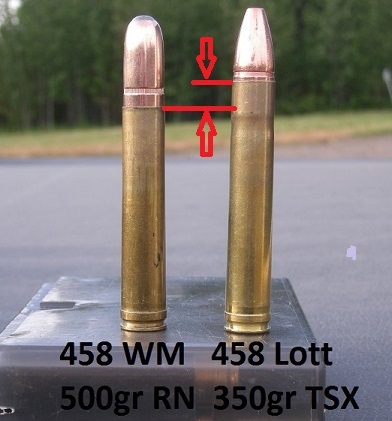
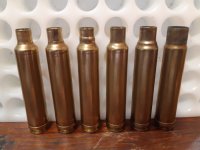
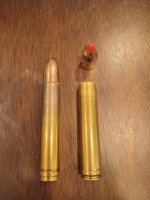
The picture is of factory loaded Hornady 500gr DGX beside a 338 win after fireforming and a 325gr FTX projectile.
 

Attachments

  • 20260610_174748.jpg
    20260610_174748.jpg
    109.5 KB · Views: 24
  • Like
Reactions: DGY
What were the failures on the cases that didn’t work? You are moving the material a lot so annealing at some point in the process may help. (I had about the same failure rate forming 30 Gibbs from once fired cases, after I started annealing them I stopped getting any splits) I also use cow for fire forming. Those ftx might be pretty fragile at 458 velocities, might be fine for your use case but personally if I’m using a cartridge that big I’d want a more sturdy projectile.

 
I have necked up lots of brass. Do it in stages. So if you start with 338, neck to to 375, then to 416, then to 458. All you need is the sizing dies. In fact you can get away with just using the stem and increasing expander balls in the 458 die if you don't have the other dies. A whole lot easier than fire forming. Anneal before you start and press the expander balls in gently using lots of Imperial sizing wax on the ball and brush/lube the inside of the necks. If you keep fire forming, anneal them first too
 
Last edited:
What were the failures on the cases that didn’t work? You are moving the material a lot so annealing at some point in the process may help. (I had about the same failure rate forming 30 Gibbs from once fired cases, after I started annealing them I stopped getting any splits) I also use cow for fire forming. Those ftx might be pretty fragile at 458 velocities, might be fine for your use case but personally if I’m using a cartridge that big I’d want a more sturdy projectile.

Comparing the 300 and 350 grain datas and picking a mid range in between, I think the 78gr load will be pushing them to about their limit. A few people posted on here or online Hornadys reply when questioned was 2500 fps max. Ill keep it in mind about the annealing too, thanks.
 
Currently no .458 Win Mag brass for sale online(?), .458 Lott brass available which could be easily trimmed & re-sized to form .458 Win Mag brass.

ikCCxwE.jpg
 
I e never resized any brass i have several hundred 458wm cases
The 325gr hornday at full 458wm velocity is nothing but a varmint bullet. They came apart at 1600fps in my 4570
At 2500fps in my wm they rarely made it into a 3rd gallon water jug and if it did it was just shrapnel

COW method keeps the small amount of powder at the back of the case against the primer for consistent ignition in larger cases
 
COW is easy to find, is dead cheap and it does work why the fuss about it, you don’t like it don’t use it, you think it’s dumb, don’t use it! For fyck sake thousands of reloaders have used it w/o an issue why is it so dumb?
A friend of mine swears that when using led cast bullets, the COW, helps with keeping the barrel lead fouling free.
 
Due to reduced powder charges of loading large rifle cases with small amounts of pistol powder, cream of wheat (and other packing materials) additionally fills space, keeping the small powder charge against the flash hole, ensuring the safe and complete conflagoration of the powder charge. Similar to cotton packing in reduced loads for cast milsurp loads. The use of cream of wheat in this case is not a "waste" as it is a legitimate use case. Op, you are doing a great job.
 
You can size brass up or down a lot with just simple steps and standard dies. I rwsize a lot of brass and do not own a single dedicated forming die . Here is an example of a large step down.

From right to left: 460 Bee case, 378 seat die, 378 fl die, 338-378 seat die part way, 338 seat die rest of the way, 338 fl die.

In this case, Do NOT anneal before forming as it makes the shoulder to body junction too soft and prone to collapse. Anneal after forming and before fire forming.

20210303_122643.jpg
 
Last edited:
Anyone here know how changing the neck size will affect the volume of powder used? Im assuming 7mm is too far of a stretch but if I fireform 300 win to 458 in one go, do you use less powder? because the pressure will be higher going through a smaller neck? Or does it not matter as the chamber itself is the same size. Will post some results after the next range trip.
 
Anyone here know how changing the neck size will affect the volume of powder used? Im assuming 7mm is too far of a stretch but if I fireform 300 win to 458 in one go, do you use less powder? because the pressure will be higher going through a smaller neck? Or does it not matter as the chamber itself is the same size. Will post some results after the next range trip.
Neck restriction from .30 to .284 is not going to have much of an effect. When fire forming with COW, make sure you weigh how much filler you are using. Keep the weight under 100 grains, but also keep it the same on each case, as the filler weight has roughly the same effect as bullet weight. A 100 grain bullet does produce more resistance so if you switch to cast pistol bullets for plinking while forming, work the load back up. Work up the load till you are using just enough fast powder to get a decent fire form. Keep a record of that load for future use.

Make darn sure you don't accidentally double charge with fast powder, you can get catastrophic failure as it does make a lot of pressure. That is why guys switched to Trail Boss or 4895 for subsonic loads.

These round balls loaded to 900 FPS make great forming loads, they also are great for shooting small game under 25 yards. These are in 308 Win cases. I also had round ball loads for my 45-70, that are every bit as accurate.

1781365156501.jpeg

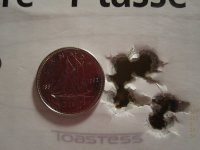
Eight rounds of round ball at 25 yards, testing 2 different loads for the 308.

1781365291332.jpeg
 
Last edited:
Successfully fireformed 17 mixed brass 338 into 458 with 100% success rate under the following conditions:
5 non annealed nickel plated, all the rest annealed
3 brass using large rifle magnum primers
3 nickel plated with LRM primers
again 3 and 3 brass/nickel using non magnum large rifle primers

All fireformed completely and fully, no cracks and no partial forming, despite 5 not being annealed.

All cases were loaded with 25 grains of HS-6, a 1 inch x 1/2 inch patch of kleenex as over powder wad, filled up to midway up neck with cream of wheat (instant packets), topped off with a bar of soap. Make sure your wax plug is all the way around the inside of the case neck to ensure even pressure (its my theory that a slight space could cause uneven stretching and potential cracking? I don't know for sure... but that's what I did and it worked). Hope this helps anyone searching for similar info!
 
I have necked up lots of brass. Do it in stages. So if you start with 338, neck to to 375, then to 416, then to 458. All you need is the sizing dies. In fact you can get away with just using the stem and increasing expander balls in the 458 die if you don't have the other dies. A whole lot easier than fire forming. Anneal before you start and press the expander balls in gently using lots of Imperial sizing wax on the ball and brush/lube the inside of the necks. If you keep fire forming, anneal them first too

X2 - Even with a lot of fast powder and tightly packed with COW, I find that it doesn't always fill out and often splits at the neck which is expanded a lot. I also anneal after the process is complete.

If you use Lee dies, you can buy just the expander balls from Higginsons to use in the 458 WM sizing die. For example, the 416 Rem Expander/Decapper is Part Number SE2935 and costs about $15 shipped. Given that the 416 RM is a long cartridge, the slope of the expander is a long gentle taper. You should be able to get away with just that to get you from 338 WM to where the 458 WM can complete the job. I use that expander in 30-06 brass when I make 9.3X62.

I find that the original 338 WM brass is a bit short after resizing, but works fine.
 
Back
Top Bottom