Reloading at the range?

That is similar to what I had in mind. Do you find that you use all the space or could you go smaller?
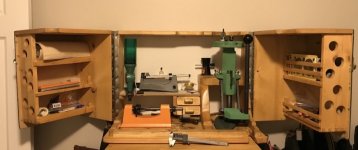
It isn't roomy, but it is more than adequate for my uses! The press goes on the right side, the break scale and powder trickler up on the top ledge. Case blocks, primers, powder, etc fit under the ledge at the back. I usually just have a scoop when load developing, so I don't bring the powder thrower. I could go smaller, but this also doubles as my bench at home, as we have very limited space there.
 
Thank you, what press are you using now are looking to use for your range work. There is a lot of space and time you can reduce depending on press

If I was only seating at the range, any inexpensive C-press would probably do. However, I was thinking an RCBS Summit. It's a little out of budget, but if I can set it up right, it can also see a lot of use at home.
 
Last edited:
I can say I've done it multiple times over the years for load development, it's part of what shifted me back to using a beam scale. My current setup is a custom reloading block that holds the scale and trickler with camera. I figured out awhile back that the most inconsistent thing about using a beam scale was how much you could change what you thought was the same measurement by where you were looking at it. And I use scoops for the bulk measure.
I like it. I've also found myself getting back to using a beam scale much more frequently.
 
It isn't roomy, but it is more than adequate for my uses! The press goes on the right side, the break scale and powder trickler up on the top ledge. Case blocks, primers, powder, etc fit under the ledge at the back. I usually just have a scoop when load developing, so I don't bring the powder thrower. I could go smaller, but this also doubles as my bench at home, as we have very limited space there.
Fantastic! I load from a small Ikea desk. Using the range box at home had certianly occured to me!
 
If I was only seating at the range, any inexpensive C-press would probably do. However, I was thinking an RCBS Summit. It's a little out of budget, but if I can set it up right can see a lot of use at home.
Honestly go with something like a Frankford Arsnel M press, Forster Co-Ax etc etc if you really want to spend one cry once a Short action custom nexus press or on the other end use something that will take the Hornady lock and load bushing. My self I upgraded my Redding T-7 with a Creedmoor Sports Adaptive press head has speed up my reloading at home and the field, same press both locations. the ability to deprime, prime (the Derraco unit for the win) full length resize, mandrel and then bullet seat all in one location without having to adjust every time and from session to session is so easy and nice. Of course if you are only doing one caliber the ability to switch between is not as needed if you have a head with enough stations.
Food for thought, I can't say I have every annealed at the range but have run thru what preped brass I had and had to to start using fired brass to prove out what I was doing.
And while primer seating depth is only as relevant as how far you want to shoot and with what accuracy priming, with a unit like the Derraco is much easier as you get older and the consistency is just a bonus. One of those things if you don't' have a big budget slowly upgrade with purpose as you go.
 
I've heard of tying flies at the side of a trout stream, but not this, but if the person isn't holding down a range with a waiting line behind him, why not? It would require better weather than I usually get, though.
I've gotten vocal with a fellow at my range who brings a dozen rifles from clients who want them sighted in. He covers two or three benches with cases, even though the safety area is 90-deg over behind the last bench. Yeah, he's earning a living and doing other shooters' a favour, but I don't like having to wait again and again for him to check or change something while me and others want to change targets.
 
I have a Lee hand press for that. Mostly gets used for my antiques.
I do the same, but more for loading ammo in culling camps than load development. There’s a couple tricks to making them work better. The first is Reddng bio green lube, it’ll make a tough sizing job on a thighmaster effortless. Another is that since you have to bottom hard on a FL die to have any consistency partial FL doesn’t work well. The work around is to use Reddng Competition shellholders. Seating depths are all over because there is so much play but dies that don’t crimp bottom out snd fix that. The irony of shell holders that cost 3 times as much as the press is real, but I already had those.

For load developement I took the easy way and moved the range to my loading bench.
 
I used to do it lots... I had a .50 cal ammo can with everything i needed. I used lee loader sets as i was trying to isolate velocity nodes via ladder testing... U used a small digital scale, some leee scopes and had a powder trickler .

It made fast work of ladder testing only having to load 5 rounds at a time , by the time i finished the 5-10 rounds my gun was cool for the next round of shooting.

my current reloading rig is setup in 2 dewalt tought system job boxes (1 for the equipment and one for brass and bullets) and can be set up on any table in minutes . I have it bolted to a real bench currently, but its setup to bolt down to a piece of plywood with bolts and wing nuts and clamp to a table. Its just a little RCBS partner press, but you can do some pretty big cartridges on it.
 
I've gotten vocal with a fellow at my range who brings a dozen rifles from clients who want them sighted in. He covers two or three benches with cases, even though the safety area is 90-deg over behind the last bench. Yeah, he's earning a living and doing other shooters' a favour, but I don't like having to wait again and again for him to check or change something while me and others want to change targets.
One bench per shooter is all that should be allowed!
Cat
 
A down side to remote loading is it usually involves useing a different press, and because of that requjres resetting your dies for that use. Competition shellholders make that easy, if your set up requires say a .006” over shellholder it’ll use that on any press you come accross. Miicrometer seating dies are helpfull too
 
A down side to remote loading is it usually involves useing a different press, and because of that requjres resetting your dies for that use. Competition shellholders make that easy, if your set up requires say a .006” over shellholder it’ll use that on any press you come accross. Miicrometer seating dies are helpfull too

I hear ya. I have dedicated dies and shell holders color coded to each individual rifle just for this reason. With Lock-n-Load bushings, it has proven repeatable and confusion free so far. Once load development is done, adjustments are rare. It is overkill, I know, but it works and is almost wife proof.

I am not planning on resizing at the range, primed brass only. Everything that I set up to weigh powder and seat bullets at the range would also get used at home.
 
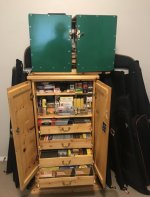
Many years ago when I had to reserve a day with my Silverado and the wife could make arrangements for a ride to work I came up with an idea to maximize my day at a local gravel pit.
A lot of measurements, drawings and head scratching came up with a portable solution that held what I needed that weighed I think was 28lbs without the Redding turret or the Rock Chucker that were on wing nuts. A little breeze I would just adjust the barn doors to block it.
Fast forward more than a few years and it is now bolted to one of my ammo cabinets as I’m not that young anymore.

IMG_1145.jpegIMG_1147.jpeg
 
Who here does this, is it worth doing?

What is your setup?

Does your local range allow and/or have facilities available?

My idea is to put together a small-ish self contained kit. Just enough to weigh charges and seat bullets. Brass prep and priming to be done in advance. My thinking is that it would make load development easier and give me something to do while waiting for the barrel to cool.

I have a basic design in mind but it would be over my budget so I am looking for ideas.

What tricks are you using to keep it portable? Problems encountered? Pictures would be fantastic.
I don't reload at "the range" but I have something of a range right outside the back door. Enough to shoot a couple through a chronagraph and about 50 more yards to my hundred yard range with the bench and back stop.

I think you are on the right track and it will be worth it. I never even considered it until I got my current place. Now I always shoot 3-4 every time I set up a run of ammo. It kind of amazes me how OFTEN I would have just loaded them all what ever the book says and now I might make SEVERAL TWEAKS before. "Load 'em all."

Like you suggested I do the case prep for every empty case I've got when I start on that and then prime them ALL. I save the desiccants that come in any bottle and will put one or two in bags, jars or bottles of ready brass.
 
I might be a bit pissed if I saw a guy whip out reloading gear on a Saturday on the bench while it got busy but aside from that I would be concerned about gr. Weight accuracy in non gun room conditions.
 
A down side to remote loading is it usually involves useing a different press, and because of that requjres resetting your dies for that use. Competition shellholders make that easy, if your set up requires say a .006” over shellholder it’ll use that on any press you come accross. Miicrometer seating dies are helpfull too
I use a couple of Lee turret presses for this. Can't say I've found any measurable difference. - dan
 
Wilson neck size dies with interchangeable bushings, good powder throw, Arbor press, and you're good to go.

Hunter Bench Rest shooters do it regularly.

This is where you get to realize how little 1/10 grain of powder means to an accurate load.

I guess you could set up your tooling in a kit to be set up at the range, but it's just another waste of good range time.

Your standard powder throws are OK, but they just aren't repeatably consistent, and you can't make minor adjustments to the charge with any precision.

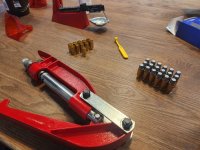
You will need tools made and adapted for field conditions. The Lee hand press is a cheaper way to get into hand loading at the range. It's only meant to neck resize or size pistol cases, but it does assemble very accurate ammo.

I used Lee hand press beside my Wilson arbor press to check consistency and things like runout. I was pleasantly surprised by how good the comparisons were.

I still have the Lyman No 45, "Ideal" powder measure I used for measuring HBR loads up to 25 years ago.

The Lyman #45 is an expensive, small reservoir, micrometer-adjustable powder throw, that is smooth as glass to operate. I mounted it to my "spotting scope" accessory box, which also held the arbor press, powder, dies, neck bushings, etc.

Even the micrometer equipped RCBS and similar powder throws have larger powder reservoirs, which quickly lose consistency when it comes to the weight of charges thrown, no matter how meticulous and consistent you think you are with your "system" to throw consistent charges. Wind even has adverse effects on electronic powder dispensers.

WIND is your biggest enemy when it comes to weighing powder charges.

You have to set up whichever powder throw you use at home and learn how to adjust the micrometer type utilized to be able to make incremental changes to your charge weights.

It may not be feasible for cartridges such as the 223 Rem, or similar small cases, but anything from the 22PPC up, it should work fine if you learn how to use it, with the components you have along.

I really liked the Lyman No 45 Ideal, because I could make changes on the dispenser, record them in my manual, then go back to the original setting, and make other changes from that known point.

Not as easy as pressing a few buttons and letting the unit do it for you, but after you're convinced of your competence, very repeatable charges could be thrown.

I had a table made up for the adjustments on my powder throw. It took a little trial and error at home on the loading bench to work out the correct "knocks" at the top and bottom of the throws, and it did what I needed done.

I saw some very elaborate setups for reloading at the range, for shotguns, handguns, and rifles. None of them bucked wind well, other than the one a fellow had set up in the back of his van, which was dedicated for the purpose. He may have used it at home as well.

 
Back
Top Bottom