Reloading for an AR

If you are loading for multiple rifles, I'd recommend a chamber gauge (I use Dillon's).
I've never needed to use anything other than a F.L. Sizer, but I have run into issues with slightly out of round rims from aggressive extraction playing havok with feeding on tight chamber. The chamber gauge will catch this.
Also of particular importance will be the case OAL.
I personally feel the S.B. Dies overwork the brass and reduce case life, but ymmv.
 
Nope,OP specifically said AR,s, then Ricks first post ,was all AR,s need SBD. What happened after that ,doesn't matter.
Your turn...:)

I'm sure the guy has enough info to work with.
But,as I just ordered a MV,now I've got something to think about also...:)
 
I would try your standard full length die and see how it goes, if you have any feeding issues then spend the money on the small base die.
I've been loading for 223 auto loaders for years and never had an issue but I've also never loaded for a MV. I have loaded for an 18 inch stainless AR barrel that came from Rick with no issues but since every barrel is different you won't know until you try it.
Overworking the brass with a SB die is of no concern to me as I have thousands of pieces of 1F brass and it's cheap if you need to buy some, I just don't feel like buying more equipment I don't need.
I plan to order a MV one of these days (just gotta get around to selling something to pay for it) and if my loads have issues I'll look into buying the SB die but I'll cross that bridge when I get to it.

Good luck, I'm looking forward to more range reports from MV owners :)
 
Go buy the reloading manual. I would recomend Sierra. They have one section dedicated specifically related to your question. Alternative is to mess up your gun and listen to "profecionals" here. I have tried both ways and reloading manual way works much better.

I am not saying that every advice related to reloading expressed on CNG is wrong, but some are questionable.
 
Go buy the reloading manual. I would recomend Sierra. They have one section dedicated specifically related to your question. Alternative is to mess up your gun and listen to "profecionals" here. I have tried both ways and reloading manual way works much better.

I am not saying that every advice related to reloading expressed on CNG is wrong, but some are questionable.

Aside from newbie virtue signaling, it is the interwebz so advice should always be taken with a grain of salt. I've found most (certainly not all) of the advice on CGN reloading forum (unlike in the Legalese forum) to match reasonably well with my personal experience. There are lots of folks on here with a deep body of experience, great advice and a willingness to help. It's my go-to spot for help with unusual situations that won't be covered in any manual.
 
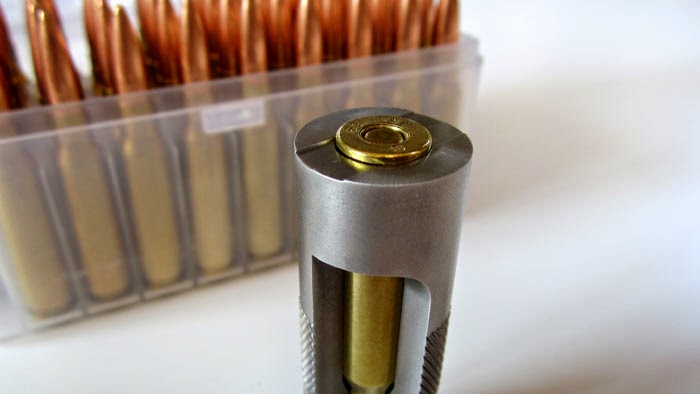
The absolute best case gauges that I have laid eyes on are made by Sheridan Engineering.
http://www.sheridanengineering.com/index-2.htm
They are slotted gauges and are cut to chamber dimensions.
I own the Dillon case gauge and they are ony advertized for headspace and trim length.
They are oversized in the body and base dimensions.
I have had success with the Dillon case gauge catching damaged bases due to agressive extraction.
 
Last edited:
Just a thought on the reloading process, I am to say the least exceptionally diligent about my match ammo. Prior to using my Lee Crimp die, I always ensure that all rounds being built will actually fit in the mag. This is based on a bad experience early that I witnessed during a match. A fellow shooter did not mag check his ammo prior to the match and when he attempted to load he found most of them a couple of thou too long.
 
As long as the AR is not overgassed or can be loaded/adjusted so it is not over gassed, I load mine like my precision 223s.

If you are suffering from an overly large gas port and no way to control that, I would NOT use Varget.

As long as your AR is not overgassed and the lock up is correct, you do not need a small base die.

I wouldn't crimp my ammo... but again, the AR has to feed properly.

Jerry

Not to derail but why not Varget ? I typically use h335 and win 748 for 223, but varget seems like a great all round type of powder.
 
If you are suffering from an overly large gas port and no way to control that, I would NOT use Varget.

That pretty much answers your question... Potentially too much port pressure and too much gas volume.

Jerry
 
The absolute best case gauges that I have laid eyes on are made by Sheridan Engineering.
http://www.sheridanengineering.com/index-2.htm
They are slotted gauges and are cut to chamber dimensions.
I own the Dillon case gauge and they are ony advertized for headspace and trim length.
They are oversized in the body and base dimensions.
I have had success with the Dillon case gauge catching damaged bases due to agressive extraction.

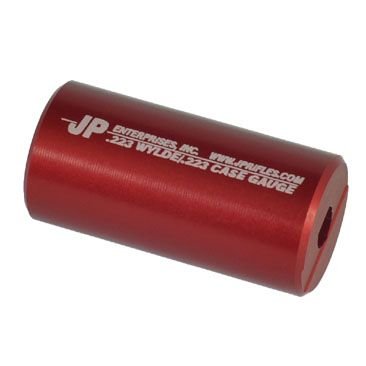
I agree 100% with thump_rrr Sheridan "or" the JP Enterprise gauges both are made from finish chamber reamers and also check case body diameter.

I use the JP Enterprise gauge for checking the sized case and as a final "plop" test of the loaded round. As stated above a Wilson or Dillon gauge have a larger inside body diameter and will not let you know if the body of the case has been reduced enough in diameter. Meaning I think they are a must have if using once fired or range pickup brass.

Review of the sheridan gauge!
http://forum.snipershide.info/showthread.php?t=269812

Below a cartridge not dropping all the way into the Sheridan Engineering gauge, due to brass spring back and case body diameter.

s7.jpg


Below I use the JP Enterprise gauge to check my .223/5.56 cases for my AR15 rifles. (because I was too cheap to buy the Sheridan gauge)

31JJ2Rd3zVL.jpg


NOTE, military 5.56 cases are made of harder brass and better suited for reloading the AR15 type rifles. (the brass is made Ford Truck Tough)

How Hard is Your Brass? 5.56 and .223 Rem Base Hardness Tests
http://bulletin.accurateshooter.com/2014/05/how-hard-is-your-brass-5-56-and-223-rem-base-hardness-tests/
 
Last edited:
Actually, I will be using BLC2. I found I have an extra 8lbs of that in the lock-up.

Wonderful metering powder... but it is even slower then VARGET so watch the gas pressure and temp changes.

I think this would be a very interesting choice for my bolt 223 practise rifle. Let me make ammo on my progressive and launch heavy bullets.

Let us know how it works out for you.

Jerry

PS since we are talking about a custom AR, why not just make a chamber gauge using the reamer that cut the chamber???? Why bother buying a gauge that was made with some unknown reamer???
 
PS since we are talking about a custom AR, why not just make a chamber gauge using the reamer that cut the chamber???? Why bother buying a gauge that was made with some unknown reamer???

That sounds like something that somebody who say, maybe makes custom rifles for a living might want to look into?

"Here's your custom high end rifle, are you planning on building your own ammo? Excellent, perhaps you might be interested in a guage that is exactly the same as the chamber in your new gun?"
 
Custom chamber gauges are certainly made with custom bolt rifles but aren't really as important as most will use proper dies to maintain the fireformed case shape and bump the shoulder enough for proper chambering.

They can be handy for semi autos as it is not as easy to confirm case dimensions using the rifle.

Personally, I treat all my rifles, factory or competition - semi or bolt, as custom chambers and load according to the needs of each chamber.

Jerry
 
The absolute best case gauges that I have laid eyes on are made by Sheridan Engineering.
http://www.sheridanengineering.com/index-2.htm
They are slotted gauges and are cut to chamber dimensions.
I own the Dillon case gauge and they are ony advertized for headspace and trim length.
They are oversized in the body and base dimensions.
I have had success with the Dillon case gauge catching damaged bases due to agressive extraction.

I agree 100% with thump_rrr...As stated above a Wilson or Dillon gauge have a larger inside body diameter and will not let you know if the body of the case has been reduced enough in diameter.

Do you guys have any proof that the Dillon gauges do not have proper case dimensions?


IMHO the Sheridan case gauges are overpriced and offer up lots of flash with not a lot of substance for the intended purpose (plus you get to pay way more than one should for a gauge).
Using a case gauge for its intended use is doing - as one poster put it - the 'plonk test' - random (or more frequent) case gauging of finished ammo to do a quick visual check for anomalies with finished rounds and verify usable headspace.
If a handloader is using it and its cut out feature to view the shoulder and make adjustments to the sizing die for the amount of shoulder bump, I'd recommend using a proper micrometer cartridge headspace tool for that that actually gives measurable data.
 
Last edited:
Back
Top Bottom