Reloading for an AR

I load for 7 different ARs. All work well with cases sized with a standard Lee FL die.

However, if the rifle maker says you should use a small base die, then that it what you should buy. He would know the dimensions of the chamber reamer used for YOUR rifle.
 
Do you guys have any proof that the Dillon gauges do not have proper case dimensions?


IMHO the Sheridan case gauges are overpriced and offer up lots of flash with not a lot of substance for the intended purpose (plus you get to pay way more than one should for a gauge).
Using a case gauge for its intended use is doing - as one poster put it - the 'plonk test' - random (or more frequent) case gauging of finished ammo to do a quick visual check for anomalies with finished rounds and verify usable headspace.
If a handloader is using it and its cut out feature to view the shoulder and make adjustments to the sizing die for the amount of shoulder bump, I'd recommend using a proper micrometer cartridge headspace tool for that that actually gives measurable data.
I have other means of measuring heaspace but to check 1,000-2,000 rounds with a headspace gauge would be time consuming and tedious which is why I use a drop in case gauge.
I bought the Dillon case gauge because it was in stock at my club and it was the first bottleneck cartridge I ever reloaded for at the time.
If I had to order one I would order the Sheridan as I suggested earlier.
I dont mind spending a little more for something that will last me a lifetime.

Looking at the drawing you can see the cartridge dimension at 0.200" from the breech should be 0.3759" and the chamber dimension at 0.200" from the breech should be 0.3769".

http://www.saami.org/PubResources/CC_Drawings/Rifle/223%20Remington.pdf

 
Last edited:
Do you guys have any proof that the Dillon gauges do not have proper case dimensions?

IMHO the Sheridan case gauges are overpriced and offer up lots of flash with not a lot of substance for the intended purpose (plus you get to pay way more than one should for a gauge).
Using a case gauge for its intended use is doing - as one poster put it - the 'plonk test' - random (or more frequent) case gauging of finished ammo to do a quick visual check for anomalies with finished rounds and verify usable headspace.
If a handloader is using it and its cut out feature to view the shoulder and make adjustments to the sizing die for the amount of shoulder bump, I'd recommend using a proper micrometer cartridge headspace tool for that that actually gives measurable data.

I have Wilson, Dillon and JP Enterprize .223 case gauges, the Wilson and Dillon gauges do not check the case body diameter.

Below the full length resized .223 cases have been inserted backwards into the gauge, as you can see the cases drop further into the Wilson and Dillon gauges.

Meaning these gauges are a much larger inside diameter and do not check the cases body diameter, and only check cartridge headspace length.

I'm loading for three AR15 rifles and The JP Enterprise and Sheridan gauges both check body diameter. And if the resized case and loaded round drops freely into these gauges cut with a finish chamber reamer they will fit in any .223/5.56 chamber.

JqlMmPP.jpg


The Dillon case gauges are made of stainless steel and better than a Wilson gauge "but" I use a Hornady cartridge case headspace gauge to check base to should length. And the finial "plop" test is into the JP Enterprise gauge. I taper crimp my blasting ammo and this gauge will also check for a neck bulge if any below the crimp.

NOTE, a fired case will not drop all the way into the JP Enterprise gauge and has the rim sticking well above the top of the gauge. The same case dropped all the way into my Wilson or Dillon Gauge and shows the case is longer than max headspace length. The only thing that will prevent a case from going all the way into these gauges would be a ding in the case rim.

 
Last edited:
Since we are discussing an AR and there are some new reloaders in the audience, consider a few points...

Reamer, die, gauge, chamber dimensions can vary in a variety of directions within SAAMI specs.

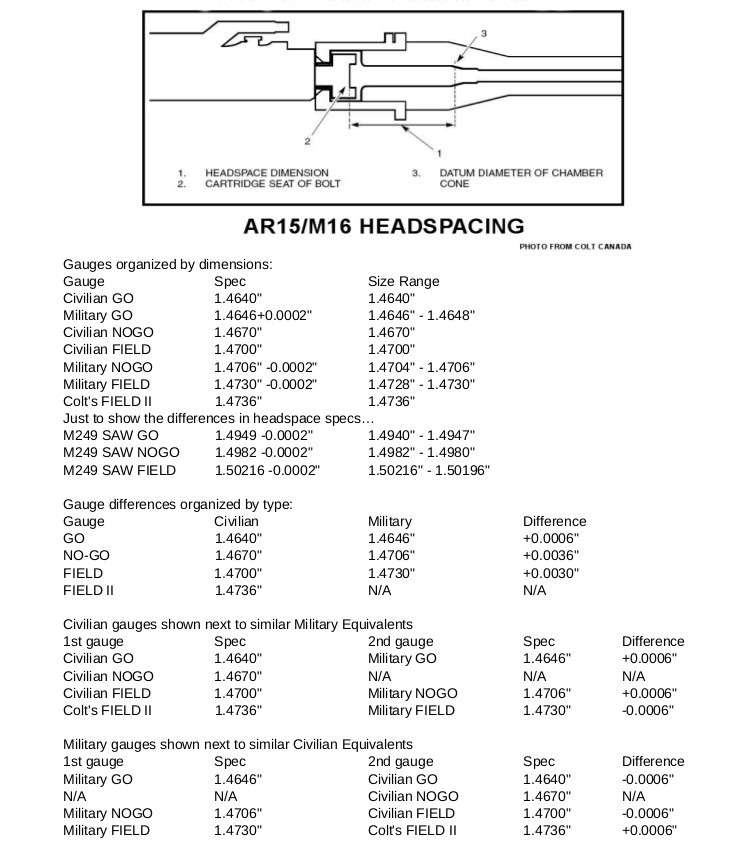
Headspace is the distance from the base of the case to an index point on the SHOULDER. It has nothing to do with case/body diameter. you can have a chamber with min spec headspace but max spec body dimensions ... and every thing in between from min/min to max/max.

Cases and chambers with the same headspace dimension may not interchange.

Sizing using min spec dies shot in a max spec chamber will lead to case separation and a bad day at the range.

The vast majority of AR barrels will NOT be chambered with a min/min spec reamer.

If you want a chamber gauge, the best and safest way is to have a gauge made with the same reamer that cut the chamber in your rifle. Everything else may be no more then an educated opinion.

YMMV

Jerry
 
Technically a standard .223 full length die is already a "small base die" because the standard AR15 chamber is .002 larger in diameter. (Line C below)

223v556.jpg


"BUT"not all .223/5.56 chambers are the same, and "why" your resized case diameter should be .003 to .005 smaller in diameter than a fired case from "your" chamber. And this is for reliable chambering and extraction and not jam the rifle.

223to5.56.jpg


And below a fired case from my AR15 and you simply bump the shoulder back .003 to .006 shorter than its fired length.

OJqNmQH.jpg


3gDuoIx.jpg


And again, if the resized case or loaded cartridge fits in a JP Enterprise or Sheridan gauges and is between the reference marks the case will fit in any chamber.

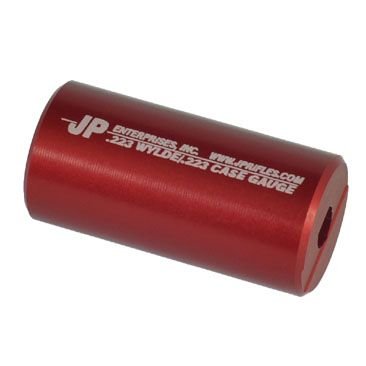
JP Enterprises Case gauge cut with chamber finish reamer .223

31JJ2Rd3zVL.jpg


JP Semi-Automatic Case Gauges

If it fits, it shoots.

Our case gauge has been the go-to tool for gas gun shooters and reloaders for nearly twenty years. That's because we recognized that gas-operated rifles need a "special diet" when it comes to ammo. Unlike a bolt gun, your AR won't reliably function with a cartridge just because it fits a standard gauge. Plenty of frustrating and badly timed malfunctions trace right back to this problem.

This is the only case gauge on the market specifically calibrated to meet the needs of the semi-auto rifle shooter. If a cartridge would not fit a minimum-depth SAAMI chamber, this gauge will catch them. Anything that fits this case gauge, you can consider factory-equivalent ammo
.


In this second generation model below, we've switched from aluminum to 416 stainless steel for greater wear resistance and longevity. In doing so, we've also significantly improved our tolerances. Side by side, these new gauges catch problem cases even the previous generation wouldn't.

4490.jpg


Below a good book for loading your AR15 for accuracy.

HANDLOADING FOR COMPETITION
http://www.zediker.com/books/handloading/hlmain.html
 
Last edited:
Looks like it's ITAR controlled.
Not sure,but they just recently sent me a FA case prep center and a magneto speed chrony. And they were gonna ship me a scope.

Just noticed that itar warning,guess some things are just too dangerous to have:)
 
Last edited:
Where did you buy that JPCG-223 case guage? Did you get it direct from JP Ent? I see on their site that they might not ship it here. Their listed dealer, CRAFM, doesn't stock it. Neither does Brownells.

Contact brownells , they carry other JP products and they will special order it for you
 
Everything EXCEPT the size die remains the same. For sizing a small base die is required due to AR style rifles having about .125" at the rear of the casing not supported, hence it swells slightly. The small base die will correct this and ensure reliable feeding.
Crimp dies are not needed in most cases.

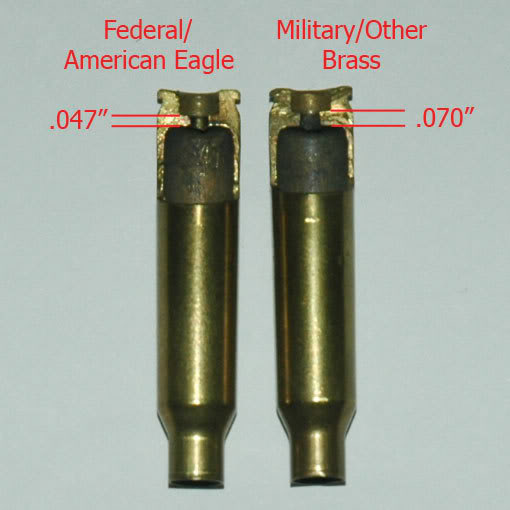
American military Lake City and commercial contract 5.56 ammo made for the military is made of harder brass with a thicker flash hole web to add radial strength.

cYeTsDp.jpg


If you use softer .223 brass you might need a small base die.

I size all the once fired Lake City brass I buy with a small base die, thereafter I use a standard die.

Dies and chambers vary in size and nothing is written in stone.

Example, I have a standard Lee .223 full length die and it will reduce the case diameter more than any of my small base dies.

So your chamber and type brass you use will determine the type die you need.

Now about drop in case gauges, tonight I pulled a coffee can of fired Lake City 5.56 brass out and dropped the cases into my three case gauges.

And 25% of these fired case would not drop all the way into my smaller diameter JP Enterprise gauge. Meaning some of the cases were too fat to drop all the way into the gauge.

"BUT" all of the fired cases had to be pushed out of the JP Enterprise gauge with a rod because they were wedged tight in the gauge.

And all the fired cases fit into the Wilson and Dillon gauges and fell out when the gauge was turned over.

Bottom line, these tighter diameter gauges are a fast way to check each loaded round and know they will fit in any chamber. And if you only load for one AR15 you can get by without the special gauge and using a standard gauge like the Dillon gauge.
 
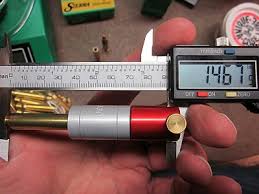
Looking at the drawing you can see the cartridge dimension at 0.200" from the breech should be 0.3759" and the chamber dimension at 0.200" from the breech should be 0.3769".


Well for the record, my Dillon case gauge for .223 looks different than yours, measures properly at .378" at the base of the cartridge (and all of the other critical measurements for that matter), and was measured with a properly calibrated set of Starrett callipers.
Not sure what you've got going on there in the photo, but I wouldn't use that either. If that came from Dillon, I'd be sending it back for a new one or a refund. From what I know of Dillon they'd gladly do that no questions asked. But: I would also suspect the quality of those digital callipers along with that gauge - if in fact it came from Dillon that is.
 
Last edited:
I have Wilson, Dillon and JP Enterprize .223 case gauges, the Wilson and Dillon gauges do not check the case body diameter.

Below the full length resized .223 cases have been inserted backwards into the gauge, as you can see the cases drop further into the Wilson and Dillon gauges.

Meaning these gauges are a much larger inside diameter and do not check the cases body diameter, and only check cartridge headspace length.

I'm loading for three AR15 rifles and The JP Enterprise and Sheridan gauges both check body diameter. And if the resized case and loaded round drops freely into these gauges cut with a finish chamber reamer they will fit in any .223/5.56 chamber.

JqlMmPP.jpg


The Dillon case gauges are made of stainless steel and better than a Wilson gauge "but" I use a Hornady cartridge case headspace gauge to check base to should length. And the finial "plop" test is into the JP Enterprise gauge. I taper crimp my blasting ammo and this gauge will also check for a neck bulge if any below the crimp.

NOTE, a fired case will not drop all the way into the JP Enterprise gauge and has the rim sticking well above the top of the gauge. The same case dropped all the way into my Wilson or Dillon Gauge and shows the case is longer than max headspace length. The only thing that will prevent a case from going all the way into these gauges would be a ding in the case rim.



And again for the record - your case gauge looks like thumperrrrs above. Maybe an older gauge?

Also, what are measurements of your cases' base going half way down the Wilson and Dillon gauges?

I measured my Dillon gauge by taking a fired case with a base that gauged .377" and inserted it backwards same as your photo above. Itwent in to the gauge .190", (similar to your results with the JP gauge) indicating to me that the .376" datum that is measured 1.238" off the shoulder is correct. (took a bit to find a fired case with that dimension I might add as most loaded rounds measure around .375" and most fired cases don't get larger than that .375" and almost none climbed beyond .377" at the most).

looks to me like the Dillon gauges are just fine.
 
Well for the record, my Dillon case gauge for .223 looks different than yours, measures properly at .378" at the base of the cartridge (and all of the other critical measurements for that matter), and was measured with a properly calibrated set of Starrett callipers.
Not sure what you've got going on there in the photo, but I wouldn't use that either. If that came from Dillon, I'd be sending it back for a new one or a refund. From what I know of Dillon they'd gladly do that no questions asked. But: I would also suspect the quality of those digital callipers along with that gauge - if in fact it came from Dillon that is.
There is nothing wrong with eiter my vernier calipers or my Dillon case gauge.
The Dillon Rifle Case Gauges are advertised as headspace and case gauges.
This is the quote from the Dillon website.
https://www.dillonprecision.com/dillon-rifle-case-gauges_8_3_25547.html
Rifle headspace case gauges assist in proper size die adjustment and in checking cases for whether they need to be trimmed. Essential for long case life, especially with semi-automatic firearms! Made of stainless steel for long life.
http://dillonhelp.com/Dillon%20Manual%20PDFs/accessory_manual_may_2007.pdf
If you look on pages 7 & 8 of the Dillon instruction manual (pages 10 & 11 of the PDF) you will see there is no mention of chamber diameter on the rifle case gauges but there is mention of chamber diameter on their pistol case gauges.


There is nothing wrong with eiter my vernier callipers or my Dillon case gauge.
The Dillon Rifle Case Gauges are advertised as headspace and case gauges.
This is the quote from the Dillon website.
https://www.dillonprecision.com/dillon-rifle-case-gauges_8_3_25547.html

http://dillonhelp.com/Dillon%20Manual%20PDFs/accessory_manual_may_2007.pdf
If you look on pages 7 & 8 of the Dillon instruction manual (pages 10 & 11 of the PDF) you will see there is no mention of chamber diameter on the rifle case gauges but there is mention of chamber diameter on their pistol case gauges.


;) Whatever. I'm going to follow the advice that is given in your sig. line.:dancingbanana:
A case gauge is meant to measure a cartridge case, not the chamber - as Dillon has alluded to in their literature, it is designed to indicate that the sizing die is adjusted correctly and therefore the sizing of the cartridge case is sized properly. If your case gauge is over .378" at the base of the cartridge, as it appears your's is from the photo you posted, it is obviously out of spec. for the .223 / 5.56 cartridge case. Mine is in spec. and works properly. It is also from Dillon.
 
Back
Top Bottom