Reloading for gas operated .308

Roddy

CGN Ultra frequent flyer
Rating - 100%
113   0   0
Location
Leduc, AB
I recently aquired an XCR-M that I want to hand load for. I have a bunch of Varget and 178 A-Max's as well as a bunch of rounds I loaded for another rifle I don't need anymore.

I am wondering if there is anything I should know about loading for a gas gun as I have never done it before.

I know some people crimp and some people don't crimp. I never have so I was hoping not to.

Do you determine optimal COAL the same way?

Can you load as hot for a gas gun? My reloads I have now I got about 2650 fps out of a 24" barrel with 43.5 grains Varget at 2.84 COAL. I was hoping to work my way up to that load and hopefully it's easy on the brass and gun and accurate and then I can just seat my rounds a bit deeper. I don't want the gun or the brass getting beat up with too hot a load though.

Thanks in advance!
 
I would strongly advise against loading outside of published data. One thing in a bolt gun is you most likely will be able to see signs of "you've gone too far" before anyone or anything is damaged if you follow proper workup techniques. With a semi auto you might not get that same issue and could potentially end up wits damage to yourself or your firearm, as you don't get the same type of feedback like sticky bolts or such.
 
I would strongly advise against loading outside of published data. One thing in a bolt gun is you most likely will be able to see signs of "you've gone too far" before anyone or anything is damaged if you follow proper workup techniques. With a semi auto you might not get that same issue and could potentially end up wits damage to yourself or your firearm, as you don't get the same type of feedback like sticky bolts or such.

Thank you. That was exactly the type of feedback I was looking for. The load waa pretty tame by bolt gun standards but I have no idea how that compares to an XCR-M.

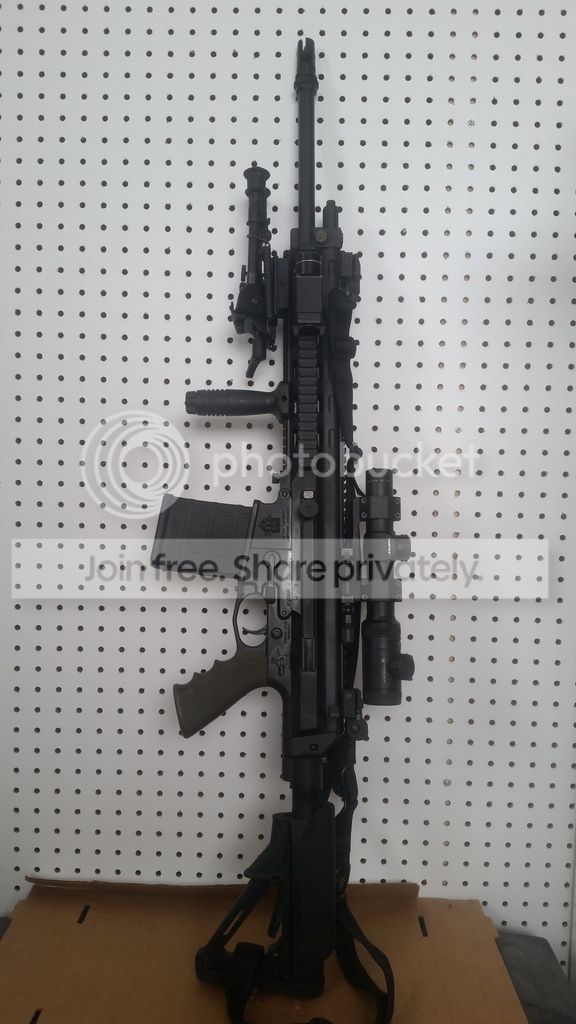
Oh and so you can more easily visualize it: :)

20170415_085811_zpsromzzqoq.jpg


I am now looking for a 2.5-10x scope or something similar, an Ergo grip, and maybe some more crap to hang off of it.
 
measure your coal on some cartridges and then go shoot one and let the gun load the next one. Then remove that cartridge and measure your coal and see if it changed. If it's significant you may want to crimp. If you have enough neck tension you might not need it.
 
I read on an m14 forum that bumping down the max published load by at least a grain and loading up to that data was a good practice, something about bent op rods and other problems from too hot a load. I have adopted this philosophy, although I rarely shoot max loads anyways. Usually find somewhere in the middle works best for me. I read it on the inteweb so it's not the gospel or anything.
 
Good to know about max loads. Mine may be a bit hot.

I have heard you shouldn't use heavy bullets in M1A's/M14's but what about a rifle with an adjustable gas setting?
 
The XCR-M has an adjustable gas setting, so in "theory" should be good for heavier bullets. I tended to stay with 168gr and less and had no problems. Why temp fate. 168 is a match bullet and seems to give good performance. If used for hunting, there are lots of 165 grain bullets that give outstanding performance and will stop anything up to moose/elk with no problem.

I've never crimped my bullets, but do use a "small base" resizing die for all my semi's. Never had any issues. It does work the brass a little more, and will shorten reloading life, but I usually discard after 5 reloads, so it hasn't been a problem.
 
Why temp fate.

I have never heard that you should not load heavier bullets for an XCR-M only M14 types. I do not know what fate, if any, I would be tempting. This is the type of information I am looking for. The manual only says to use commercial ammunition and makes no mention of bullet weight.

My reason for wanting to load heavier bulletsis that I have about 400 178 grain bullets. I could sell them and buy 168's but if I don't have to I won't. It is going to be for target shooting 90% of the time.

Good to know about the crimping. I do have small base .308 dies I bought when I didn't know what kind to buy.
 
Last edited:
i tend to be a guy that finds something that works and stays with it. M-305 uses lighter weights, but doesn't have an adjustable gas system, I get it. ATRS uses DI and doesn't (or didn't) stipulate bullet weight, but in conversation with them, found that they wouldn't recommend using anything over 168. (IIRC). I've never read anything from RA as to what their gas settings are for as to bullet weight, but given that RA rifles were originally designed for the military small arms competition, I'm guessing military weight bullets. Most gas settings tend to be for "regular" or "adverse" conditions, not "light" or "heavy" bullets. I'm just not willing to take a chance with a 3K rifle, and it is truly just my personal opinion, but I don't feel that gas guns were made for heavier bullets.

Having said all that, I'm sure there will be somebody along shortly to dispute it all. Like I said, just my personal opinion.
 
Thank you for input KePet. I appreciate it. I don't know much about how these adjustable gas systems work. Honestly I like the idea of an AR or something where you just put ammo in it and shoot it. But I have this now so I will have to figure it out.

The guy who sold it to me shot 175 SMK's out of it but that doesn't mean it's a good or bad thing to do.
 
I use the Lee factory crimp die when loading for semi's. Some people don't think its needed, but I prefer to ensure no bullet movement.
 
I think most modern semi-auto's whether fixed or adjustable gas system, still use a bleed off at the gas port.
The Garand was probably what started all the worry about powder/bullet weights etc as it didn't use a bleed, the gas port was an inch and change back from the muzzle. Once the bullet was out of the barrel, pressure started dropping. It was designed for a specific bullet weight at specific pressure.
Even the M14 has a bleed hole built in and isn't as sensitive to bullet choice and powder as people think it is.
 
I can see the bullet weight restriction making sense if you shoot commercial ammunition but since you reload it doesn't matter. Heavier bullet for commercial ammo are typically for hunting larger game so they pack a heavier punch.

What really matters is to keep your ammo within a certain pressure window. Heavier bullet are longer so they seat deeper in the case which increases pressure. However in your reloading manual you will see that for the same powder the starting load will be lighter with a heavier bullet so the precautions are already in place. Keep your pressure light enough but not too light or you might not have enough gas pressure to cycle your action reliably.

You could buy 150gr factory ammo, pay attention to the recoil impulse and use this as your baseline. That's what I do, maybe I'm wrong but I'd like to think it's right.

By the way the US military shoots 175gr match ammo in their M14.
 
Thanks for all the responses. I know these aren't huge issues but before I spend a bunch of time and money figuring out how to get this rifle to shoot well I figured I would ask here.


Kind of off topic but what do you guys think of Hornady Steel Match 155gr BTHP, both in terms of accuracy, reliability? I can buy them for not much more than I can reload .308 for.

I have seen lots of reviews saying they are accurate and then a lot of people say they had FTF and FTE issues.
 
Varget didn't work so well in my xcr-m. Using 168 hmk and smk. Wrong dwell time for the gas system at higher pressures??maybe. Failure to feed and eject. Blc-2 and cfe 223 work great, and meter better in progressive press. The steel match work well, don't expect match accuracy though.
 
I have never heard that you should not load heavier bullets for an XCR-M only M14 types. I do not know what fate, if any, I would be tempting. This is the type of information I am looking for. The manual only says to use commercial ammunition and makes no mention of bullet weight.

My reason for wanting to load heavier bulletsis that I have about 400 178 grain bullets. I could sell them and buy 168's but if I don't have to I won't. It is going to be for target shooting 90% of the time.

Good to know about the crimping. I do have small base .308 dies I bought when I didn't know what kind to buy.

Cartridge, Caliber 7.62mm Special Ball, Long Range, MK 316 MOD 0 (United States): A 175-grain (11.3 g) round specifically designed for long-range sniping consisting of Sierra MatchKing Hollow Point Boat Tail projectiles, Federal Cartridge Company match cartridge cases and Gold Medal Match primers. The Propellant has been verified as IMR 4064 (per NSN 1305-01-567-6944 and Federal Cartridge Company Contract/Order Number N0016408DJN28 and has a charge weight per the specs of 41.745-grain (2.7 g)

Old School .308 Winchester Match Loads
http://www.provenreloads-handloads.com/articles/2016/9/18/old-school-308-winchester-match-loads

Service rifle loads
http://www.bearblain.com/Service Rifle Loadings.html

.308 Reloading data only (read post 3 by Dan Newberry)
http://www.sniperforums.com/forum/reloading/43364-308-reloading-data-only.html
 
The steel match work well, don't expect match accuracy though.

It was really accurate in one of my bolt guns. I was worried about it damaging the gun but I think you need to fire a few thousand rounds to have any big effect. I recall someone did a 5000 round test on some AR's with steel but I can't afford that much ammo.

Good point about the M118/Mk 306 Mod 0 ammo. I'm hoping Varget does okay with the heavier rounds. They may get a bit long for my mags though.
 
Back
Top Bottom