Reloading for precision

Bustercluck

CGN Regular
Rating - 100%
27   0   0
Location
Fort McMurray
A couple topics if anyone wants to share.

What’s your reloading technique for f-class, benchrest or other shot to shot consistency type shooting?

What does improving each step net for accuracy improvements? Or what’s the most important steps(in order) to improve your technique?

Every time I think I’m gtting better and I’ve only got a few more things to buy, I suddenly find something else on the internet to improve some other part of my process. I’m betting the established f-class shooters have $10k (or more) worth of reloading equipment.
 
I use the best components I can buy that work in my rifles for ultimate accuracy.
I weigh on a beam scale if i want the ultimate accuracyy load for the longer distances. It's slower than an electronic measure and scale but it works .I practise shooting in the worst conditions I can, because TR and Fclass are games of score not group size.
If I can make good wind call in lousy conditions , shooting a good score in good conditions is easier .
Cat
 
It's not the equipment that you need, it's the time and labor to prep everything to be loaded, the powder and seating the bullets is the easy part.

sorting bullets base to ogive, weight/volume sorting brass, uniforming primer pockets, flash holes, skim turning necks, chamfer, deburr.......

bullet seating tests, tweaking powder load, fine tuning bullet seating, playing with neck tension, neck lubes, neck clearance in the chamber

lapua and berger take alot of the above out, but not all of it
 
I’ve never bothered weight sorting brass, or doing much brass prep at the new stage. I do turn most of my necks as long as I have the right sized mandrel and stuff here.

As far as sizing I’m trying to full length size with a bushing die and the redding competition shell holders to bump the shoulder back .001” or so, or at least until there’s no resistance closing the bolt on a loaded round. I bought a bunch of mandrels .001” smaller than bullet size over the winter, but haven’t had a chance to try them out yet.

Anneal every firing with a 2 torch annealer.

Trimming to length every time and obviously chamfer. I’ll probably buy one of those rcbs/Henderson trimmers as soon as they’re available in canada. This is one step that takes too long for me and that rcbs trimmer will probably do a better job than I do.

Cleaning is something I bounce all over the place on. Lately I went back to the walnut tumbler. Sometimes I just wash them by hand to get the lube off.

Weighing powder to within a granule.

The next tool on my list is going to be an arbor press and inline seating dies. I don’t think I’ll bother with a force pack, but who knows, maybe I’ll grab one that can be upgraded later.

The thing I was wondering about today is if I should get a precision primer seater? It’s not a huge investment, but I’m really struggling with how much something like that is going to improve things down range.

I’ve been measuring bullets too. From
what I understand most guys are only length sorting these days and not weight sorting. Maybe if I learn to shoot good enough to kotice than I’ll start doing that too.
 
It's not the equipment that you need, it's the time and labor to prep everything to be loaded, the powder and seating the bullets is the easy part.

sorting bullets base to ogive, weight/volume sorting brass, uniforming primer pockets, flash holes, skim turning necks, chamfer, deburr.......

bullet seating tests, tweaking powder load, fine tuning bullet seating, playing with neck tension, neck lubes, neck clearance in the chamber

lapua and berger take alot of the above out, but not all of it
Do you fill your cases with water over a scale to compare volume? After you weight sort them? Is this something you do after firing them in your chamber? Or new?

I totally agree on the time factor. I’ve been trying to get tools that make everything faster and still maintain quality. And I bought lots of brass for everything I shoot lots so I always have backups, but I still seem to runout. Lol
 
I don't shoot for precision... I do however load for it... I think...
For me it took about 30 years to come to terms with shooting bambi... even thought I grew up ranching and understood where our food comes from.. My respect for critters may be a fundamental flaw but it lead to my need to produce accurate ammunition for my needs. Store bought ammo was wildly inconsistent regardless of my skill. So I dove into the world of reloading..... and have been learning every day... sometimes it's a tiny detail but they all add up. My next process was going to be weight sorting... So I'm curious what others think as well. Great question. Thank you. Cheers
 
I feel like the most important thing is barrel quality and component quality. If you are running junk then reloading technique will be like trying to make a racehorse out of a donkey, so to speak.

But assuming you have that part covered this is where I am at:

1) Use quality brass (Lapua for me but there are other options out there too) and keep it in a batch (ie fired same amount of times and treated the same way each time). This is an easy win.

2) I anneal after every firing.

3) Size just enough that the case will chamber easily (some measurement required)

4) I size with no expander ball (deprimed already as a first step before cleaning) and then use a mandrel to size the necks. For me this was one of the bigger improvements. Ultimate Reloader did a video this week where he used an automated AMP press to quantify the difference between the two different methods and it seemed pretty convincing.

5) The more consistent / accurate your powder throws the more consistent your ammo should be. I wont get into what is best as it often stirs up emotion but the more accurate the better IMO.

6) Test to see what your rifle likes for jump. Some are more fussy than others. I did a test just yesterday and 20 thou was one ragged hole, 40 thou was noticeably worse (every other variable was identical). Note, Berger hybrids seem pretty much impervious to jump. If there is too much or too little I haven't noticed it with them.

Thats all I can think of for now. To sum it up easily, consistency, consistency, consistency.
 
I feel like the most important thing is barrel quality and component quality. If you are running junk then reloading technique will be like trying to make a racehorse out of a donkey, so to speak.

But assuming you have that part covered this is where I am at:

1) Use quality brass (Lapua for me but there are other options out there too) and keep it in a batch (ie fired same amount of times and treated the same way each time). This is an easy win.

2) I anneal after every firing.

3) Size just enough that the case will chamber easily (some measurement required)

4) I size with no expander ball (deprimed already as a first step before cleaning) and then use a mandrel to size the necks. For me this was one of the bigger improvements. Ultimate Reloader did a video this week where he used an automated AMP press to quantify the difference between the two different methods and it seemed pretty convincing.

5) The more consistent / accurate your powder throws the more consistent your ammo should be. I wont get into what is best as it often stirs up emotion but the more accurate the better IMO.

6) Test to see what your rifle likes for jump. Some are more fussy than others. I did a test just yesterday and 20 thou was one ragged hole, 40 thou was noticeably worse (every other variable was identical). Note, Berger hybrids seem pretty much impervious to jump. If there is too much or too little I haven't noticed it with them.

Thats all I can think of for now. To sum it up easily, consistency, consistency, consistency.
+1

I do what you do. Only thing I might move to down the road is an inline seater with a force pack.

In my last batch for my 6GT, some had a different seating force than the majority. I kept them separate, but I wouldn’t be surprised if those misbehaved compared to my usual ammo.
 
The most important is to learn how to shoot aquire those skills that you can not buy on line or on a store shelf. You can have all of the top tier componets and favourable conditions but if you're inconsistent with your technique/trigger pull or discipline you will end up frustrated with a bunch of expensive equipment.

 
I spent a great deal of time and effort in tuning my load from half moe to nearly quarter moa before I understood that a bad wind call would put me off the target at 900m.

However, for me it consistency in everything I did, at the reloading bench, and at the firing point made me a better shooter.
 
I spent a great deal of time and effort in tuning my load from half moe to nearly quarter moa before I understood that a bad wind call would put me off the target at 900m.

However, for me it consistency in everything I did, at the reloading bench, and at the firing point made me a better shooter.
Yeah, most of these tiny little improvements aren’t for the average guy. They seem to be aimed at turning those slightly high or low 4s into 5s. The top tier guys do alot of extra stuff to have that little bit of an edge on the next guy. Most of us couldn’t even measure a difference.
 
+1

I do what you do. Only thing I might move to down the road is an inline seater with a force pack.

In my last batch for my 6GT, some had a different seating force than the majority. I kept them separate, but I wouldn’t be surprised if those misbehaved compared to my usual ammo.
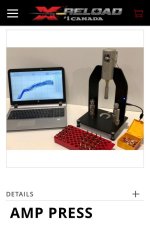
Have you seen this unit? It’s too rich for my blood, but I’m sure somebody around here can afford it. There’s some cool videos on it.

https://x-reload.com/amp-press.html

IMG_6273.jpeg
 
That fancy press is too much $ for me too. I remember seeing one of Erik Cortina’s videos where he was using the basic one with a dial gauge and separating his ammo into 2 or 3 seating force ranges.

I haven’t been using graphite when using a mandrel, (but have increased the dwell time for both mandrel and sizing), and I have used it for seating bullets, trying to be more consistent.

My 6GT is under 1/2 moa, close to 1/3 moa, with this process. Good enough for PRS and like the fellas mentioned above, to have decent ammo where I know it’s solid and I can keep working on me. I shoot best prone, and want to be able to shoot close to that in other positions.
 
Have you seen this unit? It’s too rich for my blood, but I’m sure somebody around here can afford it. There’s some cool videos on it.

https://x-reload.com/amp-press.html

View attachment 1106877
This is what Ultimate Reloader used in the video where he tests mandrels vs no mandrels.

If you like data this is for you.

If you are regimental and keep everything in batches (brass mostly) then this may not be so important as everything should be consistent by default but using it would also show you an outlier if something were to slip through the net (piece of brass that wasn't annealed or neck that wasn't sized correctly correctly etc etc).
 
Are you guys using graphite for lubing the necks when using a mandrel?

Anybody lubing bullets when they seat them? I’m guessing graphite for that too?
I graphite the inside of the case neck before running my expander mandrel ( 21st century ) as a separate process for many of my cartridge types. But it also depends on the bullet. I can't use graphite with Hammer bullets due to the parabolic bands. They become too slippery and can easily move changing the seating depth. I find that the neck tension mandrel itself makes a huge difference by itself. The Hammer bullets are only for hunting due to cost and availability. My range rounds pretty much all get graphite though and the neck tension mandrel. I don't graphite the bullet though. Cheers
 
I am early in my precision handloading journey but through reading manuals and forums, a few principles have led to some early success:
- Consistency in everything - measurement, tooling, components
- Quality components
- Loading at least 25 rounds at the same charge for range testing
 
Some of the confusing stuff for me is the contradictory info on the internet. When I started getting serious about reloading ten years ago it seemed like neck sizing was common practice, but now nobody is doing that. If you watch Eric Cortina today he’s going against accepted norms like uniforming primer pockets. The internet is full of supposed professionals I guess and the guys with the most likes aren’t necessarily the best at their trade.

Trial and error and just keep getting better I guess.
 
Some of the confusing stuff for me is the contradictory info on the internet. When I started getting serious about reloading ten years ago it seemed like neck sizing was common practice, but now nobody is doing that. If you watch Eric Cortina today he’s going against accepted norms like uniforming primer pockets. The internet is full of supposed professionals I guess and the guys with the most likes aren’t necessarily the best at their trade.

Trial and error and just keep getting better I guess.
50 or more years ago many of us were doing what was termed " partial full length sizing", basically using a full length die and expander ball and sizing the case until the stripped bolt closed easily with the case in the chamber .
This usually sized about 1/2 to 3/4 a caliber width or so of the neck while sizing the shoulder down to a point where it was not jamming in the chamber .
The SBR crowd were using custom built dies and super tight chambers doing the same thing , but what some shooters also were doing was FL resizing occasionally after using neck sizing dies for maybe 5 rounds.
The Lee collet die works, but many shooters misunderstand why it works.
Cat
 
Last edited:
Back
Top Bottom