O.K. Guys, here is my two cents worth on this subject. The Ruger 10-22 has been around for decades, and has proven to be a very good semi-automatic .22 rifle. There are certainly a lot of upgrades and modifications that are made for them, and you can easily spend twice what you paid for the rifle if you want top accuracy from one.
The Remington 597 has been around for about 15 years now, and has had it's teething troubles. (Ruger had trouble with their 40 years ago and got them ironed out). The biggest problems with the Remington 597 are magazines and guide rods.
The early 597 gained a bad reputation because of the plastic magazines. It seems that Remington can build a great rifle, but whoever designs the magazines seems to screw up royally. (Witness the Nylon 77, and 581 series.) Remington changed to an alloy magazine, then reinforced it with their GENERATION 3 magazines. I am not sure what is happening now, but Remington at one time replaced the plastic magazines one-for-one with the Generation 3 magazines. This seemed to cure a lot of the problems.
One major problem that still exists is the NUT-BEHIND-THE-BUTTPLATE. You know, the one that pulls the trigger, aims the rifle and loads the magazines. This part might be able to READ, but fails to COMPREHEND the Owner's Manual.
There are two guide rods that hold the bolt in place and position the recoil springs. Remington recently changed the recoil springs so that they are a bit larger on the ends, sort of funnel shaped. Many people, when putting the springs back to reassemble the rifle, got them jammed a bit in the rear of the bolt, and put too much friction on the bolt/guide rails resulting in short recoil and stovepipes.
The second problem with the guide rods is that people do not understand the difference between INCH pounds and FOOT pounds. The Manual says to tighten the screws that hold the guide rods in to 10 INCH pounds, which is 8/10 of a FOOT pound. In fact, it is much better to just screw them in to finger tight contact, then back these screws out 1/8 to 1/4 turn. If you screw them in too tight, you put a bend into the guide rods, and since they are not straight but have a bow in them, they provide a lot of friction when the bolt recoils after firing. Too much friction equals short stroke and stove pipes.
The Remington trigger pull can vary, but is usually toward the heavy end. The addition of a Volquartsen Hammer can cut this pressure down considerably --in my case, it cut the trigger pull down from ablut 5 1/2 pounds to about 2 pounds. There had been some problems with the Remington extractor, being a stamped piece, and some were not properly hardened. The Volquartsen Hammer cost me less than $50 from Jo-Brook Firearms in Brandon, Mb., and the Extractor less than $25. The installation of the Hammer took about three minutes, and since my extractor has not given me any trouble yet, the VQ one is a back-up IF I need it.
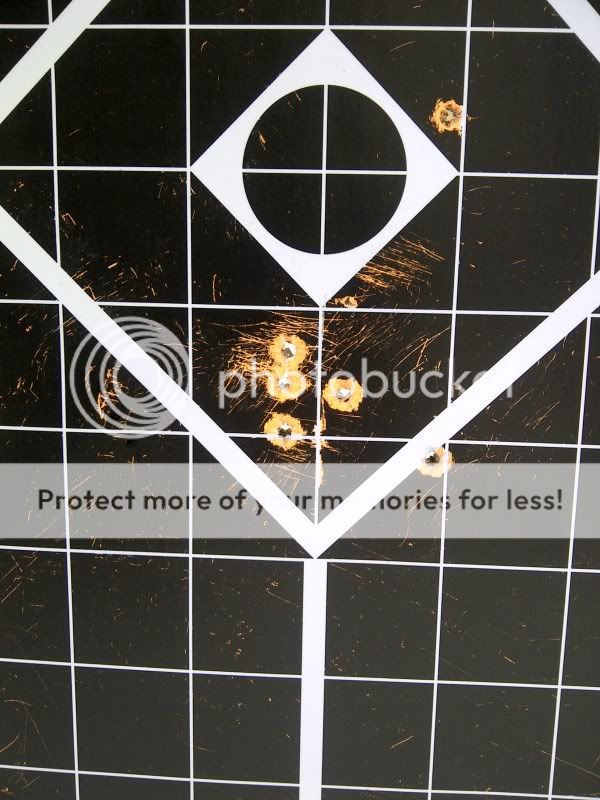
My next purchase was two sheets of #120 grit sandpaper. I disassembled the rifle, cut some sandpaper to fit over a spark plug socket, and proceeded to sand the barrel channel to make the barrel free floating. This took about 15 minutes, and when the rifle was tested later with a half box of the same ammo as the "before" testing, the 50 yard groups had shrunk to well under 1/2 inch with cheap Federal Bulk HP that I use for shooting thousands of rounds at Gophers. In fact, the accuracy is about the same as my Savage heavy barreled, Accu-trigger, laminated, thumbhole stock .22 LR varmint rifle.
One caution on the 597 is do NOT really tighten up on the screws that hold the scope base to the receiver. The receiver is an alloy, and is a bit thin at the rear scope base hole, and you can strip the hole with too much pressure.
Mine is a 1999 Model, with 3 plastic 10 round magazines and 3 plastic 30 round Remington magazines. I bought it used, with a scope mounted. It had some of the previously mentioned, previous owner induced problems, and it took about 15 minutes to get working correctly.
I used it all last Summer for shooting Gophers here on the Prairies. The scope has been replaced with one that gives multiple aiming points, and a bit of shooting has given me an idea of where each one hits out to 150 yards. I like the 597 for it's accuracy, man sized stock, and it's performance.
Being an old target shooter, accuracy and performance is what counts. The bolt action rifle has always ruled the target range, but I think my Remington 597 could give all but the most expensive and dedicated target rifle a run for it's money. Right now, I am more interested in Minute-of-Gopher at 100 yards, so the 597 does what I want it to and it fits my requirements. And, I have not spent several hundred dollars on extra Ruger accessories to get the same performance.
.