Repair of pitting on a single barrel shotgun

Arcosdad

CGN Regular
Rating - 100%
78   0   0
Hello all,
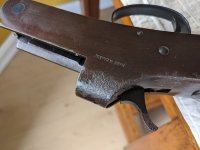
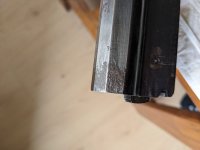
I just got a neat little Rossi 20 gauge from a member on here. It shows little sign of use but there's a bit of old pitting from poor storage. See pics..I would like to try to remove/ reduce the pitting and cold blue the area as a bit of a project..we have basic metal working tools like disc polisher, Dremel, files, angle grinder, etc. As you can see, the barrel is sort of a hexagonal shape at the chamber which might make it easier to work. Any suggestions as to how to proceed?

Thx, A/D
 

Attachments

  • PXL_20260217_203550381.jpg
    PXL_20260217_203550381.jpg
    57.6 KB · Views: 69
  • PXL_20260217_203449965.jpg
    PXL_20260217_203449965.jpg
    82.6 KB · Views: 69
You say you want to remove the pitting. Pitting is already missing steel. If you only remove this pitting you change the shape of what is left. It needs to be altered so it blends in as best possible with the undamaged steel.

Pretty well anyone can remove the pitting but it is not a easy job to do well.
 
Something to consider - the rust pits can be cleaned completely out - no more rust left in there - then, de-grease - fill the pits with something - depends how you want to finish it - if it must be blued, then consider very extensive filling with TIG weld or similar - have to match the filler rod to the parent metal, if bluing to be the same colour - or fill with Canadian Tire Bondo and rattle can spray paint over everything - including the existing (non-pitted) area.
 
It’s going to look weird with the pitting filed off. One side won’t match the other and the cold blue won’t match the original blueing.

Don’t take it the wrong way but it’s a Rossi. I would completely disassemble, take the barrel and receiver down to bare metal, get all the rust out of the pitting, degrease with brake cleaner, fill the pitting with jb weld, sand, then duracoat/cerakote the barrel and receiver black. Or use “Rustoleum appliance epoxy” from Home Depot if you want to keep it inexpensive. It takes forever to completely cure but holds up pretty well.

The best way I have found to take gun parts down to bare metal without blasting is evaporust (removes rust, original blueing, grease, everything) but you need to make a long tank to fit the barrel. I have used a piece of abs pipe in the past. You could also just sand it and use a wire brush to clean all the rust out of the pitting.
 
And the 'rounded' top of the recvr will be a bytch to 'smooth out with a file'. I'd consider polishing the whole thing with a sander, then degreasing and either try to blue it or paint it as was suggested. I wouldn't spend $$$ for Cerakote - "... but it's a Rossi...", not an Annie.
 
First of all, do not go near it with any kind of power tool. Second, the thought of bondo and paint gives me the shivers.
Chances are good, some of the rusted areas are now standing proud of the parent metal - built up rust. Read up on draw filing. In my opinion, that is the way to tackle the barrel flats and any other flat areas, but the filed areas will need to be blended into the surrounding areas. A different approach is needed for the curved areas. Make a sanding block. Glue a strip of stiff leather to a paint stir stick letting the edges of the leather extend about 1/8" beyond the wood and the end of the leather opposite the handle extend about 3/4" beyond the wood. You can cut strips of wet and dry sand paper and attach them to your sanding block with an alligator clip on the leather overhanging the end. Take long continuous strokes following the curve. You will likely want to start with about 150 grit and work down to about 400 to 600 grit. That should smooth the surface, but blending in the finish is a whole other kettle of fish.
Were it me, I would start by immersing the damaged parts in boiling water, which will loosen the built up rust and turn it from brown to black. Follow that by carding with 4 ought steel wool. That might reduce the rust damage to an acceptable level. As others have said, one should consider the value of the gun when deciding how much effort to put into restoration. You could just call it patina and move on.
 
Draw filing will remove some of the high spots and can blend in the surrounding areas. A stippling punch can hide a lot of the remaining pits by adding a design or artwork. A stippling punch/s can be made or purchased. Different shapes/sizes/patterns might be needed.

I recommend practicing with the punches on both flat and curved surfaces before working on the real thing. Draw some sketches of the affected areas with different patterns to see what both fits and looks good.
 
Thanks guys for all the excellent ideas. I have to now decide how much effort I am willing to put in vs. possibly making a mess! I'm pretty decent with a flat file ie: I can hold a true surface so may start on the barrel with that. I'd never thought of a stippling punch...that could be interesting. Anyway, I'm going to be cutting it down to 19" but unfortunately the best metal is at the waste end!
 
I've refinished some Cooeys for friends and family with a rust blue finish. These guns were stored basically outside and not touched for decades so they had lots of pitting. I used a gentle citric acid mixture to dissolve the rust and bluing, sanding and filing to expose fresh steel, and then rust blued. Whatever pitting was left after my efforts stayed. It didn't affect function and it reflects the guns history and use.

If I had to deal with your pitting, I'd draw file the barrel flats for basically the full length of the barrel, and use a wide fine file over the round receiver, and maybe draw file with a half moon file up the back of the receiver tang area. Imagine you're trying to make the receiver 1/64th-32nd" smaller in those regions. It's enough work, but could be worth it to you. Oh, then don't forget to sand the whole thing with wooden backer blocks to the same grit so you have a consistent finish after re-blueing.
 
Before anything else rub on the rust with an old copper penny and oil. You'll be surprized how much of the rust will flush off without damaging the steel underneath or the surrounding blue. Keep going until the oil doesn't turn rusty. Lots of time for files later if needed.
 
Mrd 74 makes a good point. The flattened end of a brass shell casing works even better than a penny. Cut the base off and stick it on a dowel to make it easier to use. The setup also makes an excellent file card. A few strokes will cut the file pattern into the brass, which will then reach to the bottom of the valleys between teeth.
 
Back
Top Bottom