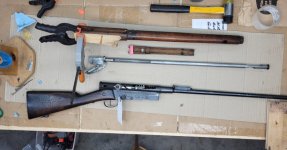
Repairing a Fusil Automatique Modèle 1917 forend

louthepou

Snow-White Le Mod<br>Moderator
Moderator
Rating - 100%
792   0   0
Location
Aylmer, QC
Haven't posted in quite a while... but have to share this neat one.

A fine gentleman trusted me with repairing the forend of a French Fusil Automatique Modèle 1917. I think this qualifies as "rare", and definitely fits in the "worth more than a SKS" category.

There's a great video about this WW1 semi auto rifle made by Forgotten Weapons, worth watching it.

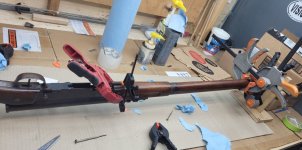
Anywho, there were several splits on both ends of this forend. Challenging to position clamps, given so many spots are very thin and could split some more when putting clamping pressure. Should be done with this one tomorrow.
 

Attachments

  • 20240830_151631.jpg
    20240830_151631.jpg
    90.8 KB · Views: 131
  • 20240831_083859.jpg
    20240831_083859.jpg
    88.9 KB · Views: 130
What do you use as "glue" in those cracks? - I see in your first picture what appears to be West System 105 Epoxy - are you able to work that stuff into the cracks, before you clamp them??
 
Indeed, West epoxy it is. When possible I slightly pry open the cracks, and allow gravity to pull epoxy in the cracks for a few minutes, it's fluid enough that most of the time it saturates the crack and all's good. But sometimes for very thin hairline cracks that can't be opened up, cyanoacrylate can be used instead. The main thing always is to have a totally clean area (no grease and oil or any other contaminant), and perfectly dry.
 
A very rare rifle indeed!
Clamping repairs can pose challenges. In addition to conventional clamps, and depending on the circumstances, elastic wrapping, wedges, etc. can be useful. Trick is to get the joint closed without distorting anything.
And as mentioned, cleanliness of the surfaces to be glued is critical for a strong repair.
 
Try cotton ball material and crazy glue
Stuff crack with cotton and fill with crazy glue
The combination hardens like fibre glass
 
That's a great show of respect by the owner!

I find Mark Novak "Anvil" on YT always has clever banter and useful advice on how to use handtools and simple materials. Although this job has probably already gone back to the owner, I've learned rubber surgical tubing is a good clamp for strange shapes. He also uses spiral dowels and spiral brass repair "bolts". From the furniture refinishers, I've learned that heated hide glue can be reversed with a reapplication of heat. They use compressed air to move adhesives deeper into cracks than the usual gravity flow. Likewise, there are times when epoxy is the wrong medium. Its place most of the time is only as a void filler when mixed with colloidal silica or sawdust.

But .... did you test fire the 1917?
 
That's a great show of respect by the owner!

I find Mark Novak "Anvil" on YT always has clever banter and useful advice on how to use handtools and simple materials. Although this job has probably already gone back to the owner, I've learned rubber surgical tubing is a good clamp for strange shapes. He also uses spiral dowels and spiral brass repair "bolts". From the furniture refinishers, I've learned that heated hide glue can be reversed with a reapplication of heat. They use compressed air to move adhesives deeper into cracks than the usual gravity flow. Likewise, there are times when epoxy is the wrong medium. Its place most of the time is only as a void filler when mixed with colloidal silica or sawdust.

But .... did you test fire the 1917?
Thanks for that info, MLE, greatly appreciated !

Sadly I haven't tried this rifle! Nor would I dare, given it's rarity and associated value :)
 
Ian McCallum did a video shooting a M1917 and M1918 a while back. Recorded in Canada...
The only M1917 rifles I can remember being sold on the surplus market was perhaps 60 years ago by Martin B Retting of Culver City California.

Probably the best single source for information about the M1917 and M1918 rifles (and French rifles in general) is "From Chassepot to FAMAS" from Headstamp Publishing.
 
Last edited:
If you have a tight fitting, clean and oil free joint, titebond is a good choice. If not, products like acraglass or 2 part epoxy work well. If you need to winch into a joint, cyanoacrylate is your huckleberry.
 
One thing I learned from the animated video linked above - the M1917 clip is designed to fit guides in the receiver. No doubt that is why the Berthier clip was not utilized.
 
Back
Top Bottom