Revolver case separation?

Gatehouse

CGN Ultra frequent flyer
Rating - 100%
147   0   0
Location
Pemberton BC
Only revolvers I've loaded for in the past have been single action Rugers. But I decided to tool up for 357 for my Ruger GP100 because of the ammo shortage. I am using a Dillon Square Deal, brand new.

I'm using once fired PMC and Federal brass, with a starting load of 7.4gr Longshot since I have a pound of it and nothing better to do with it. This gives modest 950fps velocity with the Campro 158gr bullet. Factory 158gr is about 1250 fps. The load is clearly low pressure as there is some soot on the fired cases and the cases just about fall out of the cylinder when it's opened.

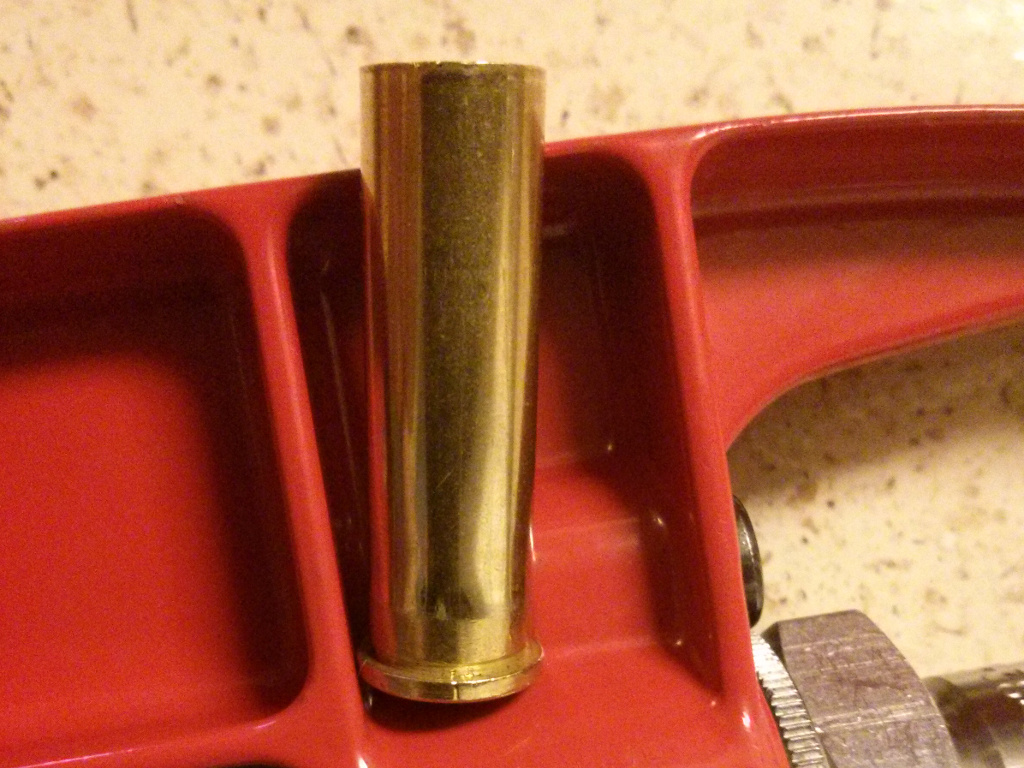
What's weird is a line that forms near the base of the case. It doesn't go all the way around most of the cases but you can feel it with a fingernail. It looks like a crack is forming. I can't feel anything on the inside of a case with a thin piece of metal like checking for case separation in a bottleneck case. No such line forms from the first (factory) firing.

You can see it on the case on the right easily.

164779942_10159095511765516_1809172229391323444_n.jpg


Didn't have calipers at the range so didn't check to see if the case had grown in length. I'm wondering if this is a byproduct of the low pressure load somehow? I've never seen a case do this after one reload.
 
line is left after full length resizing in a Carbide die, that's as far as the carbide goes down.
shows up more on a dirty case after firing.
 
line is left after full length resizing in a Carbide die, that's as far as the carbide goes down.
shows up more on a dirty case after firing.

I thought of that too but when I inspected the loaded cartridges before firing there wasn't the same line. But I didn't run my fingernail on them to see if I could feel anything. Maybe I'll check them more carefully and dirty them up a bit, use my nail. :)
 
Looks like metal being shaved/swagged outside the case. Use a bend wire to check the inside for separation.
 
Last edited:
Question is that the PMC brass or the Federal Brass ? I've never seen that before . almost looks like a Belted Magnum case . as in a rifle case with more brass at the base . I'm wondering if the brass is garbage .I don't know if it has any bearing on it but did you buy used brass at a show or did you have it on hand ? if it's the PMC brass then discard it . also pick up a few cases from a buddy or buy some new cases and see what happens . it has to be the brass . that's like a 38 special load . it's nothing - weak . try a different type of brass. let us know what happens .

also is that 357 new to you or have you owned it for sometime ? quote I have only loaded for single action for some time ? did someone sell you a Lemon ? over sized chamber ? 357 is expensive so ??? why didn't you reload for it in the past ?
 
line is left after full length resizing in a Carbide die, that's as far as the carbide goes down.
shows up more on a dirty case after firing.

I think this is the answer. I went out this morning and looked at some of the newly loaded ammunition and ran my fingernail over it and sure enough some of it has a bit of a ridge that feels like a "crack" I also used a sharpie to darken the ridge area to emulate some soot and then wiped it off and sure enough it left a bit of a line. Lines from dies on resized brass is fairly common but this looked weird enough to question it.

The line shows up the most on the PMC brass, less on Federal brass and not at all on PPU brass. PPU brass is also 4-5gr heavier than the other two brands. So maybe the PMC is a top end load with thinner brass and it's getting worked in the die than the other ones. I don't think I have any more factory PMC so can't test it for velocity comparison.
 
Last edited:
I'd reach for my bent-wire probe and check the inside of the case there. If it's incipient separation then you'll feel a groove on the inside too.

You'll see a lot more about this from those of us who shoot .303 British since it's a particular issue there, but basically you take a piece of stiff wire and give it a 90 degree bend right near the end and make sure it's somewhat pointy so that it can be used as a feeler to check the inside of the case.

In the case of your photograph, though, it looks a lot more like your sizing die goes down exactly that far and there's still a bit of bulge before the rim.
 
Seriously people?! :bangHead:

Even with yomomma's comment sandwiched in between?

I can't feel anything on the inside of a case with a thin piece of metal like checking for case separation in a bottleneck case.

Use a bend wire to check the inside for separation

Did you, perhaps, miss the part where he stated he did that very thing.

I'd reach for my bent-wire probe and check the inside of the case there. If it's incipient separation then you'll feel a groove on the inside too.

You'll see a lot more about this from those of us who shoot .303 British since it's a particular issue there, but basically you take a piece of stiff wire and give it a 90 degree bend right near the end and make sure it's somewhat pointy so that it can be used as a feeler to check the inside of the case.
 
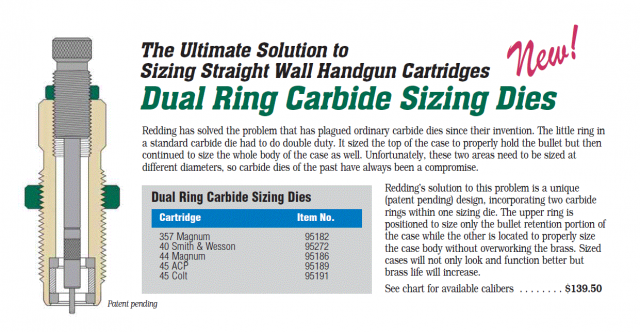
As stated before the ring around the case is where the carbide die stopped sizing. Raise the die and the carbide ring will not over resize the base of the case.

0ML32Zo.jpg


https://www.redding-reloading.com/online-catalog/124-dual-ring-carbide-dies

51104dfbc85101267.png


Redding has solved the problem that has plagued ordinary carbide dies since their invention. The little ring in

a standard carbide die had to do double duty. It sized the top of the case to properly hold the bullet but then

continued to size the whole body of the case as well. Unfortunately, these two areas need to be sized at

different diameters, so carbide dies of the past have always been a compromise. Redding's solution to this

problem is a unique (patent pending) design, incorporating two carbide rings within one sizing die. The upper

ring is positioned to size only the bullet retention portion of the case while the other is located to properly size

the case body without overworking the brass. Sized cases will not only look and function better but brass life

will increase.
 
Last edited:
I had the same issue with reloaded Federal brass 357Mag loaded with light loads and 158gn campro bullets. About 3/16 to 1/4 inch up where the web is. Shot out of 4 different rifles (3 levers, 1 bolt action). I had a one seperate completely and a few that cracked half way around the case. Cases were used 2 to 3 times. I could squish some with pliers right were the mark is and the case would crack. Others had the mark was visibly and that you could feel on out side but not noticeable on inside with a bent paper clip. Tried to squish them but didn't crack just squished. Blazer, win, rem and other assorted brass no issues and have been reloaded many times. May be just soft brass? I use Lee Carbide dies and cases were dry media tumbled.
 
On my older RCBS .357 carbide sizing die it tell you to place a nickel on top of the shell holder and raise the ram. Then screw the die down until it contacts the nickel leaving an air space between the die and the shell holder. You can use a .357 case gauge or your pistols cylinder and check to see if the cases are sized enough.

If you resize a case in a standard non-carbide die where the die is tapered you will not see any ring.

Dies and chambers vary in size and you can adjust the die up and down to compensate for the amount of sizing.

This is like raising a full length rifle die and "partial full length resizing" the neck and case body.
 
On my older RCBS .357 carbide sizing die it tell you to place a nickel on top of the shell holder and raise the ram. Then screw the die down until it contacts the nickel leaving an air space between the die and the shell holder. You can use a .357 case gauge or your pistols cylinder and check to see if the cases are sized enough.

If you resize a case in a standard non-carbide die where the die is tapered you will not see any ring.

Dies and chambers vary in size and you can adjust the die up and down to compensate for the amount of sizing.

This is like raising a full length rifle die and "partial full length resizing" the neck and case body.


Isn't that something . I was taught many years ago when I was shown how to load 357 in a gun shop to have the ram all the way up with the shell holder in place screw the sizing die down so it meets the shell holder then back it up a quarter of a turn . that was with the RCBS 357 carbide dies I had just bought . so I was right the PMC brass isn't as good . and thanks for the info Gatehouse as in the Yugo brass being 4 to 5 grains heavier . I have also found the Seller and bellot flash holes to be smaller than other flash holes . we used to be able to buy Lapua 357 brass back in the day . very nice stuff . you all take care .
 
My LEE carbide dies leave the same 'ring'. As the brass is used more, it is my prevalent when you first reload and they become a little more 'straight' after firing. Hasn't effected accuracy and the cases still fit easily into the cylinder.
 
The case usually give up by showing crack at the mouth from expanding and crimping long before any other fault show up.

If the ring become a problem - not chambering - the only way around is to toss them or use a roll sizer. But I never had to do that even on case used in my Coonan semi-auto.

Got cases that were reloaded 20/25 times so far and none had to go to the trash bin...they last a long time if you don’t flare or crimp too hard.

Glad you found out why your case look like the way they do. :)
 
Last edited:
The case usually give up by showing crack at the mouth from expanding and crimping long before any other fault show up....

Agreed.

I use Dillon carbide dies for .357 / .44 and don't get that even after many reloads. The only straight wall case I need to back off the carbide die is with my Redding Titanium & Carbide Dies on my .460S&W. I contacted Redding about it as the die set is marketed as specifically for .460S&W but the sizer is actually a .45LC /.454Cas die. They told me I'd be better off with a steel Lee die for the .460S&W. Wish I would have known before spending $250+ on a Redding set.

Out of curiosity have you tried different dies just as a test?
 
As stated before the ring around the case is where the carbide die stopped sizing. Raise the die and the carbide ring will not over resize the base of the case.

0ML32Zo.jpg


https://www.redding-reloading.com/online-catalog/124-dual-ring-carbide-dies

51104dfbc85101267.png


Redding has solved the problem that has plagued ordinary carbide dies since their invention. The little ring in

a standard carbide die had to do double duty. It sized the top of the case to properly hold the bullet but then

continued to size the whole body of the case as well. Unfortunately, these two areas need to be sized at

different diameters, so carbide dies of the past have always been a compromise. Redding's solution to this

problem is a unique (patent pending) design, incorporating two carbide rings within one sizing die. The upper

ring is positioned to size only the bullet retention portion of the case while the other is located to properly size

the case body without overworking the brass. Sized cases will not only look and function better but brass life

will increase.

Interesting. I won't be able to use the Redding dies in the Square Deal press, but interesting nonetheless. :)

I had the same issue with reloaded Federal brass 357Mag loaded with light loads and 158gn campro bullets. About 3/16 to 1/4 inch up where the web is. Shot out of 4 different rifles (3 levers, 1 bolt action). I had a one seperate completely and a few that cracked half way around the case. Cases were used 2 to 3 times. I could squish some with pliers right were the mark is and the case would crack. Others had the mark was visibly and that you could feel on out side but not noticeable on inside with a bent paper clip. Tried to squish them but didn't crack just squished. Blazer, win, rem and other assorted brass no issues and have been reloaded many times. May be just soft brass? I use Lee Carbide dies and cases were dry media tumbled.

I thought I would try this out so at the range I grabbed my Leatherman and tired to squish and crack. No go. Got some bigger pliers and still would only scuff up the cases. Even the ones I had reloaded and fired twice. I think when I get another 1000 bullets I'll try reloading half a dozen cases over and over to see if I can get some failure.


Agreed.

I use Dillon carbide dies for .357 / .44 and don't get that even after many reloads. The only straight wall case I need to back off the carbide die is with my Redding Titanium & Carbide Dies on my .460S&W. I contacted Redding about it as the die set is marketed as specifically for .460S&W but the sizer is actually a .45LC /.454Cas die. They told me I'd be better off with a steel Lee die for the .460S&W. Wish I would have known before spending $250+ on a Redding set.

Out of curiosity have you tried different dies just as a test?


I am assuming you are asking me if I tried different dies? No, I didn't. Don't have any other 357 dies and the Dillon SD is a funny little press that uses funny little dies that don't really have any adjustment to them. Although even this funny little press makes 100 rounds of ammo in 15 minutes so it's a kind of a great little gizmo for someone that only uses a few thousand rounds a year of a particular type of ammo, like I do with 357. I use much more 9mm and 45 so I have a Dillon 1100 and 750 set up for those cartridges. The 1100 will crank out 100 rounds of 9mm in 3 minutes with a Mr Bulletfeeder but it's also 5x the price of the Square Deal. :)

Anyway, when I get some more bullets I will try the experiment of multiple firings for 6 pc brass and let everyone know.
 
Back
Top Bottom