Revolver Cylinder Dimensions

Ganderite

CGN Ultra frequent flyer
Rating - 99.7%
355   1   0
I was cleaning some revolvers tonight and decided to inspect the diameter of the chamber throat.

A lead 9mm bullet (0.356") was used to gauge each chamber.

One a Taurus, the bullet dropped through with no resistance.

On a Colt (Python) it dropped through, but if felt like a snug fit.

On several S&Ws, the bullet hung up at the end of the chamber.

I don't see how a tight chamber throat can be a good thing.
 
So I had to go check my 629 after all this and the end of the cylinder is tight as well. With a vernier it measures 0.429 which is the same size as a new un-installed Campro 240gr bullet but also seems to be oval shaped by a thou. A bullet didn't fall through either and whacking it with a pen only pushed it through about a 1/16". Now that you're aroused my curiosity, I'll get more precise measurements later.

Don't know if being "tight" (exact?) is an issue as there is no visible wear or issues with my cylinder after 16K+ rounds.
 
i try to load bullets in revolvers that are tight on the forcing cone (cylinder)

if you are using jacketed it will not matter much.... it matters more if they are cast lead

it will matter more if the barrel is larger than the forcing cone .. but too many varables ... it is better if the forcing cone is the same size or larger than the barrel

think 308 bullet in a 303 barrel 308/ 311 = no good

think if the taper in a barrel was reversed - bigger at the muzzle = no good

------
my buddy was shooting a 44 and getting lots of leading .. measured bullet .4285-.429 switched to a 430 and leading was almost gone
 
I was cleaning some revolvers tonight and decided to inspect the diameter of the chamber throat.

A lead 9mm bullet (0.356") was used to gauge each chamber.

One a Taurus, the bullet dropped through with no resistance.

On a Colt (Python) it dropped through, but if felt like a snug fit.

On several S&Ws, the bullet hung up at the end of the chamber.

I don't see how a tight chamber throat can be a good thing.

Your observation explains why same ammo when fired from different revolvers has different results.
It takes fraction of a second. In this time frame, bullet when fired in python vs s&s cylinder expand and then get swagged through the forcing cone before being grabbed by rifling. When it leaves the muzzle it becomes 357 diameter, but at different velocity. So in s&w it goes through more violent transformation than in python. Therefore lesser or smoother expanding and swagging during firing in python makes it more accurate than s&w. But while in s&w you get higher velocity from same load. It may be more forgiving with certain bullet construction than other. Maybe different barrel design is the factor. Each company has their own theory on how to make their cylinders. So it all has its unique purpose. Depends what needs to be achieved with what load and what application.

 
Reaming the forcing cone is a common tuning step with revolvers that have this issue. If I remember correctly you want it the same or a thousandths larger than the groove diameter.
Soft lead or hollow base bullets can help them to bump up and grip the rifling after passing through the restriction.

I've got a MKVI Webley I know would benefit from a reaming and should maybe check the rest someday.
 
Better too tight than too loose. Ideally the cylinder diameter should be the same as the bore diameter, or .001 bigger. Much more than that and accuracy can suffer. I owned a revolver like that once, and nothing worked, never got it to shoot accurately.
 
Last edited:
I shoot 99% lead at moderate velocity. What diameter is best?

Equal or 1 thou or two (for bigger bores) above throat diameter. Then hopefully your gun was built as Ryan says, and/or doesn't have a larger groove diameter. I'm sure you can run tests and evaluate leading and accuracy.

For personnal convenience I shoot unsized bullets except in a 44-40 whose chambers won't take more than .428.
 
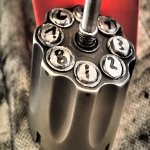
the best way to measure your cylinder throat and barrel bore diameter is by slugging them with a soft lead bullet, and then measuring that. Here's a pic of my 929 cylinder when I slugged it.
P9200014a.jpg

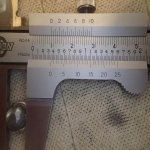
I measured the cylinder throat at .357, and the barrel bore at .356
P9200019a.jpg

From what I have read about revolvers, ideally you should have a .001" obturation at each stage (bullet dia to cylinder throat, cylinder throat to barrel bore). This provides provides good sealing to minimize gas bypass.

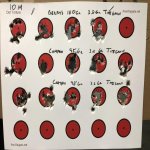
I've tested reloads using 357 bullets - 158gr .357 dia bullets, 9mm bullets - 147gr .355 dia bullets, and 380 95gr & 100gr .355" bullets. At 10-15 meters, I didn't see much difference in accuracy between bullets once I worked up a load for it. Here's some testing I just did with 380 100gr and 95 gr .355 dia bullets. I won't be using these rounds for PPC, so no use testing these out to 50m using my ransom rest ... lol
IMG_8269.jpg
 

Attachments

  • P9200014a.jpg
    P9200014a.jpg
    92.6 KB · Views: 147
  • P9200019a.jpg
    P9200019a.jpg
    77.4 KB · Views: 147
  • IMG_8269.jpg
    IMG_8269.jpg
    74.2 KB · Views: 146
The above test was using plated bullets. Agreed, not much difference, but, if the same tests were done with cast or swaged lead bullets, the outcome could be very different. Most often undersize and even oversize lead bullets will get you a quick introduction to the joys of lead mining.

 
My 686 has a noticeable restriction at the the mouth of the chamber. It has always shot respectable groups with jacketed bullets.
I later bought a 586 of a guy in Kamloops back in 88 or 89 that had the chamber reamed thru and thru. the groups were no better or worse than my old 686, but what I noticed after a few hundred rounds in the 586, was fairly deep jet cutting in the top strap. I assumed, and still do that the restriction in the 686 was designed in part to prevent this from occurring.

 
The above test was using plated bullets. Agreed, not much difference, but, if the same tests were done with cast or swaged lead bullets, the outcome could be very different. Most often undersize and even oversize lead bullets will get you a quick introduction to the joys of lead mining.

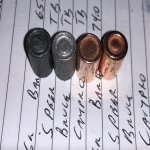
I'm doing some load development for a new gun, so I'm about to find out .... lol It's a S&W 52, and I slugged the barrel at 0.356"
IMG_8205.jpg

I'm targeting ~750 fps so hopefully won't get too much leading. Will see what ends up grouping best. From my prior load development, I've found I have to load the Berry's hotter to get them to group well.
IMG_8303.jpg
 

Attachments

  • IMG_8205.jpg
    IMG_8205.jpg
    82.8 KB · Views: 64
  • IMG_8303.jpg
    IMG_8303.jpg
    147.7 KB · Views: 64
I'm doing some load development for a new gun, so I'm about to find out .... lol It's a S&W 52, and I slugged the barrel at 0.356"
View attachment 233855

I'm targeting ~750 fps so hopefully won't get too much leading. Will see what ends up grouping best. From my prior load development, I've found I have to load the Berry's hotter to get them to group well.
View attachment 233856


That looks like a fun day at the range to me! Shoot them up and pick the load with the best groups to make lots of!
 
Back
Top Bottom